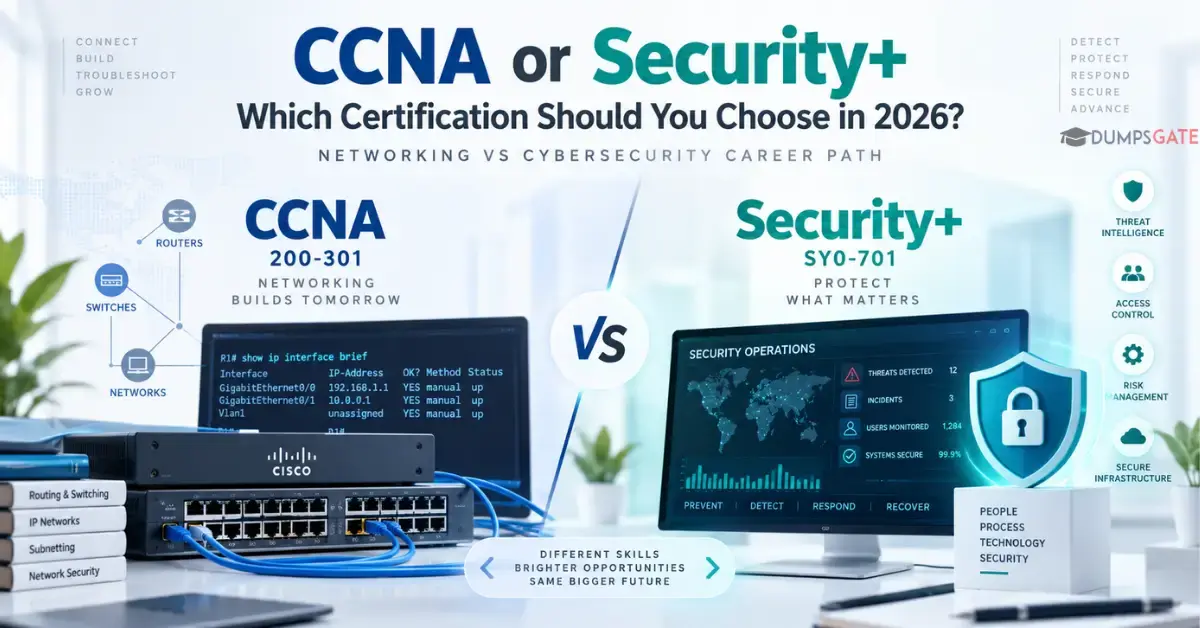
CCNA (200-301) is the more technically demanding exam, requiring hands-on subnetting, CLI configuration, and troubleshooting under a strict 120-minute clock. Security+ (SY0-701) is broader in scope but more conceptual, run in 90 minutes with a mix of multiple-choice and scenario-based questions. Neither Cisco nor CompTIA publishes an official pass rate, but training-provider and candidate-survey estimates put CCNA first-attempt passes around 65 to 75% and Security+ around 80 to 85%, with average prep time of 8 to 12 weeks for CCNA and 6 to 10 weeks for Security+ for someone with basic IT experience.
Choose CCNA if your goal is a networking or infrastructure role. Choose Security+ if your goal is a cybersecurity or SOC role. The sections below break down exam content, cost, salary data, and a decision framework for your specific situation.
What Do CCNA and Security+ Actually Test?
CCNA 200-301 (v1.1) is a single 120-minute exam covering six domains, weighted as follows according to Cisco’s official exam topics:
| CCNA 200-301 Domain | Weight |
| Network Fundamentals | 20% |
| Network Access | 20% |
| IP Connectivity | 25% |
| IP Services | 10% |
| Security Fundamentals | 15% |
| Automation and Programmability | 10% |
Security+ SY0-701 (V7) is a 90-minute exam covering five domains, weighted as follows according to CompTIA’s official certification page:
| Security+ SY0-701 Domain | Weight |
| General Security Concepts | 12% |
| Threats, Vulnerabilities, and Mitigations | 22% |
| Security Architecture | 18% |
| Security Operations | 28% |
| Security Program Management and Oversight | 20% |
The overlap is small. CCNA’s Security Fundamentals domain (15%) covers device hardening, ACLs, and port security inside a networking context. Security+ covers governance, risk, incident response, and cryptography as standalone disciplines. A CCNA holder is not automatically prepared for Security+, and vice versa.
Is CCNA Harder Than Security+?
Yes, on a technical-skill basis. CCNA (200-301) requires configuring routers and switches via CLI, calculating subnets under time pressure, and completing simulation-based lab questions where you cannot go back once you move on. Security+ (SY0-701) tests concepts and scenario judgment through multiple-choice and performance-based questions, with no equivalent hands-on configuration requirement.
| Factor | CCNA 200-301 | Security+ SY0-701 |
| Duration | 120 minutes | 90 minutes |
| Question count | Approx. 100 to 120 | Maximum 90 |
| Question format | Multiple choice, drag-and-drop, CLI simulations | Multiple choice, performance-based |
| Passing score | Not published (community estimate: approx. 825/1000) | 750 out of 900 (official) |
| Prerequisites | None (1 year networking experience recommended) | None (Network+ plus 2 years experience recommended) |
| Estimated first-attempt pass rate | 65 to 75% (training-provider estimate, not official) | 80 to 85% (training-provider estimate, not official) |
| Typical prep time | 8 to 12 weeks | 6 to 10 weeks |
Neither Cisco nor CompTIA discloses an official pass rate for either exam. Any specific percentage you see quoted, including the ranges above, comes from training providers and candidate surveys, not vendor data. Treat these as directional, not exact.
Learn More: How To Pass The CompTIA SY0-701 Exam: 10 Effective Preparation Tips
How Much Do CCNA and Security+ Cost in 2026?
| Item | CCNA 200-301 | Security+ SY0-701 |
| Exam voucher (US list price) | $300 | $439, raised from $425 on June 1, 2026 |
| Retake cost | Full $300 again, no discount | Full $439 again unless a retake bundle was purchased |
| Certification validity | 3 years | 3 years |
| Renewal method | Continuing Education (CE) credits, free through Cisco’s portal | CE units or retake |
Both vendors price in USD with local currency and tax adjustments applied at checkout, so the exact charge in Canada, the UK, Australia, or India will vary by region. Budget the voucher plus study materials: a lean, self-study total typically lands between $450 and $700 for either certification once books, labs, and practice exams are included.
For more information on cost:
How Much Does The CompTIA Security+ Cost In 2026?
CCNA 200-301 Certification Exam Cost: Complete Breakdown in 2026
CCNA vs Security+: Which Certification Pays More?
Official US Bureau of Labor Statistics data (2025 to 2035 projections, published August 2026) shows a clear divergence between the two career tracks:
| Metric | Information Security Analyst (Security+ track) | Network and Computer Systems Administrator (CCNA track) |
| 2025 median annual pay | $129,180 (BLS) | $99,130 (BLS) |
| Projected employment growth, 2025 to 2035 | +21% | -4% (decline) |
| Jobs, 2025 | 192,900 | 323,600 |
| Projected jobs, 2035 | 233,400 | 310,400 |
| Annual openings projected | 14,100 | 13,400 (all from replacement, none from growth) |
This is the most current federal data available, and it is a meaningful gap. BLS projects the security-analyst role to grow while the network-administrator role is projected to shrink over the same decade, largely due to automation and outsourced network-as-a-service offerings. This does not mean CCNA has no value.
It means CCNA functions best as a stepping stone toward higher-level Cisco tracks (CCNP, cloud networking) or as a complement to a security role, rather than a standalone long-term career destination at the associate level.
Discover More:
CompTIA Security+ Jobs 2026: Top Career Paths, Salaries & Entry-Level Roles
CCNA Jobs Salary Insights: Average Pay and Top-Paying Roles
Does CCNA or Security+ Meet DoD 8140/8570 Requirements?
This is the most commonly misstated fact in CCNA vs Security+ comparisons. Security+ is explicitly named on CompTIA’s own certification page as satisfying multiple DoD 8140 work roles, including cyber defense analyst, incident responder, vulnerability analyst, security control assessor, and information security manager.
Standalone CCNA (200-301) is not on the DoD’s approved baseline list. Only two Cisco credentials have ever qualified: the legacy CCNA Security (retired in 2020) and CCNA Cyber Ops, now renamed CCNA Cybersecurity (see next section). Cisco’s own DoD 8570 training page confirms this distinction and notes that CCNA Security holders received a temporary waiver into equivalent IAT categories after the 2020 certification consolidation. If DoD, federal, or defense-contractor eligibility is your goal, Security+ satisfies the requirement directly. Plain CCNA does not.
Click here: DoD Cyber Awareness Challenge 2026 practice questions
What Is the New CCNA Cybersecurity Certification?
On February 3, 2026, Cisco rebranded its CyberOps Associate certification as CCNA Cybersecurity, and CyberOps Professional as CCNP Cybersecurity, aligning its security track under the same naming convention as its networking track. Anyone who held an active CyberOps certification on that date was automatically migrated to the new name with no retesting required.
This matters directly for anyone researching “CCNA vs Security+” in 2026, because the name CCNA now technically applies to two different Cisco credentials:
| Certification | Exam Code | Focus |
| CCNA (200-301) | 200-301 | General networking: routing, switching, IP connectivity |
| CCNA Cybersecurity (formerly CyberOps Associate) | 200-201 | Security operations center (SOC) skills: threat detection, monitoring, incident response |
CCNA Cybersecurity is a closer functional competitor to Security+ than the standard CCNA is, since both target entry-level SOC and security-analyst roles. If your search intent was actually “should I get Cisco’s security cert or CompTIA’s,” confirm which CCNA you mean before comparing costs or difficulty, since the two Cisco credentials test almost entirely different skills.
Should You Get CCNA or Security+ First?
The right first certification depends on your starting point and target role, not on which exam is “better.”
| Your situation | Recommended first certification | Why |
| Targeting network engineer, network admin, or NOC roles | CCNA | Directly matches job posting requirements for Cisco-based infrastructure roles |
| Targeting SOC analyst, security admin, or DoD/government roles | Security+ | Meets DoD 8140 baseline directly; broader, vendor-neutral applicability |
| No IT background, career changer | Security+ | Shorter prep time, no hands-on lab requirement, gentler learning curve |
| Currently in helpdesk or IT support | Either, based on target role | Both are viable next steps; let the job description you want dictate the choice |
| Want maximum job-posting coverage in either direction | CCNA first, then Security+ | CCNA’s Security Fundamentals domain (15%) gives a useful primer before Security+’s deeper security content |
Can You Get Both CCNA and Security+?
Yes, and it is common. Neither certification requires the other as a prerequisite, and the content overlap is minimal enough that studying both does not create redundant work. A realistic combined timeline for someone with some IT background is 10 to 16 weeks: roughly 8 to 12 weeks for CCNA followed by 6 to 10 weeks for Security+, or the reverse order if your target role is security-first.
Holding both signals to employers that you understand infrastructure and security as connected disciplines, which is increasingly relevant as network engineers are expected to have baseline security literacy (reflected in CCNA’s own Security Fundamentals domain) and security analysts are expected to understand the network layer they are defending.
CCNA vs CCNP: Is CCNA Enough on Its Own?
CCNA is the associate-level entry point into Cisco’s certification track. CCNP is the professional-level certification that follows it, requiring a core exam plus a concentration exam in a track such as Enterprise, Security, Data Center, Automation, or the newly renamed Cybersecurity track. Given the BLS projection of a 4 percent employment decline for network administrators at the associate skill level, CCNA is best treated as a foundation to build on, either toward CCNP or toward a security specialization, rather than a terminal credential.
Explore Further: Is CCNA A Good Career: Discuss Benefits and Perks of Cisco CCNA Certification
Frequently Asked Questions (FAQs)
Is CCNA or Security+ better for a beginner with no IT experience?
Security+ has a gentler learning curve for complete beginners because it tests concepts rather than hands-on configuration. CCNA has no formal prerequisites either, but its CLI-based simulation questions are harder to pass without prior hands-on practice.
Do I need Network+ before Security+?
No. CompTIA recommends Network+ and two years of security-related experience, but neither is mandatory to sit the SY0-701 exam.
Does CCNA expire?
Yes. Both CCNA and Security+ are valid for three years and require continuing education credits or a retake to renew.
Is the CCNA 200-301 exam changing soon?
Cisco published new exam topics on May 20, 2026, for the next major CCNA update, but the current 200-301 v1.1 exam remains valid through February 2027. Anyone certifying before that date earns a fully valid, three-year credential under the current version.