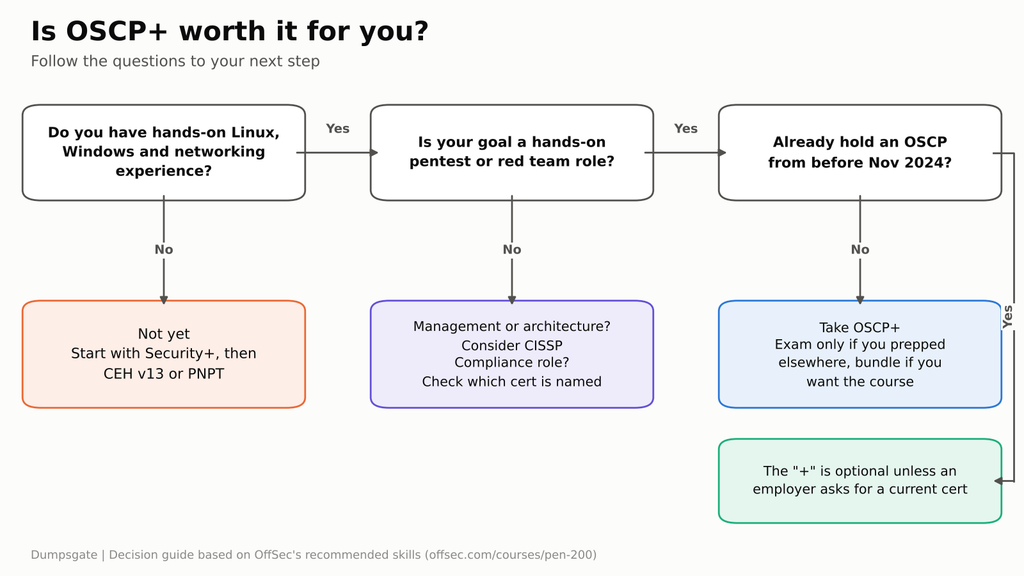
Is OSCP+ worth it? Yes, if you already have hands-on Linux, Windows, and networking experience and you want a penetration testing or red team job. The OSCP+ has a proctored, hands-on exam where you break into live machines and write a professional report, which proves skills a multiple-choice exam can’t. If you are new to IT, it is not worth it yet: build the foundation first, because the exam assumes it.
Is OSCP+ worth it for you? The verdict by career stage
Your current role matters more than the certificate’s reputation. Find your situation below.
| Your situation | Verdict |
|---|---|
| New to IT, student, or help desk with no security work | Not yet. The exam assumes admin-level Linux, Windows and networking skills. |
| SOC analyst, sysadmin or network engineer who wants to move into pentesting | Yes. This is the reader OSCP+ fits best. |
| You passed OSCP before November 1, 2024 | Usually optional. Your OSCP never expires. |
| 5+ years in security, aiming for management | Probably not. A management credential fits the goal better. |
| Defense contractor or DoD role | Depends on the work role. Contracts name approved credentials. |
| Tight budget, but you want a hands-on pentest exam | Consider a cheaper practical exam first. |
OSCP+ at a glance (as of November 16, 2026)
OSCP+ is OffSec’s hands-on penetration testing certification. Passing one exam earns two credentials.
| Item | Detail |
|---|---|
| What you earn | Both OSCP and OSCP+. The “+” expires three years after issue; the OSCP does not. |
| Exam length | 23 hours 45 minutes of hacking, then 24 hours to upload your report. All OSCP+ exams are proctored as mentioned in their exam guide. |
| Pass mark | 70 of 100 points for exams starting before December 1, 2026 at 08:00 GMT. Scaled scoring after that. |
| Formal prerequisites | None. OffSec recommends TCP/IP networking, Windows and Linux administration experience, and basic Bash or Python scripting. |
| Cost | $1,699 to $2,749 upfront, depending on the path. |
What OSCP+ really costs over three years
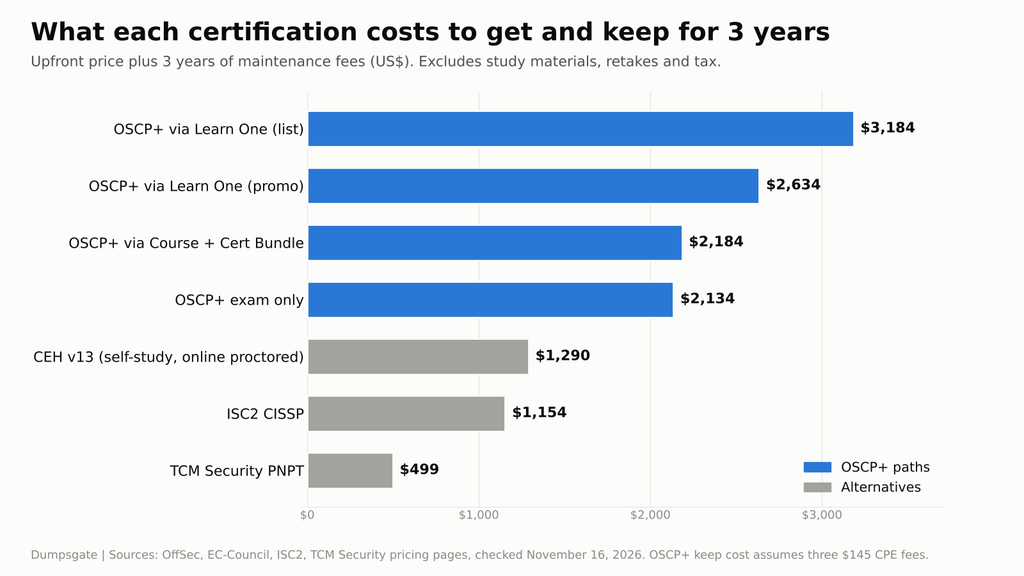
The cheapest way to get OSCP+ costs $1,699, but keeping the “+” for three years adds up to $435 more if you use OffSec’s CPE route. Most comparisons only show the exam price. The table below adds the cost of keeping each credential, so you can compare like with like.
| Path | Upfront | What’s included | Cost to keep for 3 years | 3-year total |
|---|---|---|---|---|
| OSCP+ exam only | $1,699 | 2 attempts within 90 days, no course | $435 (CPE route) | $2,134 |
| OSCP+ via Course + Cert Bundle | $1,749 | PEN-200, 90 days of labs, 1 attempt | $435 | $2,184 |
| OSCP+ via Learn One | $2,749 list, $2,199 promo | 365 days of labs, 2 attempts, renews yearly unless cancelled (same source) | $435 | $3,184 list / $2,634 promo |
| Base OSCP only (let the “+” lapse) | Any path above | Same as above | $0 | Upfront cost only |
| EC-Council CEH v13, self-study route | $1,050 ($100 eligibility fee + $950 online proctored voucher; $1,199 at VUE) | Knowledge exam; 2 years of security experience required without official training | $240 ($80 a year) (EC-Council ECE policy) | $1,290 |
| ISC2 CISSP | $749 | 5 years of experience in 2 of 8 domains | $405 ($135 a year) | $1,154 |
| TCM Security PNPT | $499 | Voucher, one free retake, 12 months of training | $0 (does not expire) | $499 |
How we calculated it:
- The OSCP+ keep cost uses OffSec’s CPE program, which charges a $145 annual maintenance fee and requires 120 CPE credits over three years (OffSec CPE Program). We counted three annual payments. [UNVERIFIED: confirm in OffSec’s CPE handbook whether the first fee falls in year one.]
- Totals exclude study materials, retakes, taxes and the cost of earning continuing education credits.
- Prices were checked on November 16, 2026. OffSec’s Learn One discount is a time-limited promotion.
Read More: 30-Day OSCP+ Study Plan and 4-Stage Exam-Day Checklist
Exam only or a bundle?
Buy the $1,699 exam-only attempt if you have already prepared with other labs: it is the cheapest OffSec route and the only one with two attempts at no extra cost. Buy the Course + Cert Bundle if you want PEN-200’s course and labs and can prepare within 90 days. Learn One makes sense only if you need a full year of lab time; cancel the renewal if you don’t want a second year.
A worked break-even example
Payback time is your 3-year total divided by your monthly pay increase. The figures below are an illustration, not salary data.
- Take the bundle route: $2,184 over three years.
- Suppose the certification helps you land a role paying $10,000 a year more. That is about $833 a month.
- $2,184 ÷ $833 ≈ 2.6 months to recover the cash cost.
If the certificate doesn’t change your job or pay, it never pays back in cash. That is why the career-stage verdict matters more than the price. The calculation also leaves out your study time, which is the higher cost for most people.
What changes on December 1, 2026: the scaled scoring update
OSCP+ exams starting on or after December 1, 2026 at 08:00 GMT use scaled scoring, so there is no longer a single raw-point pass mark across exam sets. Exams starting before then keep the 70-of-100 pass mark, and OffSec says the skills required, exam content, format and duration do not change.
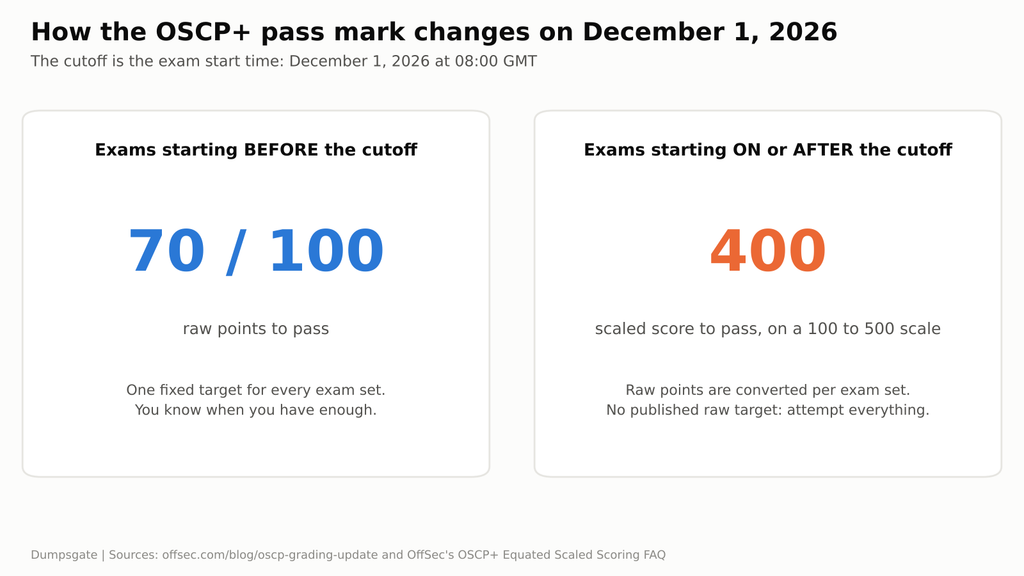
OffSec’s scaled scoring FAQ reports results on a 100 to 500 scale, with 400 as the pass mark (OffSec Help Center). A score of 400 is not 400 out of 500 raw points. Your raw points are converted, and a harder exam set needs fewer raw points to reach 400.
Many guides answering “is OSCP worth it 2026-27” still give 70 points as the only pass mark. That is only true for exams starting before the December 1 cutoff.
Should you book before or after December 1?
Book whenever you are ready. OffSec says it does not recommend one scoring method over the other, and an exam moved from before the cutoff to after it is scored with scaled scoring (same OffSec source as above). The practical change is on exam day: you can no longer count to 70 and stop. Attempt every machine, submit every flag, and submit your report regardless of how many points you think you have.
OSCP vs OSCP+: what you actually get
OSCP and OSCP+ come from the same exam. The only difference is that the “+” expires after three years and the OSCP lasts for life.
To keep the “+”, OffSec gives you three options:
- Pass a recertification exam within six months of the expiry date.
- Pass another qualifying OffSec exam before it expires: OSEP, OSWA, OSED or OSEE.
- Complete OffSec’s CPE program.
If you do none of these, you lose the “+” and keep the OSCP. For most working pentesters, option 2 happens naturally as they move to advanced OffSec certifications.
Is OSCP plus worth it if you already hold the old OSCP?
Usually not. Your pre-November 2024 OSCP remains valid for life. Retake the current exam only if an employer, client contract or job posting you are targeting asks for a currently valid certification. If you do, the exam-only attempt in the cost table below is the cheapest route.
What the OSCP+ exam tests
The exam is 100 raw points across six machines on a private network:
- Three standalone machines: 20 points each. 10 for initial access and 10 for privilege escalation.
- One Active Directory set: three machines worth 40 points (10, 10 and 20). You start with a username and password, which simulates a breach that has already happened.
LLMs and AI chatbots are strictly prohibited during the exam, and results arrive by email within ten business days of submitting your report. Since bonus points for course exercises were removed in November 2024, the exam alone decides your result.
Will OSCP+ get you hired? OSCP salary and the job market
OSCP+ helps you get interviews for pentest roles, but it doesn’t get you hired by itself. Hiring managers also look at practical work you can show, such as lab write-ups and reports.
OSCP salary: what the data shows
There is no official US salary dataset for OSCP holders. The most reliable benchmark is the government’s: the median annual wage for information security analysts was $129,180 in May 2025, with employment projected to grow 21% from 2025 to 2035. That covers the whole occupation, not just pentesters or OSCP holders, so use it as a reference point, not a promise.
Third-party “OSCP salary” averages come from job boards and self-reported surveys. They mix experience levels, so treat any single average with caution.
What US job postings ask for
OSCP appeared in 63% of the US pentest and red team postings we read, more than any other certification, but only 17% required it. On November 16, 2026, we read 94 live US postings on Built In and recorded how each one treated six certifications.
| Certification | Named in the posting | Required | Preferred |
| OSCP (incl. OSCP+) | 59 (63%) | 16 (17%) | 43 (46%) |
| GPEN | 39 (41%) | 8 (9%) | 31 (33%) |
| CEH | 32 (34%) | 11 (12%) | 21 (22%) |
| CISSP | 18 (19%) | 7 (7%) | 11 (12%) |
| PNPT | 9 (10%) | 3 (3%) | 6 (6%) |
| CPTS | 4 (4%) | 1 (1%) | 3 (3%) |
What the numbers mean for you:
- “Required” usually meant “one option in a list.” Only 4 postings made OSCP itself mandatory. The other 12 that required it also accepted alternatives such as OSWE, GPEN or a SANS course certification.
- Most postings didn’t require any of the six. 68 of 94 (72%) listed none of them as required, and 23 (24%) didn’t name any of them at all. That group included all four Microsoft red team postings and both Target red team postings, plus several defense contractors that asked only for a DoD 8140 or 8570 baseline.
- Red team roles cared less about certifications. 12 of the 28 red team postings named none of the six, compared with 11 of the 66 penetration tester postings.
- CEH showed up mainly in government contracting jobs. In 6 of the 11 postings that required CEH, it was one option in a broad list that also accepted defensive or networking certifications such as CySA+, CCNA Cyber Ops or CISA.
- Almost nobody writes “OSCP+”. Only one posting named OSCP+ specifically, and it required an active OSCP+. Everyone else wrote “OSCP”, which the OSCP you earn alongside the “+” satisfies.
How we sampled: we searched Built In’s US job listings for “penetration tester” (all 70 results) and “red team” (the first 70 results) on November 16, 2026. We kept roles whose main job is penetration testing or red team operations, and removed duplicates, AI model red-teaming, software development and physical security roles, and one posting outside the US. That left 94 postings. A certification counted as required only when it sat in required or minimum qualifications without “preferred” wording; anything described as preferred, desired, a plus or nice to have counted as preferred. We ignored Built In’s automatic “Skills Required” summary, which sometimes contradicts the employer’s own text.
Discover more insights on OSCP Salary
Is OSCP for beginners?
No. For beginners, the honest answer to “is OSCP worth it” is “not yet”. OffSec has no formal prerequisites, but the skills it recommends are ones most beginners don’t have yet.
Readiness checklist
You are ready to start OSCP+ preparation if you can do all five without step-by-step guides:
- Explain how TCP/IP, DNS and common ports work, and read a packet capture.
- Administer a Linux server from the command line: users, permissions, services and logs.
- Administer Windows, including basic Active Directory concepts: domains, users, groups and authentication.
- Write a short Bash or Python script to automate a repetitive task.
- Compromise beginner-level lab machines and write up how you did it.
A better first step
If you missed two or more of the checks, build the foundation first:
- Security+ covers the security concepts most entry-level roles expect. Our Security+ SY0-701 practice questions help you check your readiness.
- Then a lighter offensive exam. CEH v13 adds attack terminology and methodology. PNPT adds hands-on practice for less money
OSCP+ vs the alternatives
OSCP+ wins when the job is hands-on offensive testing. The alternatives win when the goal is compliance, management or a lower budget.
OSCP vs CEH: which one gets you a pentest job?
Choose OSCP+ if you are applying for hands-on pentest roles. Choose CEH v13 if your employer or contract names CEH, or if you need an offensive security credential before you are ready for a practical exam that runs almost a full day.
The two prove different things:
- CEH (312-50v13): a knowledge exam. EC-Council sells CEH (Practical) separately.
- OSCP+: fully hands-on, so it shows you can actually compromise systems.
CEH is cheaper upfront but needs two years of security experience if you skip official training. If CEH is your next step, start with our CEH v13 practice questions.
OSCP vs CISSP: technical track or management track
These certifications serve different careers, so pick the career first:
- OSCP+: proves you can break into systems.
- CISSP: proves broad security knowledge across eight domains and is aimed at senior and management roles. It requires five years of experience, though one year can be waived with an approved degree or ISC2 credential. If you pass without the experience, you become an Associate of ISC2 with up to six years to earn it (same ISC2 source as the cost table).
If you are heading toward security management or architecture, CISSP is the better next step. Our CEH vs CISSP comparison covers that track in detail, and our CISSP practice questions help you prepare.
PNPT and CPTS: cheaper practical routes
TCM Security’s PNPT is a real-world-style pentest: you get five days to complete it, two more days to write the report, and then a live 15-minute debrief with TCM Security pentesters. It costs a fraction of OSCP+ and never expires.
Hack The Box’s CPTS is another practical option, sold through Hack The Box Academy subscriptions; check Academy’s current pricing before you buy. [NEEDS: confirm current CPTS pricing on Hack The Box Academy’s official pricing page and add it with a date.]
Both are good preparation, and either can be enough for a first role. Take OSCP+ later if the jobs you are targeting ask for it by name.
DoD 8140 roles: check the matrix, not a listicle
Don’t rely on generic “DoD-approved” lists. Under DoD 8140, each qualification maps to a specific work role in the DoD Cyber Workforce Framework at a Basic, Intermediate or Advanced proficiency level. Look up your work role code in the current matrix and your contract language before you pay for any certification.
Discover More: PNPT VS OSCP: Which one to pursue in 2027?
Common mistakes when deciding on OSCP+
- Planning to stop at 70 points after December 1. Scaled scoring removes the fixed raw target.
- Comparing exam prices only. Renewal fees change the ranking, as the three-year table shows.
- Forgetting that Learn One auto-renews. Cancel the renewal if you don’t need a second year.
- Skipping Active Directory practice. The AD set is 40 of the 100 raw points.
- Buying OSCP+ for a compliance-driven role. If the contract names a different credential, OSCP+ won’t satisfy it.
- Treating the certificate as the whole application. Pair it with lab write-ups or a report sample you can show.
Verdict: who should take OSCP+, who should pick something else, and who should wait
- Take OSCP+ now if you work in IT or a SOC, pass the readiness checklist, and are applying for pentest or red team roles. Use the exam-only attempt if you have prepared with other labs, or the bundle if you want OffSec’s course.
- Pick an alternative if your goal is management (CISSP), a contract that names CEH (CEH v13), or a hands-on cert on a tight budget (PNPT).
- Wait if you missed two or more checks on the readiness checklist. Build the foundation first, then come back to OSCP+.
- Skip the “+” if you already hold a pre-2024 OSCP and no employer asks for a current certification.
Frequently asked questions about OSCP+
Does OSCP+ expire?
Yes. The “+” expires three years after it is issued, while the OSCP you earn alongside it never expires. You can keep the “+” with a recertification exam, another qualifying OffSec exam or OffSec’s CPE program.
Is OSCP+ harder than the old OSCP?
There is no extra safety net anymore. Bonus points for course exercises are gone, and the Active Directory set starts from supplied credentials. OffSec says the December 2026 move to scaled scoring does not change the competency needed to pass.
Do I need to take the PEN-200 course to sit the OSCP+ exam?
No. OffSec sells an exam-only attempt for people who want OSCP+ without the PEN-200 course, and the exam has no formal prerequisites. Skip the course only if you already have the networking, Linux, Windows and scripting skills OffSec recommends.
How long does it take to prepare for OSCP+?
OffSec doesn’t publish an official figure. Preparation time depends on how many of the readiness checks you already pass. Choose a purchase path with enough lab time for your gap: 90 days with the bundle, or a full year with Learn One.
Can I use ChatGPT or other AI tools during the OSCP+ exam?
No. LLMs and AI chatbots are prohibited, and OffSec treats their use as receiving third-party help.
What happens if I fail the OSCP+ exam?
You can try again. The exam-only purchase includes two attempts within 90 days, and Learn One includes two attempts in its year. The Course + Cert Bundle includes one attempt, so a second try costs extra. Check OffSec’s current retake price before you choose a path.
Is OSCP worth it without a degree?
It can help, but don’t count on the certificate alone to replace a degree. The U.S. Bureau of Labor Statistics says information security analysts typically need a bachelor’s degree in computer and information technology or a related field, may need work experience in a related occupation, and that employers may prefer analysts with professional certification (U.S. Bureau of Labor Statistics). Without a degree, pair OSCP+ with lab write-ups and relevant work experience.
Is OSCP better than CEH?
For hands-on pentest jobs, yes. For roles where an employer or contract names CEH, no. CEH costs less upfront, but OSCP+ is fully hands-on, so it shows you can actually compromise systems.