

Every year, the demand for cybersecurity professionals grows stronger, yet the shortage of skilled talent continues to widen. According to ISC2, the global cybersecurity workforce gap exceeds 4 million professionals. At the same time, the U.S Bureau of Labor Statistics reports that security analyst roles are growing at 29%, far faster than most careers. This demand has made IT security certifications one of the most reliable ways to enter and grow in the field.
Certifications do more than validate knowledge. They show credibility, structured training, and real commitment. Hiring data from CyberSeek reveals that more than half of cybersecurity job postings request at least one credential. The challenge, however, is knowing which certifications actually create career value. This guide explains the best IT security certifications, who they are for, and how to choose the right one based on real career outcomes.
How To Choose The Right IT Security Certification?
Not all IT certifications are going to deliver the same impact. The right choice depends less on popularity and more on career direction, timing, and real-world relevance. Here is how you can simplify this decision:
1. Start With The Role You Actually Want
Cybersecurity is not a single job. It is a collection of specialized roles. Someone interested in threat monitoring should focus on SOC Analyst certifications, while someone interested in ethical hacking should pursue penetration testing certifications. Professionals working with modern infrastructure benefit more from cloud security certifications, which align with how companies build systems today.
Industry data reveals that most professionals specialize within their first 2 to 3 years of their career. Choosing certifications aligned with that path creates faster career progress.
2. Do Not Chase Advanced Certifications Too Early
Many professionals assume that advanced certifications automatically lead to better jobs. In reality, timing matters more than difficulty. Advanced credentials often validate existing experience rather than create new opportunities on their own. Without practical exposure, the knowledge remains theoretical. This is why employers often prioritize foundational cybersecurity certifications for beginners when hiring entry-level candidates. These certifications prove readiness for real job responsibilities.
3. Assess The Value You Get Back
Certifications require time, effort, and financial commitment. Exam fees alone can range significantly, which makes understanding the cost of certification exams important before starting.
It is important to understand that more expensive certifications are not always better. Instead, certifications that include hands-on security labs often deliver stronger skill development and better interview performance. Employers also consistently value practical ability over theoretical knowledge alone.
4. Follow Employer Demand Instead Of Popularity
The most reliable indicator of certification value is employer demand. Certifications like CISSP, Security+, and OSCP appear frequently in job listings because they align with real industry needs. These credentials consistently appear in lists of best cybersecurity certifications because they solve real hiring problems for employers.
Choosing certifications based on hiring demand improves both short-term job prospects and long-term career growth.
5. Think In Career Stages, Not Individual Certifications
Strong cybersecurity careers develop in layers.
Early certifications build foundations.
Mid-level certifications develop specialization.
Advanced certifications validate leadership and architecture skills.
This layered approach ensures steady progression instead of random certification accumulations.
Top IT Security Certifications By Career Level
Selecting from the best IT security certifications becomes much easier when you view it through the lens of career stage. Each certification serves a different purpose. Some build foundations, others validate specialization, and a few confirm leadership-level expertise. Below, we will cover the IT security certifications list 2026, including what each certification covers, the skills it builds, and the real career outcomes associated with it.
Entry-Level IT Security Certifications
Entry-level credentials focus on core security principles, basic threat defense, and operational awareness. These IT security certifications for beginners help candidates qualify for roles such as SOC analyst, junior security analyst, and security administrator.
➡️ CompTIA Security+
The CompTIA Security+ has long been considered the universal baseline for anyone entering the information security field. In an industry that changes overnight, this certification has remained a constant because it focuses on the vendor-neutral principles that underpin all security work. It helps prove to employers that you understand the fundamental vocabulary of threats, attacks, and vulnerabilties.
In 2026, it remains the most common mandatory requirement for entry-level roles, specifically due to its alignment with global standards and various government compliance mandates like DoD 8140.
➥ Key Target Areas.
To earn this credential, you must demonstrate a good grasp of 5 core domains:
- General security concepts
- Threats, vulnerabilities, and mitigations
- Security architecture
- Security operations
- Security program management and oversight
Security+ forces you to think about how a firewall interacts with a cloud environment and how a simple misconfiguration can lead to a catastrophic data breach. While it is not a hands-on exam in the sense of building a network from scratch, it ensures that when you walk into a SOC, you are not overwhelmed by the technical jargon.
➥ Job Opportunities And Salary Potential
- Junior Security Analyst
- Systems Administrator
- SOC Tier 1 Analyst
- Help Desk Lead
- Network Security Technician.
Hiring data indicates that entry-level holders typically see salaries between $68,000 USD and $85,000 USD. Its market value is essentially unmatched at the junior-level, as it appears to be in over 70% of introductory cybersecurity job postings and is a non-negotiable for defense contracting work.
To learn more about the CompTIA Security+:
CompTIA Security+ Jobs 2026: Top Career Paths, Salaries & Entry-Level Roles
How Much Does The CompTIA Security+ Cost In 2026?
How To Pass The CompTIA SY0-701 Exam: 10 Effective Preparation Tips
➡️ ISC2 Certified In Cybersecurity (CC)

The ISC2 Certified In Cybersecurity (CC) was born out of necessity to address the global talent shortage. As the entry-level offering from the creators of the world-renowned CISSP, it carries immediate brand weight despite being a relatively new credential. It is designed specifically for those switching careers, recent graduates, and those who may not have a traditional technical background but possess the analytical mindset required for security.
➥ Key Target Areas
The ISC2 CC certification focuses heavily on high-level principles, ensuring that a candidate understands the reason behind security protocols. The curriculum is streamlined to cover the essential pillars, which are:
- Security principles
- Business Continuity (BC), Disaster Recovery (DR) & Incident Response Concepts
- Access Controls Concepts
- Network Security
- Security Operations
It is intentionally less granular than the Security+, acting more as a sa strategic introduction to the field. Because ISC2 often provides the training for free as part of their “One Million Certified Initiative,” it has become a primary choice for those looking to validate their interest in the field without a massive financial investment.
➥ Job Opportunities And Salary Potential
- Entry-level Cybersecurity Technician
- Junior Risk Analyst
- IT Support Specialist
- Security Compliance Assistant
Salaries for CC holders generally range from $58,000 USD to $72,000 USD per year. It shows recruiters that you are serious enough to pursue a credential from the industry’s most respected governing body.
To learn more about this certification, check out: Launch Your Cybersecurity Career: The Complete Guide to the ISC2 CC Certification in 2026
➡️ Google Cybersecurity Professional Certificate
Unlike traditional certifications that rely on multiple-choice questions, the Google Cybersecurity Professional certificate is an immersive project-based experience. It was built by Google’s own security experts to bridge the gap between theoretical knowledge and the daily tasks performed in a SOC. It assumes no prior knowledge and systematically builds your technical stack, focusing on the actual tools that analysts use every day.
➥ Key Target Areas
The depth of this Google program is surprising for an entry-level certificate. It allows you to write scripts to automate security tasks and use SQL to query databases for evidence of a breach. You learn to navigate SIEM tools and intrusion detection systems.
By the time you finish, you have a portfolio of work that proves you can actually perform the technical labour of a security analyst.
➥ Job Opportunities And Salary Potential
- SOC Analyst Tier 1
- Cybersecurity Analyst (Entry-level)
- Information Security Researcher
- Junior Threat Analyst
Google reports that graduates see significant career outcomes with salaries in the $62,000 to $90,000 USD range. It is highly valued in technical interviews where you are asked to demonstrate your skills.
➡️ Blue Team Level 1 (BTL1) Certification
The Blue Team Level 1 (BTL1) certification has quickly become a cult favorite among hiring managers who prioritize practical skills. This is a 100% practical certification that replaced the traditional testing format for a grueling 24-hour incident response simulation. In this exam, you are dropped into a compromised network and tasked with investigating a live breach, analyzing malicious files, and identifying the attacker’s path through the system.
➥ Key Target Areas
The curriculum is a deep dive into the “Blue Team” or defensive side of security. It covers:
- Security fundamentals
- Phishing analysis
- Threat intelligence
- Digital forensics
- Security information and event monitoring
- Incident response
Because the exam is so demanding, holding this certification is an immediate signal that you are ready for SOC tasks, since it equips you to handle tasks involving stopping security attacks.
➥ Job Opportunities And Salary Potential
- Junior SOC Analyst
- Incident Responder
- Threat Hunter
- Digital Forensics Analyst
This is a high-value entry-level certification, with typical salaries ranging from $70,000 USD to $90,000 USD per year. It is arguably one of the most respected practical defensive junior certifications, as it proves that you can survive the pressure of a real-world incident.
➡️ GIAC Information Security Fundamentals (GISF)

The GIAC Information Security Fundamentals (GISF) certification from GIAC is another popular choice for entry-level IT security certifications. It focuses on the core principles that form the backbone of IT security. This credential is designed for individuals who want a structured introduction to IT security without needing prior hands-on experience. It essentially helps you build conceptual clarity around how secure systems are designed and protected.
➥ Key Target Areas
These are the different aspects of IT security you will learn about:
- Adversary Analysis and Threat Frameworks
- Defensive Technologies and Emerging Intelligence
- Foundations of Cryptography and Digital Trust
- Foundations of Cybersecurity
- Foundations of Network Communication
- Identity, Access and Data Protection
- Intrusion and Initial Access Techniques
- Managing and Mitigating Cyber Risk
- Network Security and Architecture
- Post-Exploitation and Advanced Threat Techniques
- Securing Connected and Cloud-Based Environments
- Security Foundations and Awareness
➥ Job Opportunities And Salary Potential
From a career perspective, GISF holders typically qualify for entry-level jobs or security support roles. Some of these are as follows:
- IT Security Administrator
- Help Desk Technician
- System Analyst
- Junior Digital Forensic Examiner
Globally, professionals at this stage often earn between $55,000 to $70,000 USD, depending on region and technical background. While it may not command high salarieson its own, it provides a strong academic style foundation for more advanced certifications later.
GISF can be a good pick because strong IT security careers are built on understanding fundamentals. Before learning how to break or defend complex systems, you need clarity on how they function. This certification delivers that clarity and sets the stage for future specialization.
Read More: Are GIAC Certifications Worth It? 7 Reasons why You Should get GIAC Certifications
➡️ eLearnSecurity Junior Penetration Tester (eJPT)
For those drawn to the “Offensive” side of security, the eJPT is the definitive starting point. It is widely considered the most realistic introduction to the world of ethical hacking. Unlike other beginner exams that focus on the names of hacking tools, the eJPT forces you to perform a real penetration test against a network. You must find the vulnerabilities, exploit them, and navigate the target system just as a professional would.
➥ Key Target Areas
The training covers the entire penetration testing methodology, from initial reconnaissance to the final report. Here are the areas you will be learning about:
- Host and network penetration testing
- Assessment methodologies
- Host and networking auditing
- Web application penetration testing
➥ Job Opportunities And Salary Potential
- Junior Penetration Tester
- Vulnerability Analyst
- Security Engineer (Red Team)
- Application Security Associate
Salaries for those starting in offensive roles typically range from $78,000 USD to $95,000 USD per year. It is highly respected in technical circles and serves as the ideal training ground for more advanced certifications like the OSCP.
➡️ Microsoft SC-900: Microsoft Certified: Security, Compliance, and Identity Fundamentals
As the corporate world migrates to the cloud, the Microsoft Certified: Security, Compliance, and Identity Fundamentals has become an essential add-on for any IT professional. This exam focuses specifically on Microsoft’s Security, Compliance, and Identity (SCI) solutions across the Azure and Microsoft 365 ecosystems. It is a foundational credential that proves you understand how to navigate a Zero Trust environment and manage shared responsibility models.
➥ Key Target Areas
The SC-900 exam provides a broad overview of Microsoft’s massive security stack, including Microsoft Defender, Sentinel, and Entra ID. Here are the areas it focuses on:
- Concepts of security, compliance, and identity
- Capabilities of Microsoft Entra
- Capabilities of Microsoft security solutions
- Capabilities of Microsoft compliance solutions
➥ Job Opportunities And Salary Potential
- Junior Administrator
- Cloud Support Technician
- Compliance Coordinator
- Security Sales Specialist
Salaries usually fall in the $50,000 USD to $90,000 USD range. This is a low-cost high-visiblity win for your resume, especially if you plan to work in a company that mainly uses Microsoft applications.
Learn More: SC-900 EXAM- A COMPREHENSIVE GUIDE IN 2026
Mid-Career IT Security Certifications
Mid-level certifications are for professionals who already understand networking and security fundamentals and are now ready to operate in real-world threat environments. Here are some popular mid-career IT security certifications you can pursue:
➡️ CompTIA CySA+
The CompTIA CySA+ certification is designed for cybersecurity analysts who actively monitor, detect, and respond to threats. While entry-level certifications teach you how security works, CySA+ teaches you how to defend systems in real time.
➥ Key Target Areas
The exam focuses on investigation. You learn how to interpret logs, identify suspicious activity patterns, and respond before a threat turns into a breach. Here are the key focus areas of the CySA+ certification exam:
- Security operations
- Vulnerability management
- Incident response management
- Reporting and communication
➥ Job Opportunities And Salary Potential
Here is who the CompTIA CySA+ is ideal for:
- SOC analyst
- Security Analyst
- Cybersecurity Analyst
- IT Auditor
From a career perspective, cybersecurity analysts with CySA+ commonly earn between $85,000 to $115,000 USD per year globally. In high-demand markets, experienced professionals often cross six figures. Organizations increasingly value professionals who can detect attacks early, and that demand continues to grow as security operations centers expand worldwide.
More on this: Unlocking the Worth of CySA+ Certification in 2026: Exam Cost, Salary Trends and In-Demand Jobs
➡️ Certified Ethical Hacker (CEH)

The Certified Ethical Hacker certification by the EC-Council shifts the focus from defense to offense. It teaches you how attackers think, how they can scan networks, exploit vulnerabilities, and move inside systems. The goal is to help security professionals understand attack methodologies so they can identify weaknesses before malicious actors do.
➥ Key Target Areas
Completing the CEH certification involves passing two exams: the knowledge exam + the practical exam. The knowledge exam is supposed to test your skills in:
- Information security threats and attack vectors
- Attack detention
- Procedures and methodologies
The practical exam is optional; however, will reward you with a higher level of certification. Your practical skills will be tested in regard to:
- Port scanning tools (e.g Nmap, Hping)
- Vulnerability detection
- Attacks on a system (e.g DoS, DDoS, session hijacking, web server and web application attacks, SQL injection, and wireless threats)
- SQL injection methodology and evasion techniques
- Web application security tools
- SQL injection detection tools
- Communication protocols
➥ Job Opportunities And Salary Potential
Such a well-recognized and respected certification, such as the CEH, that targets offensive security can land you the following jobs:
- Penetration Tester
- Cybersecurity Auditor
- SOC Analyst
- Vulnerability Assessment Analyst
- Cyber Defense Analyst
Professionals holding the CEH typically earn between $130,000 USD and $170,000 USD per year globally. Experienced penetration testers can exceed $200,000 USD annually in mature cybersecurity markets. Offensive security remainsone of the fastest growing domains within cybersecurity. CEH is highly valuable because modern organizations need professionals who can think like attackers. Proactive vulnerability discovery significantly reduces breach risk.
To learn more about the CEH certification:
CEH v13 Modules, Syllabus and Exam Cost All You Need To Know
Unveiling the Value of CEH Certification: Is It Worth Your Investment
➡️ Systems Security Certified Practitioner (SSCP)

The ISC2 Systems Security Certified Practitioner (SSCP) certification sits comfortably between entry-level and advanced credentials. It is designed for professionals who already work in IT and are responsible for implementing and maintaining security controls. Unlike beginner-level certifications that introduce concepts, SSCP assumes you are already working in an operational environment and want to strengthen your applied security knowledge.
➥ Key Target Areas
- Security Concepts and Practices
- Access Controls
- Risk Identification, Monitoring and Analysis
- Incident Response and Recovery
- Cryptography
- Network and Communications Security
- Systems and Application Security
➥ Job Opportunities And Salary Potential
Obtaining the SSCP certification can qualify you for multiple hands-on, operational IT security jobs, such as:
- Security Analyst
- Information System Security Officer (ISSO)
- Security Administrator
- Network Security Engineer
Professionals holding the SSCP certification typically earn between $80,000 USD and $110,000 USD globally, depending on region and experience. It is especially valuable for those who want to build toward more senior credentials like CISSP in the future.
The SSCP certification can be a wise choice because many organizations need professionals who can implement security controls correctly, not just design them. It proves you can handle operational security responsibilities with confidence.
Discover more on the SSCP certification:
Exam Cost, Salary Trend, and Job Openings of SSCP Certification in 2026
SSCP vs CISSP: 10 Major Differences to Clarify the Pathway
Best Advanced IT Security Certifications
Advanced IT security certifications mostly validate leadership, architecture, and enterprise-level security expertise. These are designed for professionals responsible for strategic security decisions. Here are some key senior IT security certifications worth pursuing:
➡️ Certified Information Systems Security Professional (CISSP)
The Certified Information Systems Security Professional (CISSP), offered by ISC2, is one of the most recognized and established IT security certifications globally. It represents a broad expertise across multiple security domains and is often seen as a benchmark for senior security professionals.
It focuses primarily on designing, managing, and evaluating enterprise security programs rather than configuring individual tools. It demonstrates both technical depth and strategic understanding.
➥ Key Target Areas
The CISSP certification exam targets 8 major domain which are as follows:
- Security and Risk Management
- Asset Security
- Security Architecture and Engineering
- Communication and Network Security
- Identity and Access Management (IAM)
- Security Assessment and Testing
- Security Operations
- Software Development Security
➥ Job Opportunities And Salary Potential
Since the CISSP certification is an advanced-level certification, it can help you land various security-related senior jobs, such as:
- Information Security Officer
- Security Manager
- Cloud Security Manager
- GRC Lead
Professionals holding the CISSP certification reportedly earn anywhere from $89,000 USD to $170,000 USD, with an average of $133,000 USD per year. However, senior-level CISSP holders may earn well above the industry average.
CISSP certification matters because cybersecurity leadership requires more than just technical knowledge. It requires risk-based decision-making and expertise-level thinking. In fact, hiring managers often report that CISSP allows them to build trust that the holder will be competent in making strategic policy decisions, risk approach evaluation, and executive communication.
To learn more about the CISSP certification, check out: A Complete Guide to CISSP Certification | 2026 Updated
➡️ Certified Information Security Manager (CISM)
The Certified Information Security Manager (CISM) certification by ISACA focuses specifically on security management and governance. It is designed for professionals responsible for aligning security programs with business objectives. It emphasizes policy, compliance, and leadership rather than hands-on technical configuration. Another aspect that makes the CISM certification a good choice for your IT security career is its focus on tackling risks associated with emerging technologies such as AI and blockchain.
➥ Key Target Areas
The CISM exam tests your knowledge across 4 major security domains:
- Information Security Governance
- Information Security Risk Management
- Information Security Program
- Incident Response
➥ Job Opportunities And Salary Potential
Here are the senior-level roles you can pursue with the CISM certification:
- Chief Information Security Officer
- Information Security Analyst
- Chief Information Officer
CISM-certified professionals typically earn anywhere from $90,000 USD to $144,000 USD per year; however, professionals may earn above of $150,000 USD, depending on location and company.
The CISM certification has been gaining traction because cybersecurity and IT security are a board-level concern. Organization, now, requires leaders who understand both risk and business impact and make the best-informed decisions accordingly. This certification helps you do exactly that.
Check out more content on CISM:
Complete Breakdown Of CISM Certification Exam Cost in 2026
CISSP vs CISM: Which Certification is Preferable?
➡️ Certified Chief Information Security Officer (CCISO)
The Certified Chief Information Security Officer (CCISO) certification, another credential offered by the EC-Council, is primarily designed for senior IT security leaders who operate at the executive level. Unlike technical certifications that focus on tools and systems, CCISO focuses on leadership, governance, and strategic decision-making. It emphasizes how to build and manage an enterprise-wide security strategy rather than how to configure security tools.
➥ Key Target Areas
The CCISO certification exam focuses on 5 key areas of information security management:
- Governance and risk management
- Information security controls, compliance, and audit management
- Security program management and operations
- Information security core competencies
- Strategic planning, finance, procurement, and third-party management
➥ Job Opportunities And Salary Potential
The CCISO makes you ready to take on high-level executive roles in cybersecurity and IT governance. There are the job titles you can land:
- Chief Information Security Officer (CISO)
- Senior Security Consultant
- Director of Information Security.
- Risk and Compliance Manager
- Security and Operations Manager
Certified Chief Information Officers (CISOs) generally earn anywhere between $290,000 and $500,000 USD annually, however, this may vary depending on your location and the scale of your company.
The CCISO certification is important because organizations need leaders who understand risk, compliance, budgets, and strategy alongside technical security principles. This certification positions you as someone capable of making high-level decisions that impact the entire business.
For a more comprehensive guide on the CCSIO certification, check out: CCISO Certification: A Gateway to Cybersecurity Leadership In 2026
Which IT Security Certification Should You Choose?
Selecting the top IT security certification doesn’t mean picking the most famous name. It is about choosing what fits your current level and your future direction. Let’s break it down in a way that actually helps you decide.
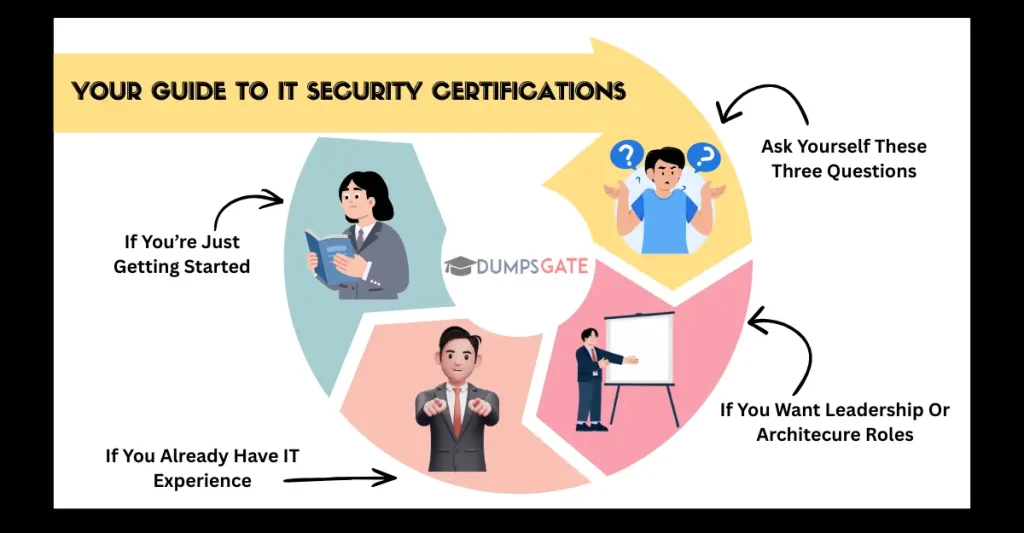
➜ If You’re Just Getting Started
If you are new to IT or transitioning from another field, start with a strong foundation.
Certifications like CompTIA Security+ or GISF introduce you to core IT Security concepts such as network protection, access control, threat types, and risk management. They are designed to build clarity, not confusion.
These certifications are ideal if:
- You have little to no IT security experience
- You want your first security role
- You need structured learning before specializing
Typical roles at this stage include IT support, junior security specialist, and system administrator with security responsibilities. Salary expectations at this level often range between $50,000 to $80,000 USD, depending on your location and prior experience.
If you are unsure where to begin, this is your safest and smartest starting point.
➜ If You Already Have IT Experience
If you understand networking, systems, and basic security principles, you may feel ready for something more hands-on.
Mid-level certifications like CompTIA CySA+ or Certified Ethical Hacker (CEH) are better suited for professionals who want to actively detect, investigate, or simulate attacks.
Choose this path if:
- You enjoy analyzing logs and tracking suspicious behaviour
- You are curious about how attackers exploit systems
- You want to work in a Security Operations Center
- You are ready for more responsibility
With this path, you can land roles such as SOC analyst, threat analyst,- and penetration tester.
At this stage, professionals often earn between $90,000 and $120,000 USD per year, with offensive security specialists earning more in competitive markets. This is where IT security becomes practical and dynamic.
➜ If You Want Leadership Or Architecure Roles
If your goal is to design security programs, manage risk, or lead teams, advanced certifications like CISSP, CISM or CCISO align better with your ambitions. These certifications focus on governance, enterprise, architecture, compliance, and aligning IT security with business strategy.
You should choose this path if:
- You want to move into management
- You enjoy strategic thinking over technical configuration
- You aim for a director, architect, or consulting roles
Senior IT security professionals in these positions often earn above $120,000 USD annually, with compensation increasing significantly in leadership roles. This level is about influence and decision-making.
➜ Ask Yourself These Three Questions
Before choosing any certification, pause and reflect:
- What is my current experience level?
- Do I prefer hands-on technical work or strategic leadership?
- Am I building a foundation or accelerating an established career?
The best IT security certification is the one that supports your next logical step, not the one that sounds the most impressive. IT security rewards progression. Build your base. Gain experience. Then specialize.
When you choose based on clarity rather than hype, your certification becomes a career accelerator instead of just another credential.
Final Thoughts
IT security is a journey, not a race. You do not have to collect every certification or jump straight to the most advanced one to succeed. Start where you are. Build your foundation. Get comfortable. Then, level up.
The best IT security certification is the one that makes sense for you right now, not the one that sounds the most impressive on LinkedIn. Each step you take adds real skills, real confidence, and real career momentum. Therefore, choose smart and grow steadily. Enjoy the process. IT rewards those who play the long game.
Frequently Asked Questions (FAQs)
Which IT security certification is the best for beginners?
For beginners, foundational certifications like CompTIA Security+, ISC2 CC, and GISF are usually the best starting point. They introduce core IT security concepts such as network protection, access control, threats, and risk management. These certifications are widely recognized by employers and help candidates qualify for entry-level roles.
Are IT Security certifications worth it in 2026?
Yes, IT security certifications remain highly valuable in 2026. Organizations continue investing heavily in data protection, compliance, and risk management due to increasing cyber threats and regulatory requirements. These certifications validate your knowledge, strengthen your resume, and help you stand out in competitive job markets.
Can you get an IT security job with just a certification?
It is possible to land an entry-level IT security role with a recognized certification and basic technical knowledge. However, employers also value hands-on experience, internships, home labs, and practical problem-solving skills.
Article Sources
- ISC2. “ISC2 Cybersecurity Workforce Study: Looking Deeper into the Workforce Gap, https://www.isc2.org/Insights/2023/11/ISC2-Cybersecurity-Workforce-Study-Looking-Deeper-into-the-Workforce-Gap.” Accessed February 2026.
- U.S. Bureau of Labor Statistics. “Information Security Analysts, https://www.bls.gov/ooh/computer-and-information-technology/information-security-analysts.htm.” Accessed February 2026.
- Glassdoor. “Ethical Hacker Salaries, https://www.glassdoor.com/Salaries/ethical-hacker-salary-SRCH_KO0,14.htm.” Accessed February 2026.
- Payscale. “Salary for Certification: Certified Information Systems Security Professional (CISSP), https://www.payscale.com/research/US/Certification=Certified_Information_Systems_Security_Professional_(CISSP)/Salary.” Accessed February 2026
- Glassdoor. “Chief Information Security Officer Salaries, https://www.glassdoor.com/Salaries/chief-information-security-officer-salary-SRCH_KO0,34.htm.” Accessed February 2026.


