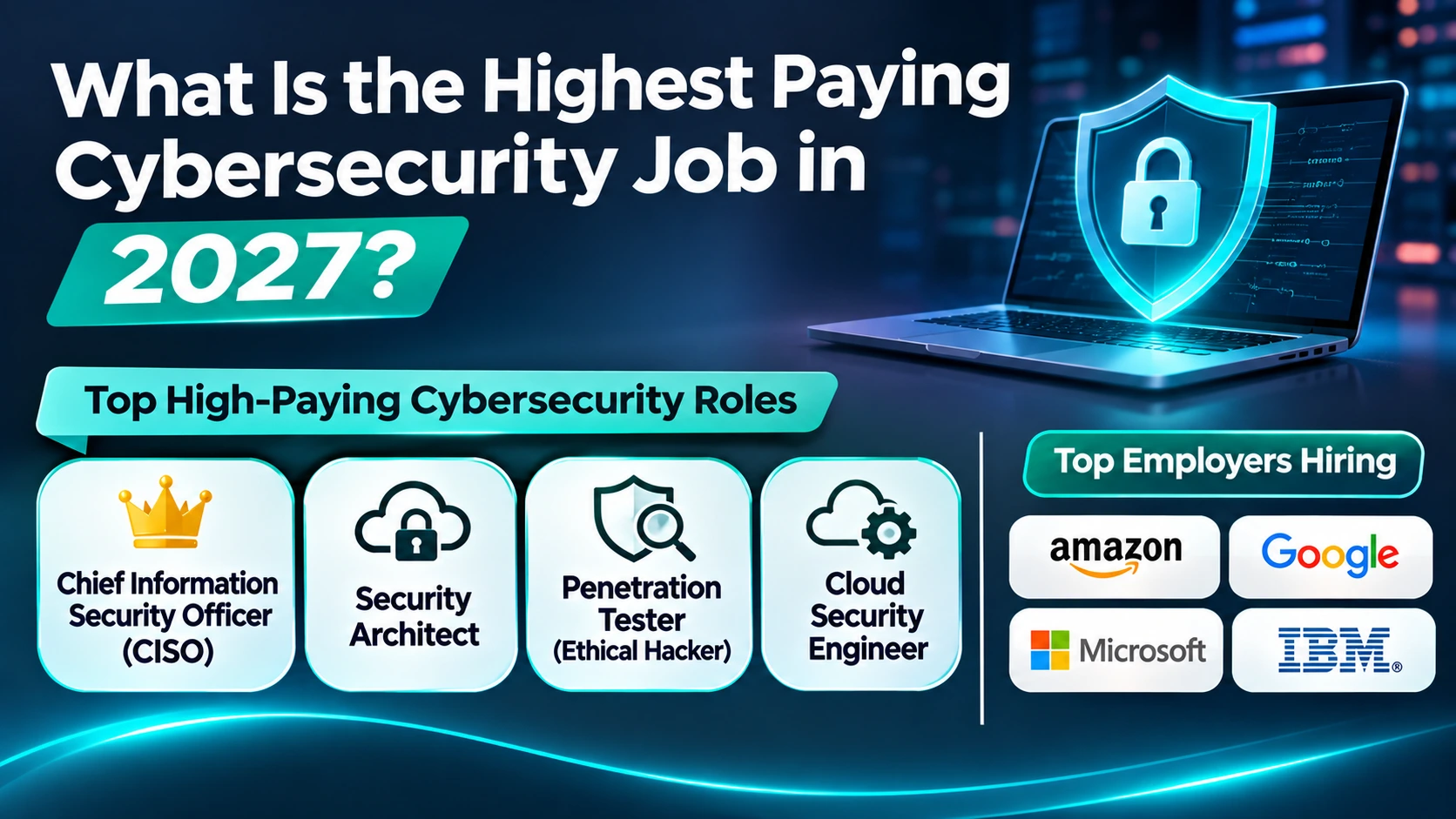
Quick answer: The Chief Information Security Officer (CISO) is the highest-paying cybersecurity job in the US in the end of 2026. Base salaries range from $250,000 to $450,000, with total compensation exceeding $500,000 at large enterprises when bonuses and equity are included, according to salary data from Glassdoor and ZipRecruiter. Security architects and cloud security engineers rank next as the highest-paid cybersecurity roles.
Pay ceilings across cybersecurity vary widely by specialization, seniority, and certification level. An entry-level cybersecurity analyst salary looks nothing like a senior security architect salary, even though both roles fall under the same broad “information security” umbrella. The sections below break down exact pay ranges, required experience, and the certifications tied to each role.
Which Cybersecurity Jobs Pay the Most? (Salary Comparison Table)
The table below ranks the highest-paying cybersecurity jobs by pay ceiling, using US-based salary data aggregated from CyberSeek, Glassdoor, and ZipRecruiter.
| Role | Pay Ceiling (US, Base) | Experience Required | Key Certifications |
| Chief Information Security Officer (CISO) | $250,000-$450,000+ | 10+ years | CISSP, CISM |
| Cybersecurity/Security Architect | $150,000-$220,000 | 7-10 years | CISSP, SABSA, TOGAF |
| Cloud Security Engineer/Architect | $140,000-$210,000 | 5-8 years | CCSP, AWS/Azure Security Specialty |
| Information Security Manager | $140,000-$200,000 | 6-9 years | CISM, CISSP |
| DevSecOps Engineer | $135,000-$195,000 | 4-7 years | CKS, AWS Security |
| Application Security Engineer | $130,000-$190,000 | 4-7 years | CSSLP, OSCP+ |
| Penetration Tester/Ethical Hacker | $120,000-$180,000 | 3-6 years | OSCP+, CEH |
| Incident Response/Digital Forensics Analyst | $115,000-$170,000 | 3-6 years | GCFA, GCIH |
| Network Security Engineer | $110,000-$160,000 | 3-6 years | CCNP Security, CISSP |
| Threat Intelligence Analyst | $110,000-$160,000 | 3-6 years | GCTI, CTIA |
CISOs sit at the top of this list because the role carries board-level accountability for breach prevention, regulatory compliance, and security budget ownership. Every role below it trades some of that scope for a narrower technical focus, which is why pay ceilings drop as the job title moves from “leadership” to “specialist.”
How Much Does a Chief Information Security Officer (CISO) Earn?
A Chief Information Security Officer earns $250,000 to $450,000 in base salary, with total compensation packages at Fortune 500 companies frequently exceeding $500,000 once bonuses, equity, and retention incentives are included, according to Glassdoor’s CISO salary benchmarks. This is consistently the best paying cybersecurity career path in the US market.
Core responsibilities:
- Own the enterprise security strategy and budget
- Report security posture and risk to the board and executive team
- Manage compliance with frameworks like SOC 2, ISO 27001, and NIST CSF
- Lead incident response during major breaches
Certifications that matter most: CISSP (Certified Information Systems Security Professional) and CISM (Certified Information Security Manager) appear in most CISO job postings because both validate management-level security governance knowledge rather than hands-on technical execution.
How Much Does a Cybersecurity Architect Earn?
A cybersecurity architect (also called a security architect) earns $150,000 to $220,000 in base salary, positioning it as one of the highest-paid cybersecurity roles below the executive tier. Architects design the security infrastructure that every other team, from network engineers to application developers, has to build within.
Core responsibilities:
- Design secure network, cloud, and application architectures
- Set technical security standards across the organization
- Evaluate new security tools and vendors before deployment
- Translate business risk into technical control requirements
Certifications that matter most: CISSP remains the baseline credential, while SABSA and TOGAF strengthen candidacy for architecture-specific roles that require enterprise design frameworks.
How Much Does a Cloud Security Engineer Earn?
A cloud security engineer earns $140,000 to $210,000 in base salary, making cloud security jobs among the fastest-growing and highest-paid segments of the cybersecurity market. Demand has climbed alongside enterprise migration to AWS, Azure, and Google Cloud, and pay reflects the scarcity of engineers who can secure multi-cloud environments.
Core responsibilities:
- Configure identity and access management (IAM) policies across cloud platforms
- Monitor cloud workloads for misconfigurations and unauthorized access
- Build automated security controls into CI/CD pipelines
- Respond to cloud-native security incidents
Certifications that matter most: CCSP (Certified Cloud Security Professional) and vendor-specific credentials like the AWS Certified Security Specialty or Microsoft Azure Security Engineer Associate carry the most weight for cloud security jobs specifically.
How Much Does an Information Security Manager Earn?
An information security manager salary ranges from $140,000 to $200,000, just below architect-level pay but with more people-management responsibility. This role bridges technical security teams and executive leadership, making it a common step toward the CISO track.
Core responsibilities:
- Manage a team of security analysts and engineers
- Oversee security policy development and enforcement
- Coordinate audits and compliance reporting
- Manage vendor relationships for security tooling
Certifications that matter most: CISM is the most frequently requested credential for this title, with CISSP as a strong secondary certification.
How Much Does a DevSecOps Engineer Earn?
A DevSecOps engineer earns $135,000 to $195,000 in base salary. This role embeds security directly into software development pipelines, making it one of the top-paying jobs in information security as companies shift left on security testing.
Core responsibilities:
- Automate security scanning within CI/CD pipelines
- Manage container and Kubernetes security
- Collaborate with developers to fix vulnerabilities before deployment
- Enforce secure coding standards across engineering teams
Certifications that matter most: CKS (Certified Kubernetes Security Specialist) and AWS Security certifications align most closely with this role’s cloud-native focus.
How Much Does an Application Security Engineer Earn?
An application security engineer earns $130,000 to $190,000 in base salary. This role focuses specifically on identifying and fixing vulnerabilities within software applications before they reach production.
Core responsibilities:
- Conduct static and dynamic application security testing (SAST/DAST)
- Perform code reviews for security flaws
- Manage bug bounty and vulnerability disclosure programs
- Train development teams on secure coding practices
Certifications that matter most: CSSLP (Certified Secure Software Lifecycle Professional) and OSCP+ (Offensive Security Certified Professional) both signal strong application-layer security expertise.
Learn more about: Cybersecurity Certification Roadmap: Advance Your Cybersecurity Career From Beginner To Professional Level
How Much Does a Penetration Tester Earn?
A penetration tester, also called an ethical hacker, earns $120,000 to $180,000 in base salary. Pay at the senior end climbs sharply for testers with specialized skills in red teaming or advanced exploit development.
Core responsibilities:
- Simulate real-world attacks against networks, applications, and systems
- Document vulnerabilities with clear remediation guidance
- Perform social engineering and physical security assessments
- Support red team versus blue team exercises
Certifications that matter most: OSCP+ is the industry’s most respected hands-on penetration testing credential, and CEH (Certified Ethical Hacker) remains widely recognized for entry into the field.
How Much Does an Incident Response Analyst Earn?
An incident response and digital forensics analyst earns $115,000 to $170,000 in base salary. Demand for this role has grown as ransomware attacks and data breaches have increased across every industry.
Core responsibilities:
- Investigate security incidents and contain active breaches
- Perform forensic analysis on compromised systems
- Coordinate with legal and compliance teams during breach response
- Build and refine incident response playbooks
Certifications that matter most: GCFA (GIAC Certified Forensic Analyst) and GCIH (GIAC Certified Incident Handler) are the most commonly requested credentials for this role.
How Much Does a Network Security Engineer Earn?
A network security engineer earns $110,000 to $160,000 in base salary. This role remains foundational to nearly every organization’s security team, even as cloud-native roles capture more of the market’s growth.
Core responsibilities:
- Configure and maintain firewalls, VPNs, and intrusion detection systems
- Monitor network traffic for anomalies
- Patch and harden network infrastructure
- Support compliance audits related to network controls
Certifications that matter most: CCNP Security and CISSP both strengthen candidacy for mid-to-senior network security roles.
Read more: Entry-Level Cyber Security Jobs Salary: What Beginners Can Earn
How Much Does a Threat Intelligence Analyst Earn?
A threat intelligence analyst earns $110,000 to $160,000 in base salary. This role focuses on tracking threat actors, attack patterns, and emerging vulnerabilities to help organizations anticipate attacks.
Core responsibilities:
- Track threat actor groups and their tactics, techniques, and procedures (TTPs)
- Produce intelligence reports for security and executive teams
- Monitor dark web sources for leaked credentials or planned attacks
- Support proactive threat hunting initiatives
Certifications that matter most: GCTI (GIAC Cyber Threat Intelligence) and CTIA (Certified Threat Intelligence Analyst) both target this specialization directly.
What Cybersecurity Specialization Pays the Most?
Leadership-track roles pay more than specialist-track roles at every comparable experience level. A CISO earns $250,000 to $450,000, while a technical specialist with the same 10+ years of experience, such as a senior penetration tester or security architect, typically tops out between $180,000 and $220,000.
Choose the leadership track if you want the highest ceiling and are willing to trade hands-on technical work for budget ownership, board reporting, and people management. Choose the specialist track if you want to stay hands-on with tools, code, and live systems, and you’re comfortable with a lower (though still strong) pay ceiling in exchange for deeper technical focus.
Cloud security stands out as the exception inside the specialist track. Cloud security engineers and architects now command salaries close to management-level pay, at $140,000 to $210,000, because enterprise cloud migration has outpaced the supply of qualified security talent.
Learn more about: Entry-Level SOC Analyst Salary in 2027: What the Numbers Actually Mean
Which Cybersecurity Jobs Pay the Most by Experience Level?
Pay scales sharply with experience across every cybersecurity role. The table below shows typical salary ranges by career stage.
| Career Stage | Typical Salary Range | Example Roles |
| Entry-level (0-2 years) | $65,000-$95,000 | Cybersecurity analyst, SOC analyst |
| Mid-level (3-6 years) | $95,000-$140,000 | Penetration tester, network security engineer |
| Senior (7-10 years) | $140,000-$200,000 | Security architect, information security manager |
| Executive (10+ years) | $200,000-$450,000+ | CISO, VP of security |
According to CyberSeek data, an entry-level cybersecurity analyst salary starts around $65,000 to $95,000. That range climbs quickly once analysts move into specialized roles like penetration testing or cloud security within three to five years.
Do Cybersecurity Certifications Increase Your Salary?
Cybersecurity Certifications measurably increase cybersecurity professional salaries, with the size of the increase depending on the credential you hold. The table below shows reported salary impact by certification, based on aggregated salary survey data from the (ISC)² Cybersecurity Workforce Study and Glassdoor certification salary reports.
| Certification | Focus Area | Reported Salary Impact |
| CISSP | Security management/leadership | +15-25% |
| CISM | Security management | +12-20% |
| CCSP | Cloud security | +10-18% |
| CEH | Ethical hacking | +5-12% |
| Security+ | Entry-level foundations | +5-10% |
CISSP produces the largest measurable salary increase because it’s required or preferred in most senior and leadership-track job postings, including CISO, security architect, and information security manager roles. Security+ delivers a smaller but still meaningful boost, largely because it functions as an entry credential rather than a specialization marker.
Delve into the details of: What Is the Best CISSP Study Plan for 2027?
Which Cybersecurity Certifications Are Worth Pursuing?
The right cybersecurity certification depends entirely on which role you’re targeting, not on which credential has the most name recognition. A cloud security engineer gains more from a CCSP than from an OSCP+, just as a penetration tester gains more from an OSCP+ than from a CISM.
- CISSP (Certified Information Systems Security Professional) — The most widely requested credential for leadership and architecture roles, including CISO, security architect, and information security manager positions. Administered by (ISC)².
- CISM (Certified Information Security Manager) — Targets security management roles specifically, with a stronger focus on governance and risk than CISSP. Administered by ISACA.
- CCSP (Certified Cloud Security Professional) — Directly relevant for cloud security engineer and cloud security architect roles, validating multi-cloud security knowledge. Administered by (ISC)².
- CEH (Certified Ethical Hacker) — A widely recognized entry point into penetration testing and ethical hacking, often paired with OSCP+ for candidates building toward senior roles.
- CompTIA Security+ — The standard entry-level certification for cybersecurity analyst and SOC analyst roles, covering foundational security concepts.
- GCFA / GCIH (GIAC certifications) — Focused on forensic analysis and incident handling, both directly relevant to incident response analyst roles.
Cross-reference certification requirements against active job postings for your target role before investing exam and study time. Pulling five to ten postings for the exact title you want reveals which certifications employers list as required versus preferred, which prevents spending 100+ study hours on a credential your target employer doesn’t prioritize.
Dive deeper into: What Does the GCIA Certification Actually Require in 2027?
Which US States and Cities Pay the Most for Cybersecurity Jobs?
Cybersecurity salaries vary significantly by location, with the highest pay concentrated in states with large finance, tech, and government sectors.
| State/Metro Area | Typical Salary Premium vs. National Average |
| California (San Francisco, San Jose) | +25-35% |
| New York (New York City) | +20-30% |
| Washington, D.C. (metro area) | +15-25% |
| Washington State (Seattle) | +15-20% |
| Virginia (Northern Virginia) | +10-20% |
| Texas (Austin) | +5-10% |
California and New York lead on pay because they host the highest concentration of finance and big tech employers, both of which pay premiums for security talent to protect high-value data and transactions. Washington, D.C., and Northern Virginia rank highly because federal government and defense contractor demand consistently pays above national averages for cleared cybersecurity professionals.
Outside the US, cybersecurity pay follows a similar pattern: London and Zurich lead in Europe, Sydney leads in Australia, Toronto leads in Canada, and Bengaluru and Hyderabad lead in India, all driven by concentrated finance and tech sector demand.
Can You Get a High-Paying Cybersecurity Job Without a Degree?
Yes, you can get a high-paying cybersecurity job without a degree, particularly in technical specialist roles where employers prioritize demonstrated skills over academic credentials. Cybersecurity jobs without a degree are most accessible in penetration testing, SOC analyst, and network security roles, where certifications and hands-on lab experience carry significant weight.
Steps to build a degree-free path into cybersecurity:
- Earn a foundational certification. Start with CompTIA Security+ or Network+ to establish baseline credibility with employers.
- Build hands-on lab experience. Use platforms like TryHackMe or Hack The Box to demonstrate practical skills.
- Target entry-level SOC or analyst roles. These roles hire based on certifications and demonstrated skills more often than degree-focused roles like CISO or security architect.
- Layer in specialized certifications. Add OSCP+, CEH, or CCSP once you have two to three years of experience to unlock mid-level pay.
- Document projects publicly. A GitHub portfolio or personal blog documenting CTF (capture the flag) challenges and security research can significantly strengthen job applications.
Leadership roles like CISO and information security manager remain harder to access without a degree, since many enterprise employers still list a bachelor’s degree as a formal requirement for executive-track positions. Specialist roles, particularly in penetration testing and SOC operations, offer the clearest path to a strong salary without one.
Get insights on: Cybersecurity Interview Questions That Actually Get Asked in 2027
Which Cybersecurity Career Path Should You Choose Next?
Match your next move to the pay ceiling and experience requirement that fits where you are today. If you’re early in your career, target a cybersecurity analyst role and pair it with a Security+ certification to build a foundation. If you already have three or more years of experience, evaluate whether the leadership track (CISM, CISSP, and a path toward information security manager) or the specialist track (cloud security, penetration testing, or application security) better fits your strengths and goals.
Pull five active job postings for your target role today and compare the certifications listed as required versus preferred. That single step tells you exactly which credential to pursue next.
Frequently Asked Questions
What is the highest paying cybersecurity job in 2027?
The Chief Information Security Officer (CISO) is the highest-paying cybersecurity job, with base salaries between $250,000 and $450,000 and total compensation often exceeding $500,000 at large enterprises.
How long does it take to reach a six-figure cybersecurity salary?
Most professionals reach a six-figure cybersecurity salary within three to five years, typically by moving from an entry-level analyst role into a specialized position like penetration testing, cloud security, or network security engineering.
Which certification has the biggest impact on cybersecurity salary?
CISSP has the largest measurable impact on cybersecurity salary, with reported increases of 15% to 25%, largely because it’s required or preferred across most senior and leadership job postings.
Is cloud security a good specialization for high pay?
Yes, cloud security is one of the highest-paid specializations in cybersecurity, with cloud security engineers and architects earning $140,000 to $210,000 due to strong demand from enterprise cloud migration.
Can a cybersecurity analyst become a CISO?
Yes, a cybersecurity analyst can become a CISO over time, typically by progressing through mid-level specialist roles, into a management position like information security manager, before reaching executive-level leadership after 10 or more years of experience.