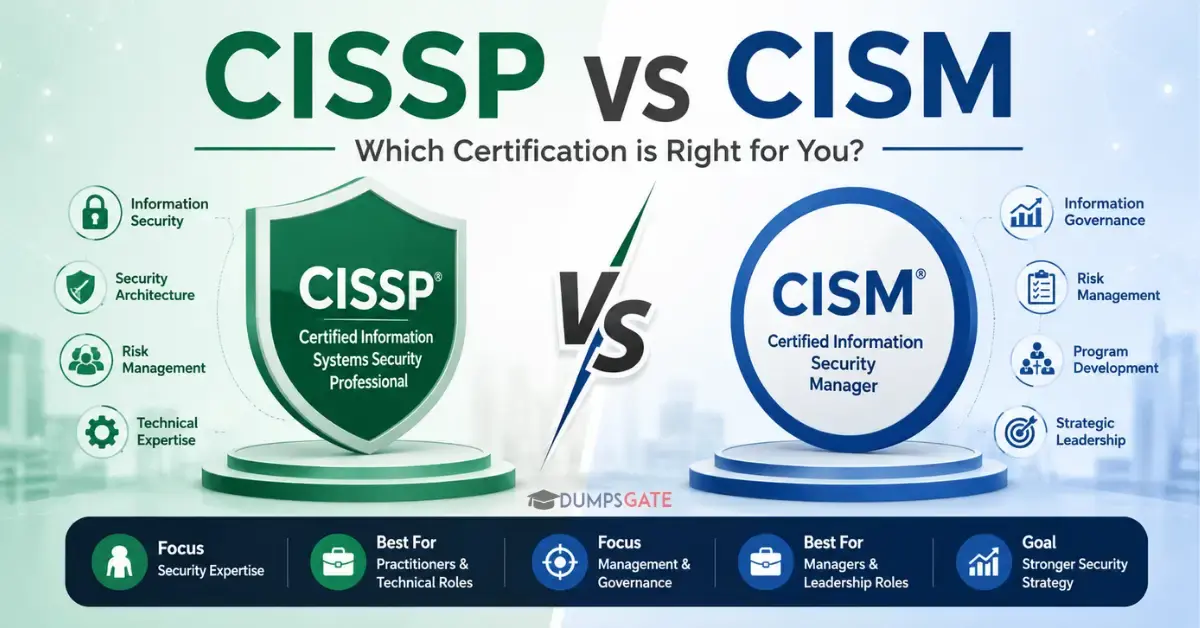
- Choose CISSP if you want broad technical credibility and the widest job-market reach.
- Choose CISM if your goal is security management, governance, or a CISO-track role.
- If you plan to earn both, CISSP first is the more efficient sequence. An active CISSP can offset up to two years of CISM’s management-experience requirement.
This CISSP vs CISM comparison guide uses official 2026 data from ISC2, ISACA, and the U.S. Bureau of Labor Statistics to compare both certifications on exam format, domains, prerequisites, cost, salary outlook, and employer expectations.
CISSP vs CISM at a Glance
| Feature | CISSP | CISM |
| Full name | Certified Information Systems Security Professional | Certified Information Security Manager |
| Issuing body | ISC2 | ISACA |
| Focus | Broad technical and managerial security | Security management and governance |
| Domains | 8 | 4 |
| Exam format | CAT, 125 to 175 questions, 3 hours | Linear, 150 questions, 4 hours |
| Passing score | 700 / 1,000 (scaled) | 450 / 800 (scaled) |
| Exam fee | $749 | $575 (member) / $760 (non-member) |
| Annual maintenance | $135/year | $135/year |
| Experience required | 5 years, across 2+ of 8 domains | 5 years, 3+ in security management |
| Best for | Engineers, architects, analysts, generalists | Managers, GRC leads, CISO-track professionals |
What Is the Difference Between CISSP and CISM?
CISSP (Certified Information Systems Security Professional) is a broad, technical credential issued by ISC2. It spans eight domains covering everything from risk management and network security to software development security. It is the go-to credential for professionals who want to demonstrate wide security knowledge across both technical and managerial disciplines.
CISM (Certified Information Security Manager) is a management-focused credential issued by ISACA. Its four domains concentrate on governance, risk, program management, and incident response at a strategic level. It does not test technical implementation depth. It tests your ability to lead and govern a security program.
The simplest way to think about it:
CISSP proves you understand security.
CISM proves you can manage it.
Decision Summary: Which Certification Fits You?
Before diving into the details, use this quick guide to find the right path.
- Get CISSP first if you are a security engineer, analyst, or architect, or if you are entering security from another IT discipline.
- Get CISM first if you are already managing a security team or program and need governance credentials to match your day-to-day responsibilities.
- Get CISSP, then CISM if you plan to earn both. CISSP offsets up to two years of CISM’s experience requirement, making the second credential more accessible.
- Get neither yet if you do not meet the experience requirements. Both exams can be taken early through the Associate pathway, giving you time to fulfill the experience requirement afterward.
Best Certification by Career Stage
| Career stage | Better choice | Why |
| Early-career security professional | CISSP | Broader recognition, higher volume of job postings |
| Mid-career technical specialist | CISSP | Covers architecture, engineering, and analytical depth |
| Current security manager | CISM | Directly validates governance and program leadership |
| GRC or compliance professional | CISM | Risk and governance domains align with daily work |
| Cloud-focused professional | Neither as a primary specialist pick | Consider CCSP if cloud security is your main focus |
| CISO-track professional | Both, CISSP first | CISSP builds the technical foundation; CISM adds governance credibility |
Is CISM Harder Than CISSP?
Neither exam is objectively harder. Difficulty is almost entirely determined by your background.
- Technical practitioners often find CISM harder. It requires strategic and governance judgment rather than technical recall.
- Current or aspiring managers often find CISM more natural, since its domains mirror everyday program leadership decisions.
- CISSP is broader by domain count (8 vs. 4) and tests both technical depth and management breadth, making it demanding for candidates without wide security exposure.
- CISM is narrower but governance-heavy, concentrating entirely on strategy, risk, program management, and incident leadership.
Neither ISC2 nor ISACA publishes an official pass rate for either exam. Any percentage cited online is a third-party estimate, not a verified statistic from the certification body. Base your preparation on the official exam outlines, not on pass-rate rumors.
What Are the CISSP and CISM Exam Formats in 2026?
| Detail | CISSP | CISM |
| Testing format | Computerized Adaptive Testing (CAT) | Linear, fixed-form |
| Question count | 125 to 175 | 150 |
| Time limit | 3 hours | 4 hours |
| Passing score | 700 out of 1,000 | 450 out of 800 |
| Delivery | Pearson VUE | PSI (test center or remote proctored) |
| Current outline effective | April 15, 2024 | November 3, 2026 |
CISSP uses Computerized Adaptive Testing across all languages since April 2024. Question difficulty adjusts as you answer, which means the exam ends when the system has enough data to make a pass or fail determination, not necessarily at the maximum question count.
CISM uses a fixed-form linear exam. The updated CISM exam outline takes effect on November 3, 2026, adding enterprise architecture and Jsecurity architecture as new content areas, with stronger emphasis on security strategy and program development. If you are testing on or after that date, confirm you are studying the correct outline on the ISACA CISM page before finalizing your study plan.
CISSP and CISM Domains and Weights
Domain weights tell you where to concentrate your study time. These are taken directly from official exam outline documents.
CISSP Domains

| Domain | Weight |
| Security and Risk Management | 15% |
| Asset Security | 10% |
| Security Architecture and Engineering | 13% |
| Communication and Network Security | 13% |
| Identity and Access Management (IAM) | 13% |
| Security Assessment and Testing | 12% |
| Security Operations | 13% |
| Software Development Security | 11% |
Source: ISC2 CISSP Certification Exam Outline.
CISM Domains
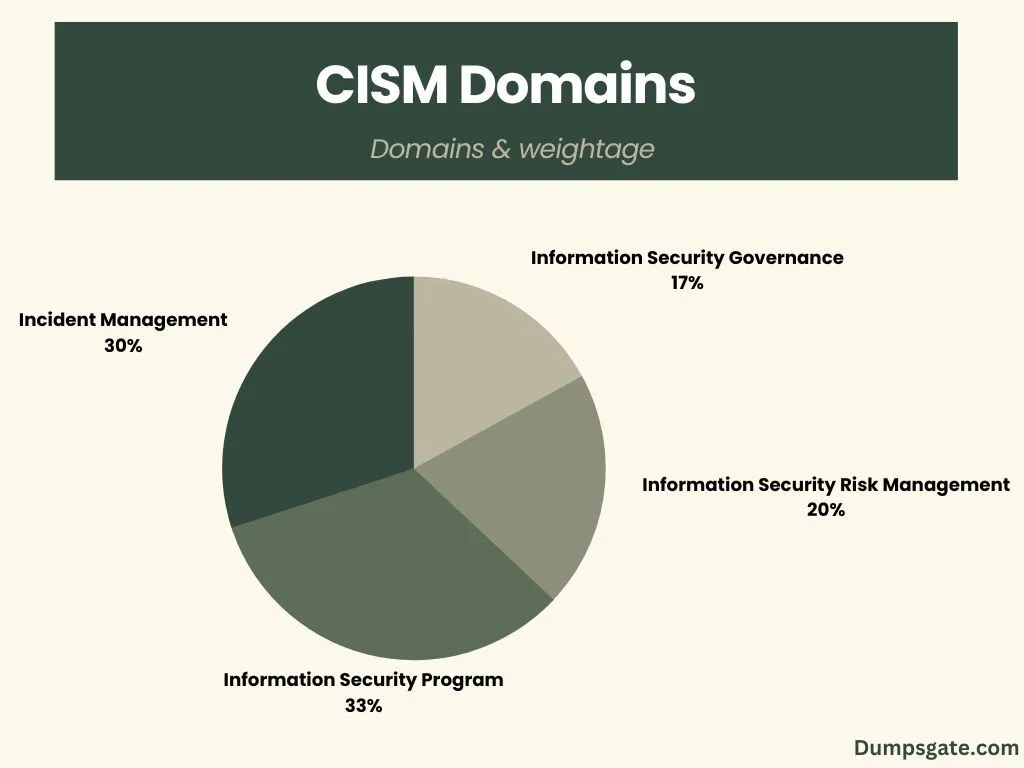
| Domain | Weight |
| Information Security Governance | 17% |
| Information Security Risk Management | 20% |
| Information Security Program | 33% |
| Incident Management | 30% |
Source: ISACA CISM Exam Content Outline.
Two-thirds of the CISM exam sits in Program and Incident Management. That is a deliberate design choice. CISM rewards governance execution, not technical recall. CISSP spreads its weight more evenly across eight domains, which is why it typically requires longer preparation.
Prerequisites for CISSP and CISM
| Requirement | CISSP | CISM |
| Minimum experience | 5 years, cumulative, paid | 5 years in information security, 3+ in management |
| Domain-specific requirement | 2+ of 8 CISSP domains | 3+ years in security management |
| Degree waiver | Up to 1 year with a qualifying degree | Up to 2 years, various options |
| Cross-credential offset | N/A | Active CISSP offsets up to 2 years of CISM experience requirement |
| No-experience path | Associate of ISC2, 6 years to complete | Exam first, experience verified within 5 years of passing |
Sources: ISACA CISM Requirements, ISC2 CISSP Experience Requirements.
Further details on CISSP Requirements: Everything You Need to Know About CISSP Certification Requirements

The cross-credential offset is the single most important strategic factor for anyone planning to earn both. Holding an active CISSP eliminates the need to separately document two years of CISM-eligible management experience. That makes CISSP-first the most efficient dual-credential path available.
How Much Do CISSP and CISM Cost in 2026?
| Cost item | CISSP | CISM |
| Exam fee (non-member) | $749 | $760 |
| Exam fee (member) | Included with ISC2 membership | $575 |
| Optional membership | ISC2 | ISACA (~$145/year) |
| Annual maintenance fee | $135/year | $135/year |
| Estimated first-year cost (self-study) | $900 to $2,200 | $1,000 to $2,000 |
| Estimated first-year cost (instructor-led) | $3,000 to $5,500 | $2,000 to $3,500 |
For CISM candidates, joining ISACA before registering saves $185 on the exam fee. At $145 for annual membership, the net benefit in the first year is around $40, with ongoing member-pricing benefits for future exams or courses.
The first-year cost estimates above are directional only. Your actual total depends on study materials, membership status, and whether you use self-paced resources or instructor-led training.
More on CISM cost: Complete Breakdown Of CISM Certification Exam Cost in 2026
CISSP vs CISM Salary: What Does the Data Show?
Salary figures for certification holders vary widely depending on source, job title, industry, and location. The most authoritative reference point for the US market comes from the federal government.
According to the U.S. Bureau of Labor Statistics Occupational Outlook Handbook, the 2024 median annual pay for information security analysts was $124,910. Employment in this field is projected to grow 29% from 2024 to 2034, far above the average for all US occupations.
| BLS Data Point | Detail |
| 2024 median annual pay | $124,910 |
| Projected job growth (2024 to 2034) | 29% |
| Projected new jobs | ~52,100 |
| Annual average openings | ~16,000 |
CISM-aligned management and director-level roles often command higher total compensation at senior levels compared to analyst or engineer titles. CISSP-aligned roles offer strong pay across a wider range of seniority levels. Treat any certification-specific salary figures from third-party salary aggregators as directional, not guaranteed.
How Many US Job Postings Require CISSP vs CISM?
Based on Indeed.com search data from August 2026, CISSP postings significantly outnumbered CISM postings in the US market.
| Search | US postings (August 2026) |
| CISSP | ~9,135 |
| CISM | ~2,848 |
| CISSP and CISM combined | ~9,422 |
These figures are directional and reflect a single point in time. Job posting counts fluctuate and should not be treated as a precise market measure.
The gap reflects the structure of the market, not a difference in credential quality. Technical security roles are simply more numerous than dedicated management positions. Most CISM-seeking postings also accept CISSP as an alternative, while the reverse is less common, which reflects CISSP’s broader scope across both technical and managerial work.
How Employers Interpret CISSP vs CISM
Employers generally read these two credentials very differently, even when they appear in the same job listing
✅ When employers see CISSP, they typically expect:
- Hands-on knowledge across multiple security domains
- The ability to work across technical and managerial functions
- Readiness for security engineering, architecture, or analyst roles
- Eligibility for DoD-cleared and federal positions governed by DoDM 8140
✅ When employers see CISM, they typically expect:
- Experience owning or overseeing a security program
- Comfort with risk frameworks, governance structures, and audit processes
- Suitability for director, manager, GRC lead, or CISO-track titles
- Strategic decision-making beyond technical implementation
In many senior-level postings, both are listed together, reflecting the expectation that senior security leaders need both breadth and governance depth. In those cases, the credentials are treated as complementary rather than interchangeable.
Side-by-Side Study Path Comparison
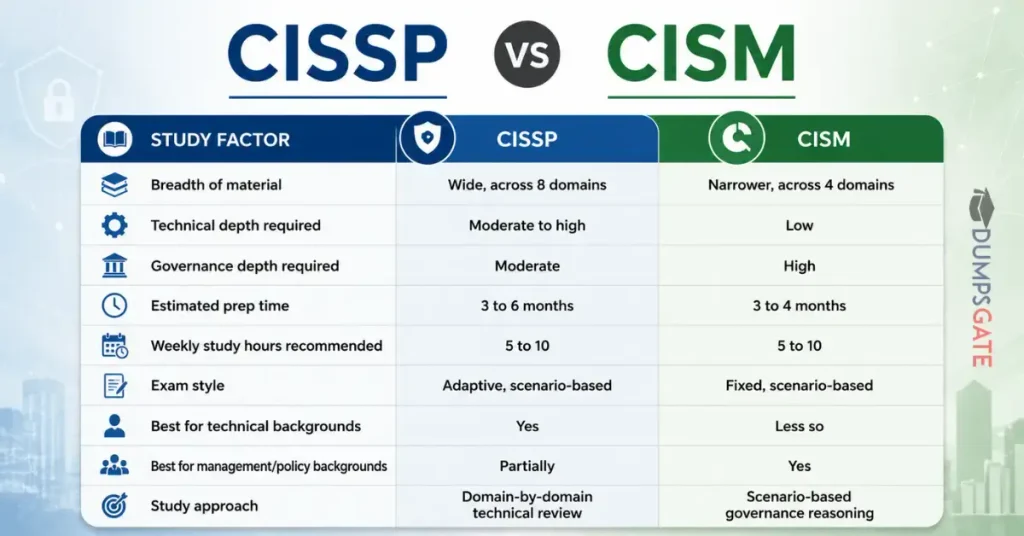
| Study factor | CISSP | CISM |
| Breadth of material | Wide, across 8 domains | Narrower, across 4 domains |
| Technical depth required | Moderate to high | Low |
| Governance depth required | Moderate | High |
| Estimated prep time | 3 to 6 months | 3 to 4 months |
| Weekly study hours recommended | 5 to 10 | 5 to 10 |
| Exam style | Adaptive, scenario-based | Fixed, scenario-based |
| Best for technical backgrounds | Yes | Less so |
| Best for management/policy backgrounds | Partially | Yes |
| Study approach | Domain-by-domain technical review | Scenario-based governance reasoning |
Realistic prep times assume consistent weekly study. Candidates with deep hands-on technical experience often find CISSP prep faster than the upper end of that range. Candidates without management experience typically need to spend more time on CISM’s governance reasoning style before testing.
Learn More: Pass the CISSP Exam 2026: A Comprehensive Study Plan
When CISSP Is Not the Best First Choice
CISSP is the right credential for most security professionals, but it is not the right starting point for everyone. Consider a different path first if:
- Your current role is entirely governance and board-level reporting with no technical implementation work.
- You are already managing a security team and need credentials that validate program leadership right now.
- You work primarily in GRC, audit, or policy, where CISM’s domains map more directly to your responsibilities.
- You already hold a strong technical credential and your next career move is clearly into security management, not deeper into engineering.
In these situations, CISM is the more targeted and efficient first choice. You can add CISSP later to broaden your credential profile.
Discover More: CRISC vs CISSP: The Better Option
When CISM Is Not the Best First Choice
CISM is built for management. If that is not where you are today, or where you are heading in the next two to three years, it may not be worth pursuing first.
Consider starting with CISSP instead if:
- You are early in your security career and still building technical foundations.
- Your current role is hands-on: engineering, operations, or architecture.
- You need maximum job-market flexibility right now, not a governance-specific credential.
- You are uncertain about your long-term direction and want a credential that keeps multiple paths open.
- You are aiming for federal or DoD roles that explicitly list CISSP under approved baseline certification requirements.
Should I Take CISSP or CISM First?
| Your situation | Recommended first cert | Reason |
| Security engineer or analyst | CISSP | Technical alignment, highest posting volume |
| Security architect | CISSP | Domain 3 maps directly to architecture work |
| Aspiring or current security manager | CISM | Governance and program-management focus |
| GRC or compliance professional | CISM | Risk and governance domains directly applicable |
| Career changer entering security | CISSP | Broader foundation, wider market demand |
| Consultant or risk advisor | Depends on scope | CISM for governance advisory; CISSP for technical consulting |
| Planning to earn both | CISSP first | Offsets up to 2 years of CISM experience requirement |
| No experience yet | Either, as Associate pathway | Sit the exam early, earn experience within the allowed window |
Is CISM Worth It After Already Holding CISSP?
Yes, if your career is shifting toward management or governance. The two credentials complement rather than duplicate each other. CISSP signals that you understand security at a technical level. CISM signals that you can lead and govern a security program at the organizational level.
Because an active CISSP offsets up to two years of CISM’s management-experience requirement, the incremental investment is primarily the exam fee and around three to four months of focused study. For technical professionals moving into leadership or CISO-track roles, CISM after CISSP is one of the most efficient credential combinations available.4
Discover More: SSCP vs CISSP: 10 Major Differences to Clarify the Pathway
CISSP vs CISM vs CCSP: How Does a Third Option Compare?
If your work centers on cloud infrastructure, neither CISSP nor CISM may be the most precise fit. CCSP (Certified Cloud Security Professional), issued by ISC2, is designed specifically for cloud security architecture and operations.
| Feature | CISSP | CISM | CCSP |
| Issuing body | ISC2 | ISACA | ISC2 |
| Focus | Broad technical security | Management and governance | Cloud security |
| Domains | 8 | 4 | 6 |
| Best for | Engineers, architects, analysts | Managers, GRC leads, CISOs | Cloud architects, cloud engineers |
| Delivery | Pearson VUE | PSI | Pearson VUE |
CISM and CCSP rarely target the same role. CISM is governance-focused. CCSP is cloud-technical. CISSP bridges both worlds and is the most common foundation for professionals planning to specialize later.
For a full comparison of CISSP and CCSP, see the CISSP vs CCSP guide.
Frequently Asked Questions (FAQs)
Is CISM recognized outside management roles?
Rarely. CISM is built for governance and management titles. Technical and architecture roles almost always request CISSP or a more technical credential instead.
Can I take CISM before CISSP?
Yes. There is no requirement to hold CISSP first. Candidates need either the standard CISM experience or a qualifying waiver. The exam can be taken before the experience requirement is fully met.
Does CISSP cover security management the way CISM does?
Partially. CISSP includes management content across its Security and Risk Management and Security Operations domains, but it does not match CISM’s governance depth across strategy, program development, and incident leadership at the organizational level.
Is CISM harder than CISSP for someone with no management background?
Typically yes. CISM tests governance judgment and program-level decision-making, which is harder to apply correctly without direct management experience, regardless of technical skill level.
What is the CISM passing score?
The CISM passing score is 450 out of 800 on a scaled scoring system. Confirm the current model on the ISACA website before your exam, as ISACA updates its exam structure periodically.
What is the CISSP passing score?
The CISSP passing score is 700 out of 1,000 on a scaled scoring system
Does holding both CISSP and CISM affect salary?
Reported figures for professionals holding both credentials tend to be higher, though this reflects seniority and role scope more than the certifications alone. The BLS reports a 2024 median of $124,910 for information security analysts as a reliable US-market anchor.
Which certification is more technical, CISSP or CISM?
CISSP is significantly more technical. It covers eight domains spanning cryptography, network security, identity management, software development security, and more. CISM does not test technical implementation. It focuses entirely on management and governance.
Which certification has broader market recognition?
CISSP is more broadly recognized across job postings and industries, including technical, consulting, and federal roles. CISM is highly recognized within governance, risk, and management circles, but it serves a narrower segment of the security job market.