Key Takeaways
- Lean Six Sigma certification costs range from free (White Belt) to over $7,000 for comprehensive Black Belt programs, including training.
- ASQ is the most recognized certification body in the United States, followed by IASSC for independent and international credentialing.
- Exam only paths are the most affordable—CSSC charges $99–$295, IASSC charges $350 for its Green Belt exam voucher, and ASQ charges $483–$585.
- Salary data supports a strong ROI: Green Belt holders earn ~$85,000/year on average, Black Belts earn $95,000–$119,700, and Master Black Belts can earn up to $135,000.
- Employer sponsorship is common in manufacturing, healthcare, and finance—ask your employer before self funding.
Lean Six Sigma certification costs anywhere from $0 for a White Belt to over $7,000 for a comprehensive, university led Black Belt program. The main driver isn’t the belt itself. It’s whether you’re paying for an exam only (CSSC, IASSC, ASQ: $99–$585) or for bundled training plus the exam (Purdue, Villanova, UC Davis: $2,195–$7,000+). There’s no single governing body for Lean Six Sigma, so ASQ, IASSC, CSSC, and individual universities each set their own pricing, which is why the range is so wide.
What Is Lean Six Sigma Certification?
Lean Six Sigma combines two frameworks: Lean (eliminating waste) and Six Sigma (reducing defects and variation), providing professionals with a structured, data driven toolkit to improve efficiency across industries.
Certifications are structured by “belt” level:
- White Belt — basic awareness; no project experience required
- Yellow Belt — foundational knowledge; supports Green Belt projects
- Green Belt — project leadership, part time; the most popular entry point
- Black Belt — full time project leadership, data analysis, team leadership
- Master Black Belt (MBB) — organizational strategist; coaches Black and Green Belts
Unlike the PMP or CPA, there is no single governing authority for Lean Six Sigma. Certifications are issued by a patchwork of organizations — ASQ, IASSC, the Council for Six Sigma Certification (CSSC), universities, and private training companies. Each sets its own price and requirements, which is exactly why cost varies so widely.
How Much Does Lean Six Sigma Certification Cost? Belt by Belt Breakdown
The most direct answer to “how much does Lean Six Sigma certification cost” is this: it depends on which belt you’re pursuing and whether you want training included or just the exam credential.
Here is a general market range for 2026:
| Belt Level | Exam Only Range | Training + Exam Range |
|---|---|---|
| White Belt | Free | Free–$200 |
| Yellow Belt | $99–$250 | $200–$1,000 |
| Green Belt | $195–$483 | $1,000–$3,000 |
| Black Belt | $295–$585 | $3,000–$7,000 |
| Master Black Belt | $750+ | $5,000–$10,000+ |
The cost of the Yellow Belt certification deserves its own note, since it’s often the cheapest and most overlooked tier. Because it requires no prerequisites and no proctored capstone project, most providers price it as a loss leader; some universities and training companies even offer it free to funnel candidates toward paid Green Belt tracks. If you’re brand new to process improvement, this is a low risk way to confirm the discipline is a fit before spending more.
Wondering how much you’ll actually need to invest? Explore our detailed guide to: How Much Does The Six Sigma Certification Cost In 2026? {A Detailed Analysis}
Lean Six Sigma Certification Cost by Provider
| Provider | Belts Offered | Price Range (2026) | Prerequisites | Best For | |
|---|---|---|---|---|---|
| CSSC | White–Master Black | $0 (White) to $295 (Black); +$300–$750 for project tiers | No (exam/credential only) | None | Budget conscious self studiers |
| IASSC | Green, Black | ~$295–$402 (Green Belt exam voucher) | No — exam only | None | Pairing with outside training; international |
| ASQ | Green (CSSGB), Black (CSSBB) | $483 (Green, non member) / $585 (Black, non member); ~$100 less for members | No — exam only | Experience + projects for BB | Most employer recognized US credential |
| MSI Certified | Yellow–Black | $99.95–$199.95 (promotional pricing common) | Yes — self paced courses | None | Entry level/guided self study at low cost |
| Purdue University | Green, Black | Green $2,195; Black $3,750 (bundle saves $805) | Yes — instructor led cohort | None stated | University credibility with online flexibility |
| Villanova University | Green–Black | ~$4,095 (Black Belt); ~$7,000 full path | Yes — instructor led | None stated | Employers who value university brand |
Best Lean Six Sigma Certification Online — Marketplace & Bootcamp Tier
Beyond ASQ, IASSC, and CSSC, a lower cost tier of course marketplaces and private bootcamps is where many first time searchers actually land, and the certification cost calculus here is different: you’re often paying for instruction, not an accredited credential.
| Platform | Belts Offered | Typical Price Range | Credential Type | Notes |
| Udemy | Yellow–Black (course dependent) | $10–$200 (frequent discounts) | Certificate of completion — not accredited | No proctoring; quality varies by instructor; best used as supplementary study, not a standalone credential |
| Coursera | Yellow–Black (via university/partner specializations) | Free to audit; ~$49–$79/mo subscription or $39–$79 per specialization | Certificate tied to partner institution — not ASQ/IASSC | University partnered specializations carry more weight than generic marketplace courses |
| Simplilearn | Green–Black (often bundled) | ~$1,500–$3,000+ | Often aligned to IASSC Body of Knowledge; exam voucher sometimes bundled | Live + self paced hybrid; confirm whether the IASSC exam fee is included or separate |
| GreyCampus | Yellow–Black | ~$300–$1,200 (bundle dependent) | Aligned to IASSC standards; voucher often included | Budget alternative to Simplilearn |
| 6sigma.us | Yellow–Master Black Belt | ~$1,000–$5,000+ | Proprietary certification — not ASQ/IASSC | Private training company; verify employer recognition before enrolling |
Still deciding whether Six Sigma is the right fit for your career? Read our detailed comparison, Six Sigma vs Agile, to understand which methodology aligns best with your goals: Six Sigma vs Agile: Choosing the Right Path for Your IT Career
The tradeoff: these platforms are cheaper and more flexible, but with the exception of university partnered Coursera specializations, none issue an ASQ or IASSC recognized credential. If cost is your only constraint and you don’t need employer recognized certification, they’re a legitimate way to learn the material. If you need the credential for a resume line or promotion case, pair a Udemy course with an actual CSSC or IASSC exam voucher rather than relying on the course certificate alone.
Lean Six Sigma Certification Cost in the USA
Most certification today is delivered online, so the credential itself doesn’t carry a different sticker price by ZIP code, including for professionals searching for Lean Six Sigma certification costs near California or San Jose, CA. Regional cost differences show up in three real ways instead:
- In person/instructor led classes in high cost of living metros (San Jose, San Francisco, Los Angeles, New York, Boston) typically run 15–30% higher than the same course delivered elsewhere due to venue and instructor overhead.
- Community college and continuing education programs in California, Texas, and the Midwest often offer Green Belt and Black Belt courses for $500–$1,500 — notably cheaper than private bootcamp style providers.
- State workforce funding, such as California’s Employment Training Panel (ETP), occasionally subsidizes process improvement training for eligible employers.
For California based professionals specifically, UC Davis’s $2,195 Green Belt program (see comparison table above) is one of the more transparent, regionally credible options — though nationally available online programs at the same price points remain a strong alternative if you don’t need a local classroom.
Lean Six Sigma Certification Cost by Country
Lean Six Sigma is a globally relevant credential, and costs vary significantly by country, due to currency differences and because some local providers price for regional markets.
| Country | Approximate Cost Range |
|---|---|
| USA | $295–$7,000+ (depending on provider and belt) |
| UK | ~£190–£380 (GBP equivalent of IASSC/CSSC range) |
| India | ₹20,000–₹40,000 INR (~$240–$480 USD) |
| South Africa | 4,255–8,510 ZAR ($230–$460 USD) |
| Philippines | No discounted local tier — same USD pricing as the U.S.: CSSC $0–$295, IASSC Green Belt voucher $350, ASQ $483–$585 |
| Pakistan | No discounted local tier — same USD pricing as the U.S.: CSSC $0–$295, IASSC Green Belt voucher $350, ASQ $483–$585 |
| Bangladesh | No discounted local tier — same USD pricing as the U.S.: CSSC $0–$295, IASSC Green Belt voucher $350, ASQ $483–$585 |
| UAE | Same USD exam pricing as above, plus a higher cost in person tier — Dubai/Abu Dhabi corporate training workshops typically run above global online rates due to venue and instructor overhead |
Professionals in the Philippines, Pakistan, and Bangladesh pay the identical USD denominated fees as U.S. candidates; there is no local discount tier for CSSC, IASSC, or ASQ. That means a Green Belt exam voucher costs the same $350 in Manila, Karachi, or Dhaka as it does in Chicago. Local training companies in these markets may bundle coursework at their own local currency pricing, but the certification exam fee itself doesn’t change by region. In the UAE, the same USD exam pricing applies, but the market also includes a meaningfully higher cost in person corporate training tier; Dubai and Abu Dhabi based instructor led workshops routinely price above online equivalents.
In India, a growing number of local providers offer bundled training and certification packages priced between ₹20,000 and ₹40,000. KPMG India, for example, has been mentioned in professional communities as a recognized training provider, though costs will vary by program tier.
Choosing between project management and process improvement certifications can be challenging. Our guide, Six Sigma vs PMP, breaks down the skills, career paths, and earning potential of both certifications: Six Sigma vs PMP: Choosing The Right Certification Path for Your IT Career
Online Lean Six Sigma Certification Cost
Online certification typically costs 30–60% less than in person equivalents, since it eliminates venue and travel overhead and often allows self paced study. When comparing options, prioritize programs that:
- Align explicitly with the ASQ or IASSC Body of Knowledge
- Include a proctored exam, not a self graded quiz
- Offer project mentoring or review, especially at Green Belt and above
- Publish transparent pricing up front, rather than requiring a sales call to get a quote
The quality of online programs varies considerably. Look for programs that include practice exams, live or recorded instruction, and clear alignment with either IASSC’s or ASQ’s Body of Knowledge. Programs that cannot specify which body their curriculum aligns to should be treated with caution.
Factors That Affect the Lean Six Sigma Certification Cost
Understanding the price gap between a $99 CSSC Yellow Belt and a $7,000 Villanova Black Belt path requires looking at what actually drives cost:
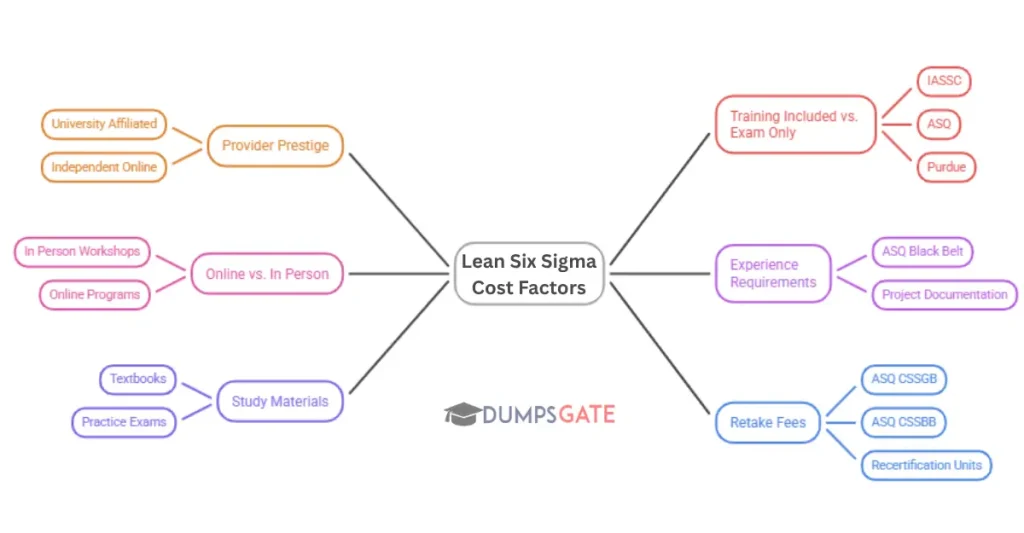
1. Provider Prestige
University affiliated programs (Purdue, Villanova, UC Davis) command higher prices due to brand recognition, alumni networks, and structured, faculty led instruction. Independent online providers trade prestige for accessibility.
2. Training Included vs. Exam Only
This is the single biggest cost driver. IASSC and ASQ charge only exam fees; you fund your own preparation. Programs from Purdue, Villanova, and UC Davis include full coursework.
3. Online vs. In Person
In person workshops typically cost more due to venue, facilitator, and travel overhead. Online programs reduce these costs significantly, which is why online Lean Six Sigma certification costs are almost always lower.
4. Experience Requirements and Project Documentation
ASQ’s Black Belt requires documented project work, which may entail an unpaid time commitment in addition to the exam fee. Some employers cover this as part of job duties; others do not.
5. Study Materials and Prep Resources
Textbooks, practice exams, and study guides can add $50–$300 to your total cost. ASQ’s Body of Knowledge (BOK) primer and third party prep books are commonly purchased separately.
6. Retake Fees
The cost of Lean Six Sigma certification doesn’t end with the exam fee charged by each provider. ASQ’s CSSGB and CSSBB credentials are not permanent. They must be renewed every three years, either by earning recertification units (RUs) through continuing education, professional activity, or documented work experience, or by retaking the exam. Recertification carries its own fee, typically in the $100–$150 range for non members (less for ASQ members). A Real, ongoing cost that most first time cost comparisons omit entirely.
IASSC and CSSC certifications, by contrast, generally do not expire, which matters if you’re weighing total cost of ownership over a career rather than just the upfront fee.
Beyond the Sticker Price: Hidden & Soft Costs
The listed exam or program fee is rarely the full cost. Budget for:
- Study materials — ASQ’s Body of Knowledge primer and third party prep books, typically $50–$300
- Retake fees — $283–$385 for ASQ; comparable fees apply at IASSC
- Recertification — see above; a recurring cost for ASQ credential holders every three years
- Unpaid project time — ASQ’s Black Belt requires documented project work; if it’s not part of your paid job duties, that’s real time invested outside your salary
- Travel and venue costs — in person capstones or workshops in high cost metros run 15–30% above online equivalents
- ASQ membership — joining saves ~$100 on exam fees, but only nets out in your favor if you’re not already paying membership dues for another reason
How to Maximize Your Lean Six Sigma Investment
Ask Your Employer First
Many organizations, particularly in manufacturing, healthcare, and logistics, sponsor Lean Six Sigma certification as part of employee development. Before spending your own money, confirm whether your employer has a reimbursement policy or preferred training vendor.
Join ASQ Before Sitting the Exam
ASQ members save approximately $100 on initial exam fees. If you plan to pursue multiple certifications or use ASQ’s learning resources, the membership fee often pays for itself.
Bundle Courses When Possible
Purdue’s 3 Course Package saves $805 compared to the cost of individual courses. University programs frequently offer tiered packages; always compare the bundle cost before purchasing à la carte.
Use Official Body of Knowledge (BOK) Materials
For ASQ exams, align your study directly with the official ASQ Body of Knowledge. Third party prep books are helpful supplements, but the BOK is the definitive exam blueprint. Misaligned study materials are a leading cause of first attempt failures.
Pass on the First Attempt
Retake fees are not trivial; ASQ charges $283–$385 per retake. Invest in adequate preparation time upfront. Most practitioners recommend 80–120 hours of study for the Green Belt, and 120–200 hours for the Black Belt.
Consider the CSSC Path for Initial Credentialing
If you want to build foundational knowledge before committing to ASQ exam fees, CSSC’s $195 Green Belt credential provides structured study at a fraction of the cost. Some professionals use it as a stepping stone while accumulating the project experience needed for ASQ’s prerequisites.
Which Six Sigma Certification Is Most Recognized?
This is one of the most debated questions in professional forums, and for good reason. There is no universally mandated certification, so employer preferences vary by industry, company size, and geography.
That said, the community consensus and employer data point clearly:
- ASQ (American Society for Quality) is the most recognized Lean Six Sigma certification body in the United States. Its CSSGB and CSSBB are the benchmarks in quality intensive fields such as manufacturing, aerospace, pharmaceuticals, and healthcare.
- IASSC is the leading independent international body and is respected for its rigor (closed book, no prerequisites, proctored exams). It does not offer training, which reinforces its credibility as a neutral assessment provider.
- CSSC is widely available and affordable, but some employers in competitive industries may prefer ASQ or IASSC credentials when reviewing candidates head to head.
The Reddit community (r/SixSigma) offers a nuanced perspective here. A frequently cited viewpoint is that employers in large enterprises, particularly in manufacturing and supply chain, specifically look for ASQ credentials, while smaller organizations or those new to process improvement are less discerning about the issuing body. One thread on r/ChemicalEngineering noted that “most companies will pay for it if they see fit”. A reminder that employer sponsorship often determines which provider you’ll use anyway.
Practical recommendation: if your employer isn’t specifying a provider, pursue ASQ. If cost is the primary constraint, IASSC is a credible second option.
More Detail: Which Six Sigma Certification Is Most Recognized? (2026 ASQ vs IASSC vs CSSC Verdict)
Which Six Sigma Certification Is Best for You?
There’s no single “best” answer; it depends on who’s paying and what you need the credential to do.
- Self funding, cost is the primary constraint: CSSC. Lowest barrier to entry, no prerequisites, scales from free to $295.
- Employer is sponsoring: ASQ. It’s the most recognized U.S. credential; let sponsorship absorb the higher $483–$585 exam fee rather than defaulting to the cheapest option.
- Want the credential fast, no bundled training: IASSC. A straight exam voucher with no coursework requirement and no employer preference politics to navigate.
- Want university brand weight for a resume or promotion case: Purdue (Black Belt, $3,750) or Villanova (full path, ~$7,000). You’re trading cost for prestige and structured live instruction.
- New to process improvement, not sure it’s the right fit yet: CSSC or MSI Certified Yellow Belt. Near-free, low risk way to test the discipline before committing real money.
Six Sigma Certification Salary and ROI
The financial case for Lean Six Sigma certification is well supported by current salary data.
| Belt Level | Average Annual Salary (US, 2026) |
|---|---|
| Green Belt | ~$85,000–$128,000 |
| Black Belt | ~$95,000–$147,000 |
| Master Black Belt | ~$100,000–$180,000+ |
According to Lightcast labor market data, Black Belt professionals can earn up to $119,700 annually, with earnings varying by industry, geography, and years of experience. Master Black Belts in high cost markets such as California, New York, and Texas frequently reach the upper end of the $100,000–$135,000 range.
To calculate ROI: a Green Belt certification through ASQ costs approximately $700–$1,000 all in, including prep materials. If it results in even a $5,000–$10,000 annual salary increase, which is conservative based on market data, the payback period is less than three months.
A Black Belt path via Purdue at $3,750 becomes ROI positive in under six months if it enables a move into a role paying $20,000–$30,000 more annually. The math is favorable at virtually every belt level.
Is Lean Six Sigma Certification Worth the Cost?
The answer comes down to where you are in your career, which body you certify with, and whether you back the credential with real project experience. A $585 ASQ Black Belt exam, combined with documented DMAIC project work and a salary trajectory toward $110,000+, is one of the cleaner ROI calculations in professional certification. A $99 online credential with no practical application and no employer recognition is a different story.
Lean Six Sigma certification is a proven tool for career advancement in process improvement fields. The key is choosing the right provider for your goals, not just the cheapest option available. Start by confirming your employer’s preferences, researching the ASQ or IASSC path appropriate to your belt level, and invest in preparation that maximizes your first attempt pass rate. Before you pay for anything, confirm whether your employer already sponsors a preferred provider; that single check eliminates the most common overspend in this category.
Frequently Asked Questions
How much does Lean Six Sigma Green Belt certification cost in 2026?
Lean Six Sigma Green Belt certification costs range from $195 (CSSC exam only) to approximately $3,000 for training inclusive university programs.IASSC Green Belt exam voucher ~$295–$402. ASQ $483 (non member). UC Davis offers a comprehensive Green Belt program for $2,195 starting October 2026.
How much does Lean Six Sigma Black Belt certification cost?
Black Belt certification costs range from $295 (CSSC exam only) to $7,000 or more for full training programs. ASQ’s CSSBB exam fee is $585 for non members. Purdue University’s online Black Belt program costs $3,750, and Villanova’s full certification path totals approximately $7,000.
Which Lean Six Sigma certification is most recognized by US employers?
ASQ (American Society for Quality) is the most recognized Lean Six Sigma certification body in the United States. Its CSSGB and CSSBB credentials are considered benchmarks in quality intensive industries such as manufacturing, healthcare, and aerospace. IASSC is the leading independent international body and is widely respected as a rigorous, neutral credentialing organization.
Can I get Lean Six Sigma certified for free?
CSSC (Council for Six Sigma Certification) offers a free White Belt certification. Yellow Belt is available for $99. Free White Belt courses are also offered by some online platforms, though these carry limited employer recognition. Meaningful credentials, Green Belt and above, require payment of exam fees to recognized bodies.
How long does it take to get Lean Six Sigma certified?
The timeline depends on the belt level and study pace. Green Belt programs typically run 4–8 weeks for structured courses, or longer for self paced study. Black Belt programs range from 12 weeks (accelerated, instructor-led) to 6+ months for self study paths requiring project documentation. Villanova’s full certification path spans approximately 24 weeks.
Is Lean Six Sigma certification worth it for salary growth?
Yes, for professionals in operations, quality, or process improvement roles. Green Belt holders earn approximately $85,000 annually. Black Belt professionals earn $95,000–$119,700, with senior roles reaching higher. Master Black Belt salaries range from $100,000 to $135,000. The ROI on certification costs is typically realized within months of a salary increase or promotion.
Do employers care which Lean Six Sigma certification body you use?
In large enterprises and quality intensive industries, yes, the employer preference for ASQ is well documented. Smaller organizations tend to be less selective. The key risk with budget providers is that a credential from an unrecognized body may not differentiate you from uncertified candidates in competitive hiring situations. When in doubt, pursue ASQ or IASSC.
How much does Lean Six Sigma certification cost in India?
In India, Lean Six Sigma certification costs approximately ₹20,000–₹40,000 INR (roughly $240–$480 USD) through local providers. Professionals can also access CSSC and IASSC at standard USD pricing through their online portals.
Can my employer pay for my Lean Six Sigma certification?
Employer sponsorship is common, particularly in manufacturing, logistics, healthcare, and finance. Many organizations view Lean Six Sigma training as a direct investment in operational efficiency. Before self funding, check whether your employer offers a tuition reimbursement policy or has a preferred training partner.
What is the difference between CSSC and ASQ Six Sigma certifications?
CSSC is a low cost, self paced online provider with no formal prerequisites or project requirements. ASQ requires documented work experience and project completion at the Black Belt level, and its exams are more rigorous. ASQ certifications are more widely recognized by US employers, particularly in quality and manufacturing sectors. CSSC is a viable starting point for foundational knowledge, but ASQ is the stronger career credential in competitive markets.
Does Lean Six Sigma certification expire?
ASQ’s CSSGB and CSSBB credentials require recertification every three years through continuing education units or a retake exam, plus a recertification fee. IASSC and CSSC certifications generally do not expire.
Are Udemy or Coursera Lean Six Sigma certificates recognized by employers?
Udemy and Coursera courses are useful for self study and can cost as little as $10–$80, but they issue certificates of completion, not accredited certifications from ASQ or IASSC. Employers in quality intensive industries generally weight ASQ or IASSC credentials more heavily use marketplace courses as exam prep, not as a substitute for the credential itself.