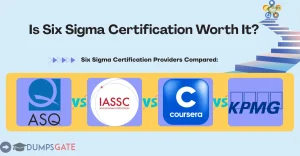
Straight answer: ASQ’s Certified Six Sigma Black Belt (CSSBB) is the most widely recognized Six Sigma certification, especially in the United States. It is accredited by ANAB (ANSI National Accreditation Board) under ISO/IEC 17024, requires verified project experience instead of just an exam, and is the default requirement listed in most US Black Belt job postings.
- Difficulty: High (4.5/5) broad Body of Knowledge, statistics-heavy, plus a mandatory documented workplace project
- Estimated pass rate: 50–70% on first attempt (ASQ does not publish an official figure; this range is aggregated from training-provider data)
- Prep reality: 100–150 hours of study, plus 3–6 months total to complete and document a qualifying project
If you need certification faster or don’t have an employer-sponsored project to reference, IASSC’s Certified Lean Six Sigma Black Belt is the strongest vendor-neutral alternative: no experience requirement, pure exam, internationally standardized curriculum, and typically recognized wherever ASQ is accepted outside the US.
Quick-Answer Comparison: ASQ vs IASSC vs CSSC
| Factor | ASQ | IASSC | CSSC |
|---|---|---|---|
| Full name | American Society for Quality | International Association for Six Sigma Certification | Council for Six Sigma Certification |
| Accreditation | ANAB, ISO/IEC 17024 | Independent, vendor-neutral standard | Not ANAB/ANSI accredited |
| Experience required | Yes (Black Belt only) | No | No |
| Belts offered | Green, Black, Yellow, Master Black Belt | Yellow, Green, Black | White, Yellow, Green, Black, Master Black Belt |
| Difficulty | High | Moderate–High | Low–Moderate |
| Recertification | Every 3 years (PDUs) | Does not expire | Varies by belt |
| Best recognized in | USA, large enterprise, government/defense | Global, vendor-neutral roles | Entry-level, small-to-midsize business |
What Is Six Sigma?
Six Sigma is a data-driven process improvement methodology built around DMAIC (Define, Measure, Analyze, Improve, Control). It originated at Motorola in 1986 and was popularized by General Electric in the 1990s. “Lean Six Sigma” merges this framework with Lean waste-reduction principles; nearly all current certification exams (ASQ, IASSC, CSSC) test both in a single credential.
The Best Six Sigma Certification Organizations Compared
ASQ (American Society for Quality)
ASQ is the oldest and one of the most respected quality organizations in the field, founded in 1946. Its Six Sigma certifications are accredited by ANAB under ISO/IEC 17024, making them among the most widely recognized credentials for quality and process improvement professionals.
- Certified Six Sigma Yellow Belt (CSSYB): Designed for professionals who are new to Six Sigma or support improvement initiatives. No education or work experience is required. The computer-based exam consists of 90 multiple-choice questions (80 scored) and has a 2-hour 18-minute time limit. Exam fee: $334 (ASQ members) / $434 (non-members).
- Certified Six Sigma Green Belt (CSSGB): Intended for professionals who analyze quality problems and contribute to improvement projects under the guidance of a Black Belt. Candidates are generally expected to have at least three years of full-time work experience in one or more areas of the Green Belt Body of Knowledge. Exam fee: $383 (ASQ members) / $483 (non-members).
- Certified Six Sigma Black Belt (CSSBB): Designed for experienced professionals who lead cross-functional improvement projects. Eligibility requires either two completed Six Sigma projects with signed affidavits, or one completed project plus three years of paid work experience in one or more areas of the Body of Knowledge. Exam fee: $485 (ASQ members) / $585 (non-members).
- Certified Master Black Belt (CMBB): ASQ’s highest Six Sigma credential for senior practitioners who mentor Black Belts, guide organizational strategy, and lead enterprise-wide continuous improvement programs. Candidates must hold an active ASQ CSSBB certification, complete a portfolio review, and pass the CMBB examination. Fees: Portfolio Review – $700 (members) / $800 (non-members); Exam – $1,499 (members) / $1,599 (non-members).
IASSC (International Association for Six Sigma Certification)
IASSC is a vendor-neutral certifying body; it doesn’t teach courses itself, but sets a standardized Body of Knowledge that training providers worldwide build curricula around.
- Yellow Belt (ICYB): ~40 questions, entry-level. Typical fee: $289 for on-demand web-based
- Green Belt (ICGB): 100 questions, 3-hour limit, 70% pass mark. Typical fee: $402 for on-demand web-based.
- Black Belt (ICBB): 150 questions, 4-hour limit, 580/750 (~77%) pass mark. Typical fee: $516 for on-demand web-based.
- No project or work experience requirement at any level. A pure knowledge-based exam.
CSSC (Council for Six Sigma Certification)
Is CSSC Six Sigma recognized? Yes, by many employers but with an important caveat. CSSC is a legitimate, established private certifying body, but it is not ANAB/ANSI-accredited as ASQ is, and it lacks IASSC’s independent, vendor-neutral role in standard-setting. It’s widely accepted for entry-level roles, small- to midsize business hiring, and self-directed career development, but it carries less weight than ASQ or IASSC in enterprise HR screening, government contracting, and regulated industries (aerospace, defense, pharma).
- Offers the widest belt range of the three: White, Yellow, Green, Black, and Master Black Belt.
- No experience requirement at any level.
- Frequently bundles free self-paced training with a paid certification exam, a major reason it ranks for “free Six Sigma certification” searches.
- Choose CSSC if you want low-cost exposure to Six Sigma concepts and are supplementing a stronger credential or an employer-sponsored program.
- Avoid CSSC if you are targeting senior quality roles, regulated industries (healthcare, aerospace, defense), or employers that explicitly ask for ANAB-accredited or ISO 17024-compliant certifications.
Six Sigma Belts Order: From White to Master Black Belt
Six Sigma uses a belt hierarchy, adapted from martial arts, to denote proficiency levels. According to ASQ, the recognized roles are:
- White Belt: Understands basic Six Sigma concepts; supports local problem-solving teams
- Yellow Belt: Participates as a project team member; reviews process improvements
- Green Belt: Leads Green Belt projects; assists Black Belts with data collection and analysis
- Black Belt: Leads complex improvement projects; trains and coaches project teams
- Master Black Belt: Develops key metrics and strategic direction; trains and coaches Black Belts and Green Belts
Note: Some providers advertise an “Orange Belt” or “Brown Belt.” Neither is recognized by ASQ, IASSC, or most enterprise employers. ASQ explicitly states the Brown Belt is not used in standard Six Sigma and is not recognized by most accrediting agencies.
Not everybody certifies every belt:
| Belt | ASQ | IASSC | CSSC |
|---|---|---|---|
| White | No | No | Yes |
| Yellow | Yes | Yes | Yes |
| Green | Yes | Yes | Yes |
| Black | Yes | Yes | Yes |
| Master Black Belt | Yes | No | Yes |
Six Sigma Certification Cost Breakdown (2026)
| Belt | ASQ | IASSC | CSSC |
|---|---|---|---|
| White Belt | Not offered | Not offered | Free |
| Yellow Belt | $334 (ASQ members) / $434 (non-members). | $289 | $99 |
| Green Belt | $383 (ASQ members) / $483 (non-members) | $402 | $195 |
| Black Belt | $485 (ASQ members) / $585 (non-members) | $516 | $295 |
| Master Black Belt | Portfolio Review – $700 (members) / $800 (non-members); Exam – $1,499 (members) / $1,599 (non-members). | Not offered | +$750 |
Explore what it takes to earn the six sigma certifications: How Much Does The Six Sigma Certification Cost In 2026? {A Detailed Analysis}
Accredited Lean Six Sigma Certification: What Accreditation Actually Means
“Accredited” has a specific meaning that most competing articles skip:
- ANAB / ISO 17024: ASQ’s Six Sigma certifications are accredited under this personnel certification standard, meaning an independent third party audits ASQ’s exam development, security, and governance processes.
- ISO 13053: This is the actual international standard for Six Sigma methodology (“Quantitative methods in process improvement — Six Sigma,” parts 1 and 2). No single certifying body owns it, but ASQ and IASSC curricula both align closely with it.
- IASSC and CSSC are not ANAB-accredited; their credibility rests on adoption by training providers and employers rather than third-party accreditation.
In practice, “accredited Lean Six Sigma certification” in the strict sense currently refers only to ASQ.
Best Six Sigma Certification Online: Free and Paid Options (2026)
Free options exist, but they carry the limitations you would expect.

Free options:
- CSSC White Belt: Free, online, no prerequisites. Useful for learning the basics. Not widely recognized by employers as a standalone credential.
- Six Sigma Online White Belt: Periodically offered at no cost. Similar scope to CSSC White Belt.
- Alison (Lean Six Sigma Green Belt course): Free course content with an optional paid certificate. The certificate itself is not the same as an IASSC or ASQ credential.
Paid options ranked by employer recognition:
- ASQ CSSBB {$485 (ASQ members) / $585 (non-members} — highest recognition, USA and Canada
- ASQ CSSGB {($383 (ASQ members) / $483 (non-members)} — strong mid-level credential
- IASSC ICBB ($516) — strong global option, no prerequisites
- IASSC ICGB ($402) — accessible international alternative
- ASQ CSSYB ($434) — solid entry point with ANAB backing
- CSSC Black Belt ($295) — low cost, limited enterprise recognition
Training costs (prep courses, study guides, question banks) are separate from exam fees and can add several hundred to several thousand dollars depending on the provider and format.
Read more: How Much Does Lean Six Sigma Certification Cost in 2026?
Global Recognition at a Glance
| Country | Most Recognized Body | Context |
|---|---|---|
| USA | ASQ | Headquartered in the US; default standard in manufacturing, healthcare, defense, aerospace |
| Canada | ASQ / IASSC (roughly equal) | No separate Canadian Six Sigma body; hiring standards largely mirror the US |
| UK | IASSC / ASQ (secondary to CQI) | Chartered Quality Institute (CQI) and ISO 13053 alignment carry more domestic weight than any single Six Sigma vendor |
| India | ASQ / IASSC | Strong presence in IT, BPO, manufacturing, and pharma; IASSC and CSSC popular for lower cost relative to ASQ’s US-based fees |
| Australia | ASQ / IASSC | No domestic accrediting body; concentrated in mining, manufacturing, healthcare, and government |
Delve into the details of: Six Sigma vs Agile: Choosing the Right Path for Your IT Career
Which Six Sigma Certification Is Most Recognized in Canada?
ASQ and IASSC are recognized roughly equally across Canadian employers. There is no separate Canadian Six Sigma accrediting body, so hiring standards and recruiter expectations largely mirror the US market, with ASQ carrying slightly more weight in large manufacturing and government-linked organizations.
Which Six Sigma Certification Is Most Recognized in the UK?
IASSC and ASQ are both accepted by UK employers, particularly multinational corporations, but neither dominates the way ASQ does in the US. Domestic UK quality-management hiring leans more heavily on the Chartered Quality Institute (CQI) and alignment with the ISO 13053 standard than on any single Six Sigma vendor certification.
Which Six Sigma Certification Is Most Recognized in India?
ASQ and IASSC are the most widely recognized certification bodies in India’s IT, BPO, manufacturing, and pharmaceutical sectors. IASSC and CSSC see additional popularity here specifically because their exam fees are significantly lower than ASQ’s US-based pricing, making them more accessible to individual professionals paying out of pocket.
Which Six Sigma Certification Is Most Recognized in Australia?
ASQ and IASSC are both accepted across Australian manufacturing, mining, healthcare, and government-sector employers, with no strong preference for one over the other. Australia has no domestic Six Sigma accrediting body, so employer recognition follows the same US/IASSC vendor split as in Canada.
What Do Professionals Actually Say? (Reddit & Industry Consensus)
Across professional forums such as r/sixsigma, r/leansixsigma, and r/humanresources, recurring themes show up consistently:
- ASQ is repeatedly described as the “resume-safe” choice for US-based Black Belt roles, largely due to name recognition among HR screeners and hiring managers.
- IASSC is the fastest, most cost-effective way to demonstrate technical knowledge without requiring an employer-sponsored project.
- CSSC is frequently debated and accepted by many for entry-level and small-business roles, but questioned by senior quality managers who prioritize ANAB accreditation.
- A recurring point across all three: employers increasingly verify practical project experience and interview competency over which logo appears on the certificate.
Which Certification Should You Choose? Decision Framework
| Who You Are | Recommended Path | Why |
|---|---|---|
| Student / no work experience | IASSC Yellow or Green Belt | No experience requirement, standardized, fast, affordable |
| US professional targeting a promotion or resume strength | ASQ CSSBB | ANAB-accredited, verified project experience, most recognized by US hiring managers |
| Budget-conscious professional or career switcher | CSSC Green or Black Belt | Lowest cost entry point, self-paced, sufficient for small-business/generalist roles |
| Executive rolling out certification across a team | ASQ (leadership hires) + IASSC (team baseline) | ASQ credibility where it matters most; IASSC keeps team-wide certification cost-efficient |
| Professional working outside the US | IASSC | Vendor-neutral, no US-specific bias, consistently accepted internationally |
Learn more about: Six Sigma vs PMP: Choosing The Right Certification Path for Your IT Career
What to Know Before You Register
A few practical considerations that are often overlooked when comparing ASQ, IASSC, and CSSC certifications:
- ASQ exam scheduling: ASQ computer-based exams are delivered through Prometric. Online applications are typically reviewed within 1–2 business days, after which approved candidates receive an eligibility email to schedule their exam. Plan to arrive at the test center 30 minutes early for check-in.
- ASQ open-book policy: All ASQ certification exams are open-book. Reference materials must be permanently bound (such as spiral or ring binders). Hand-stapled or loose papers are not permitted, while Post-it notes may be used only as page tabs.
- IASSC exam delivery: IASSC certification exams are administered by authorized providers, including PeopleCert and approved proctors. Candidates can choose an authorized test center or an approved online proctored exam, depending on availability. No Six Sigma project or project affidavit is required to sit for the exam.
- CSSC exam delivery: The Council for Six Sigma Certification (CSSC) delivers its standard certification exams online through its own certification platform. Candidates complete the exam remotely after registering, with no mandatory project requirement for standard belt certifications. (This reflects CSSC’s official certification model.)
- Salary insight: According to ASQ’s most recent published Quality Progress Salary Survey (2020), U.S. respondents holding a Certified Six Sigma Black Belt (CSSBB) reported average salaries $15,761 higher than professionals without Six Sigma certification, while Master Black Belts reported an average premium of $26,123. Since ASQ has not published a newer certification-specific salary survey, these figures remain the latest official benchmark and should be interpreted as historical reference data rather than current 2026 salary averages.
FAQs
Which Six Sigma certification is most recognized by employers in the US?
ASQ’s Certified Six Sigma Black Belt (CSSBB) is the most recognized Six Sigma certification among US employers, particularly in manufacturing, healthcare, financial services, and government-related sectors. It holds ANAB accreditation under ISO 17024 and requires verified work experience plus a completed project.
Is IASSC Six Sigma certification recognized by employers?
Yes, IASSC certification is recognized by many employers, especially internationally. It is part of the PeopleCert portfolio and is available in 165 countries. IASSC is a better fit for candidates without work experience or those outside North America. It carries less weight than ASQ in US-based enterprise hiring but is genuinely credible in the global market.
Is CSSC (Council for Six Sigma Certification) recognized?
CSSC certification recognition varies by employer. CSSC does not hold ANAB accreditation under ISO 17024, which limits its standing in large enterprises and regulated industries. It is more commonly used in internal corporate training programs and by candidates building foundational knowledge before pursuing ASQ or IASSC credentials.
What is the easiest Six Sigma certification to get?
The CSSC White Belt is free and has no prerequisites or exam in the traditional sense. Among credentialed exams, the ASQ CSSYB has the highest pass rate (83% in 2024) and no work experience requirement. The IASSC Yellow Belt ($195, closed-book, 60 questions) is another accessible option with no prerequisites.
What is the difference between Six Sigma and Lean Six Sigma?
Six Sigma focuses on reducing process variation and defects using DMAIC and statistical tools. Lean focuses on eliminating waste and improving flow. Lean Six Sigma combines both methodologies. ASQ certifications cover both frameworks; IASSC certifications are explicitly titled “Lean Six Sigma.”
How long does it take to get Six Sigma certified?
Timeline depends on the certification level and your preparation approach. For the ASQ Green Belt or Black Belt, you must meet the work experience requirement first (minimum of 3 years). Exam preparation typically takes 4–12 weeks of dedicated study. For IASSC, there are no experience prerequisites; preparation time alone determines your readiness.