The JNCIA certification, officially Junos Associate (JNCIA-Junos), is Juniper’s entry-level networking credential. You earn it by passing one exam, JN0-106: 65 multiple-choice questions in 90 minutes through Pearson VUE, with no prerequisite. A full-price voucher is $200, a free Juniper course can cut that to $50, and the credential stays active for three years.
JNCIA-Junos at a glance
Juniper’s pages now carry HPE branding (the HPE Juniper Networking Certification Program), but the certification name is unchanged. These details come from Juniper’s JNCIA-Junos certification overview:
| Detail | JNCIA-Junos |
|---|---|
| Exam code | JN0-106 |
| Questions | 65 multiple-choice |
| Time | 90 minutes (about 83 seconds per question) |
| Language | English only |
| Software version | Junos OS 21.2 |
| Prerequisite | None |
| Delivered by | Pearson VUE, test center or online |
| Result | Pass or fail shown right after the exam |
| Passing score | Not published by Juniper |
| Validity | Three years |
| List voucher price | $200 (USD) |
What changed: JN0-105 to JN0-106
Juniper’s JNCIA-Junos exam change announcement states that JN0-105 reached end of life on April 5, 2026, and JN0-106 launched on April 6, 2026. JN0-105 itself lasted just over two years: it replaced JN0-104 on January 29, 2024.
Two practical effects:
- If you already passed JN0-105, nothing changes. Juniper’s policies say credentials from retired exams stay valid for their normal three-year lifespan.
- Study material ages fast. Older guides describe the same 65-question, 90-minute format, so a JN0-105 resource can look current. Check the code on every book, course, or practice test before you trust it.
What does the JN0-106 exam cover?
Juniper lists seven objective areas and says exam questions are derived from its recommended training. The table maps each objective to the modules in Juniper’s free Open Learning course that teach it. The mapping is ours, built from Juniper’s own module descriptions, so you can study objective by objective.
| Exam objective | What it tests | Free course modules that cover it |
|---|---|---|
| Networking Fundamentals | Collision and broadcast domains, Ethernet, IPv4 and IPv6, subnetting, binary conversion, longest match routing | Refreshers on IPv6, cables and Ethernet, IPv4 and subnetting, switching and VLANs, TCP and UDP |
| Junos OS Fundamentals | Software architecture, control and forwarding planes, transit and exception traffic | Junos OS Architecture (control and data plane; software) |
| User Interfaces | CLI modes and navigation, filtering output, active vs. candidate configuration, rollback, J-Web | SSH and Operational Mode; Reading a Junos OS Configuration; Configuring Junos OS (basics and power user); J-Web |
| Configuration Basics | Factory-default state, initial setup, user accounts, login classes, authentication, NTP, SNMP, syslog, rescue configuration | Setting Up a Brand-New Junos OS Device; Device Administration (and deeper dive); Configuration deeper dive |
| Operational Monitoring and Maintenance | Show and monitor commands, interface errors, ping and traceroute, upgrades, root password recovery | Logging, Troubleshooting, and Monitoring (and deeper dive); Upgrading Junos OS |
| Routing Fundamentals | Routing vs. forwarding tables, route preference, routing instances, static routing | Routing Tables and Longest Prefix Matches; Static Routes; Dynamic Routing Protocols; Routing deeper dive |
| Routing Policy and Firewall Filters | Import and export policies, policy terms and match criteria, firewall filters, unicast RPF | Firewall Filters (theory, practical, deeper dive); Junos OS Routing Policy |
How hard is the JNCIA certification test?
It is an associate exam, but it is not a vocabulary test. If you already work with routers and switches, the new material is mostly Junos syntax and the candidate-configuration and commit model. If you are new to networking, subnetting, routing tables, and firewall filter logic take the most time, so start with the fundamentals before the Junos-specific modules.
Take a closer look: Juniper Careers in 2027: Jobs, Pay and the Certification Path After HPE
JNCIA certification requirements
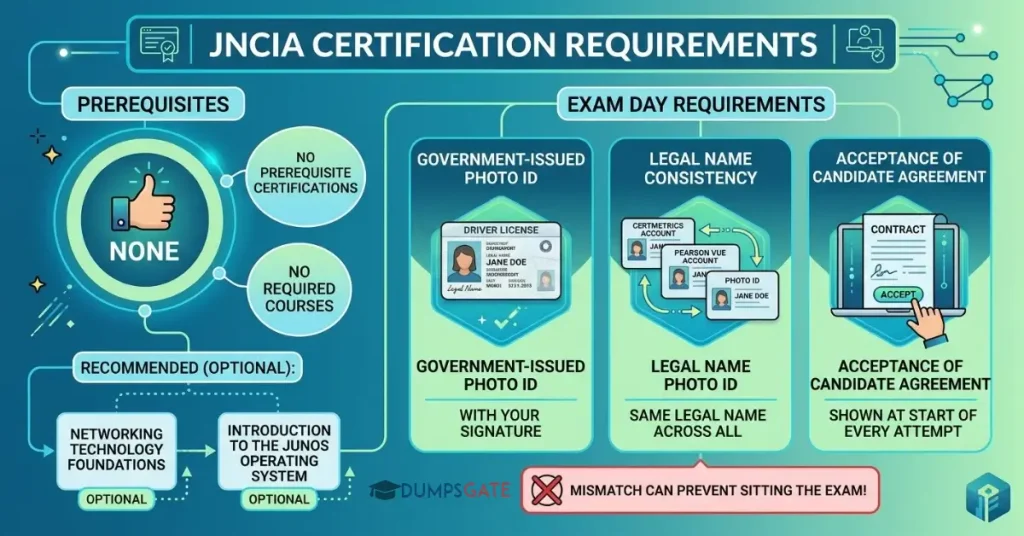
There is no prerequisite certification and no required course. Juniper recommends Networking Technology Foundations and Introduction to the Junos Operating System, but says both are optional.
What you do need on exam day, according to Juniper’s JNCIA certification requirements and program policies:
- A government-issued photo ID with your signature.
- The same legal name on your CertMetrics account, your Pearson VUE account, and your ID. A mismatch can stop you from sitting the exam.
- Acceptance of the candidate agreement, shown at the start of every attempt.
How much does the JNCIA certification cost?
Juniper’s training credits page lists the JNCIA certification cost at $200 per Associate-level exam voucher. Here is what each route costs in practice:
| Route | Exam cost | Conditions |
|---|---|---|
| Full-price voucher | $200 | Test center or online |
| Juniper Open Learning | $50 (75% off) | Free course, score 70%+ on the voucher assessment, online exam only |
| All-Access Training Pass | Included | One 100% voucher, valid 12 months, bundled with a paid year of courses |
| Fail once, then pass, at full price | $400 | Two $200 vouchers |
| Fail once, then pass, Open Learning first | $250 | $50 voucher, then a $200 retake (one voucher per certification) |
Is the JNCIA certification free?
The training is free; the exam is not, unless an All-Access Pass or an employer covers it. Juniper’s free JNCIA certification course costs $0 and includes six months of access, but virtual labs are not included. Its 38 listed modules add up to about 40 hours (2,413 minutes) of material.
The voucher rules, set out in Juniper’s Open Learning terms:
- You must be 18 or older and finish all required modules.
- You get three attempts at the voucher assessment test. Launching it and exiting counts as an attempt, even with no answers.
- The promotion runs 60 days from your course registration.
- The voucher is valid for 30 days and works only for online-proctored delivery.
- One voucher per certification, with no extensions or replacements.
In short: do not open the assessment until you can book the exam within 30 days.
Free labs for JNCIA practice
The free course has no labs, but Juniper offers two free ways to practice. Juniper vLabs runs browser-based sandbox topologies for anyone with a Juniper account; sessions default to three hours and can be extended to six. You can also run Juniper’s free virtual Junos images, including vJunos-switch and vJunos-router, on your own lab machine.
Can you earn the JNCIA certification online?
Yes. You can take the exam at a Pearson VUE test center or online through OnVUE, Pearson VUE’s online-proctored delivery. With an Open Learning voucher, online is your only option. OnVUE may use facial comparison to verify your identity; if you decline that, you must register by phone with Pearson VUE.
How to register
- Create an account on Pearson VUE’s Juniper exam registration page. If you have taken a Juniper exam before, use your existing CertMetrics ID.
- Choose JN0-106 and pick a test center or online delivery.
- Pay $200 or enter your voucher code.
- To cancel or reschedule, contact Pearson VUE at least one business day ahead. Changes inside 24 hours forfeit the fee, and so do no-shows.
What is the Juniper certification path after JNCIA?
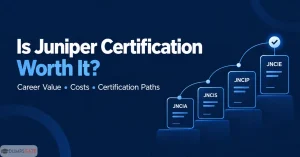
JNCIA-Junos is the Associate level for both the Enterprise Routing and Switching track and the Service Provider Routing and Switching track. Each track has four levels:
| Level | Enterprise track | Service Provider track | List price | Open Learning price |
|---|---|---|---|---|
| Associate | JNCIA-Junos (JN0-106) | JNCIA-Junos (JN0-106) | $200 | $50 |
| Specialist | JNCIS-ENT (JN0-352) | JNCIS-SP (JN0-364) | $300 | $75 |
| Professional | JNCIP-ENT | JNCIP-SP | $400 | $100 (CCNP or CCIE holders’ migration course) |
| Expert | JNCIE-ENT (8-hour lab) | JNCIE-SP (8-hour lab) | $1,600 | Not offered |
What the full path costs. At list prices, one track from JNCIA to JNCIE is $2,500 in exam fees ($200 + $300 + $400 + $1,600), assuming a first-attempt pass at each level. With Open Learning vouchers for JNCIA and JNCIS ($50 + $75), the first two levels drop from $500 to $125, which makes the track $2,125. Juniper’s Cisco-to-Juniper migration courses also offer a $100 JNCIP voucher (instead of $400) to candidates who hold CCNP or CCIE.
Path details that change planning:
- Both specialist exams require JNCIA-Junos and use the same 65-question, 90-minute format.
- The software baseline climbs fast: JNCIA lists Junos OS 21.2, JNCIS-ENT Junos 23.1, and JNCIS-SP Junos OS 25.2.
- JNCIE lab exams require an active Professional certification in the same track.
View the full breakdown: Juniper Certification Path 2027: 4 Levels, $200 to $1,600
Enterprise or Service Provider?
Pick the track that matches the network you work on, or want to. JNCIS-ENT adds Layer 2 switching, spanning tree, Layer 2 security, OSPF, IS-IS, BGP, and high availability. JNCIS-SP covers similar routing ground and adds MPLS, RSVP, LDP and segment routing. For campus and corporate networks, Enterprise is the sensible next step; for ISPs and carriers, Service Provider.
Other Juniper certifications also start at the Associate level: Security (JNCIA-SEC), Cloud, Automation and DevOps, Design, Mist AI and Data Center.
How does JNCIA renewal work?
Juniper’s recertification rules include three points that matter:
- Higher exams renew more than you’d expect. Passing an exam or taking a course at a higher level renews all lower-level active certifications in the same track and every other active Associate-level certification you hold.
- Expiry means starting over. If JNCIA-Junos lapses past three years, you cannot recertify at that level; you restart the track.
- Open Learning courses do not count for renewal. Only live instructor-led or On-Demand courses qualify.
So, if you earn JNCIS-ENT within three years of passing JNCIA, you renew your JNCIA and any other active associate certification.
Scoring and retake rules
Juniper does not publish passing scores. Juniper sets each exam’s passing score through statistical analysis, and your score report shows it after the exam. A passing result is provisional at first; valid results reach CertMetrics within three business days.
If you fail the first attempt, you can retake at any time. After a second failure, you wait 14 calendar days. Once you pass, you must wait at least 18 months before taking the same exam again.
Is the JNCIA certification worth it? Salary and jobs
The US Bureau of Labor Statistics does not track pay by certification. The closest official occupation is network and computer systems administrators (SOC 15-1244), and BLS’s occupational outlook for network administrators reports a median annual wage of $99,130 in May 2025, for 323,600 jobs. BLS projects employment in that occupation to decline 4% from 2025 to 2035.
Treat that as an occupation benchmark, not a JNCIA salary: the median covers administrators at all experience levels, and BLS lists a bachelor’s degree as the typical entry education. JNCIA is most useful as proof you can work on Junos devices, which matters most to service providers, data centers, and enterprises that already run Juniper equipment. It does not guarantee a job or a raise.
Explore this topic: Is Juniper Certification Worth It in 2027? An Honest Verdict by Role and Real Cost
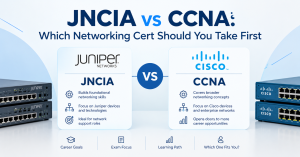
JNCIA certification vs CCNA
| JNCIA-Junos | CCNA (200-301) | |
| Exam fee | $200 | $300 |
| Lowest official price | $50 via Open Learning | $300 (Exam Safeguard Plus is $450 with a second attempt within 90 days) |
| Time | 90 minutes | 120 minutes |
| Prerequisite | None | None |
| Validity | Three years | Three years |
| Results | Pass or fail right away, finalized within three business days | Within 48 hours |
| Retake wait | None after first fail; 14 days after second | Five calendar days |
| Renewal | Pass a current or higher exam, or an approved course | Pass an exam, or earn 30 Continuing Education credits |
| Free official training | Open Learning course | Cisco Networking Academy |
How to prepare: a 5-step study plan
- Check your fundamentals. Juniper recommends Networking Technology Foundations first if you have no networking background.
- Work through the free course. Budget for about 40 hours of listed module time. The course is built on Junos OS Release 22.1R1.10, slightly newer than the exam’s 21.2, so expect minor output differences.
- Practice in a lab. Use vLabs or vJunos for configuration, commit, rollback, static routes, and firewall filters.
- Take a JNCIA certification practice test. Juniper’s official JNCIA-Junos practice exam allows unlimited attempts, shows explanations at the end, and uses a 70% pass mark that may differ from the live exam. Because its questions never change, a second high score proves memory, not readiness. Add a third-party practice test only if it maps to the JN0-106 objectives.
- Book within your voucher window. If you use Open Learning, schedule the exam as soon as you pass the voucher assessment.
Verdict: Should you get the Juniper JNCIA certification?
Get JNCIA-Junos if you work with, or are applying to, organizations running Juniper gear, or if you plan to climb a Juniper track. Take the free course and the $50 voucher route, but only open the voucher assessment once the practice exam feels easy, because a failed first attempt costs $200 to retake. Pay full price only if you need a test center. If you already hold CCNA, the migration course makes JNCIA a fast second credential.
FAQs
What is the JNCIA certification?
It is Juniper’s Associate-level credential for Junos OS, officially named Junos, Associate (JNCIA-Junos). It confirms you understand networking fundamentals and core Junos OS functions, and it starts the Enterprise and Service Provider routing tracks.
How much does the JNCIA certification cost?
Juniper lists Associate-level exam vouchers at $200. Through Juniper Open Learning, scoring 70% or higher on the voucher assessment test earns a 75% discount, bringing the exam to $50.
Is JN0-105 still available?
No. JN0-105 reached end of life on April 5, 2026, and JN0-106 replaced it on April 6, 2026. Certifications earned on JN0-105 stay valid for their three years.
How long does the JNCIA Junos certification last?
Three years. You can renew it by passing the current exam, passing a higher-level exam in the same track, or taking a qualifying instructor-led or On-Demand course.
What is the passing score for JN0-106?
Juniper does not publish passing scores. Juniper sets each exam’s passing score through statistical analysis, and your score report shows it after you finish.
Is JNCIA the Juniper equivalent of CCNA?
Broadly, yes. Both are vendor-specific associate networking certifications with no prerequisites and three-year validity; JNCIA covers Junos OS, CCNA covers Cisco platforms.
Can I take the JNCIA certification test at home?
Yes. Pearson VUE offers online-proctored delivery through OnVUE, and Open Learning vouchers work only for online exams.
Does JNCIA require hands-on labs?
The exam is multiple-choice, but many objectives describe configuring and monitoring Junos devices. Free vLabs sessions and vJunos images let you practice without buying hardware.