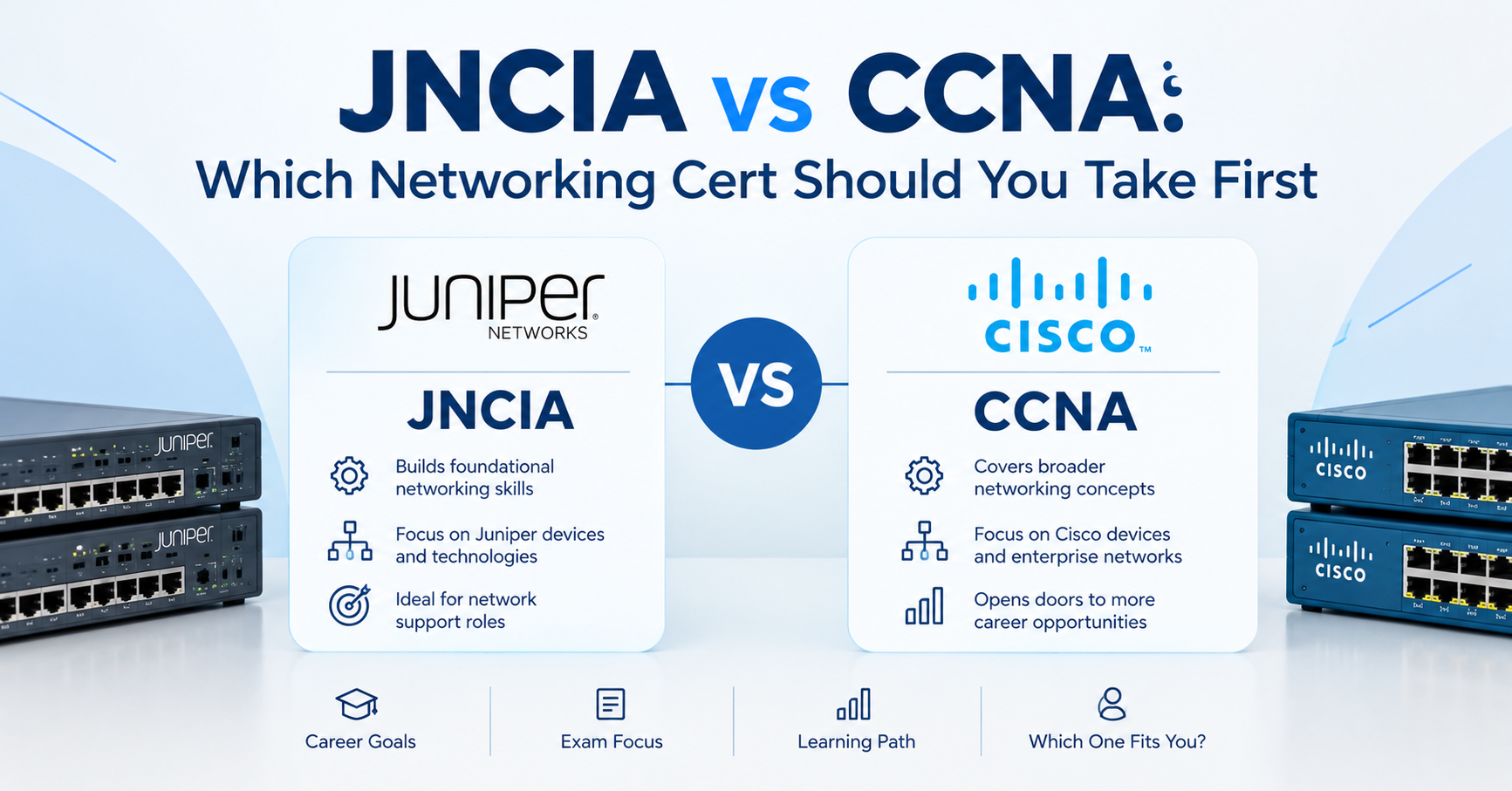
For most people, CCNA is the better first certification. It covers more ground, far more US job postings ask for it, and most postings that ask for JNCIA want CCNA as well. JNCIA-Junos is the better first pick in two cases: you’ll work on Juniper equipment at an ISP, telco or data center, or you already hold a CCNA and want a second vendor cheaply.
The three differences that decide it:
- Who hires for it: Cisco skills are requested across nearly all of US enterprise IT. Juniper skills cluster in service provider, cloud and data center networks, usually alongside Cisco.
- How hard it is: JNCIA is the easier, narrower exam. CCNA is broader, and it gets harder on February 3, 2027, when its new version adds more troubleshooting and an AI section.
- What it costs: JNCIA can cost as little as $50 through Juniper’s free training program, versus $300 for CCNA.
JNCIA Junos vs CCNA at a Glance
| JNCIA-Junos | CCNA | |
|---|---|---|
| Vendor and OS | HPE Juniper Networking, Junos OS 21.2 | Cisco, IOS XE |
| Current exam | JN0-106 (replaced JN0-105 in April 2026) | 200-301 v1.1 (v2.0 arrives February 2027) |
| List price | $200 | $300, or Cisco Learning Credits |
| Length | 90 minutes | 120 minutes |
| Questions | 65, all multiple choice | Count not published |
| Languages | English only | English, Japanese |
| Prerequisites | None | None |
Verified against Juniper’s JNCIA-Junos exam page, HPE Networking’s certification FAQ (exam fees) and Cisco’s 200-301 CCNA exam page.
On paper, the JNCIA certification vs CCNA gap is $100 and 30 minutes. The real differences are scope, question style and which employers care.
What Is the Actual Difference Between JNCIA and CCNA?
CCNA is broad. It tests switching, wireless, IP services, security, automation and, from 2027, AI-assisted network operations, all on Cisco IOS XE.
JNCIA-Junos is narrow and OS-deep. It tests networking fundamentals plus how Junos is built, configured and operated.
We mapped all seven official JNCIA domains against the official CCNA v2.0 blueprint, topic by topic:
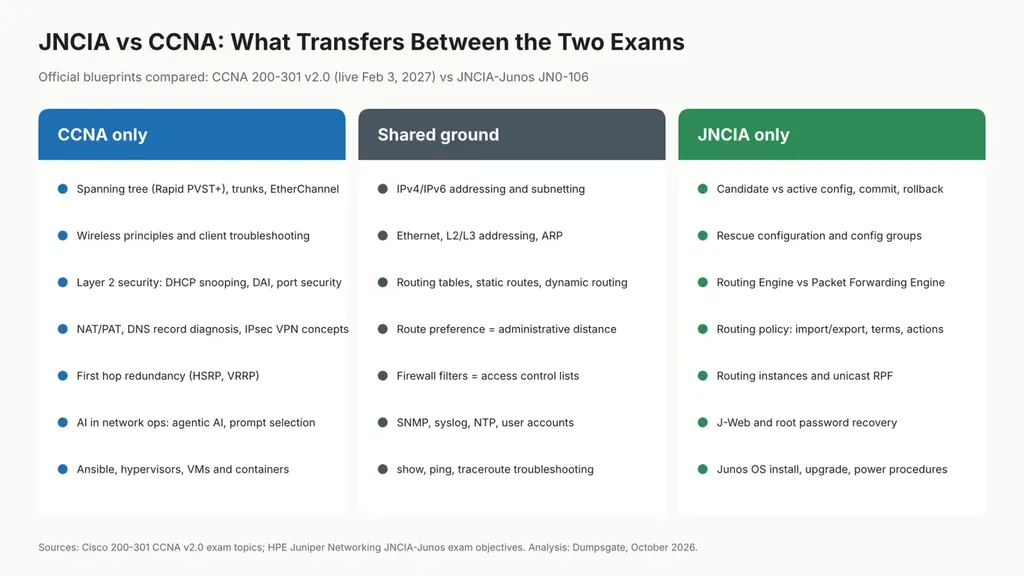
Dumpsgate analysis of the CCNA 200-301 v2.0 and JNCIA-Junos JN0-106 objectives, October 2026.
What the map shows:
- 3 of 7 JNCIA domains map directly onto CCNA material: Networking Fundamentals, Routing Fundamentals, and Operational Monitoring and Maintenance.
- 2 overlap partially: Configuration Basics (user accounts, SNMP, syslog and NTP appear in both) and Routing Policy and Firewall Filters (filters behave like ACLs, but routing policy has no CCNA equivalent).
- 2 are Junos-only: Junos OS Fundamentals and User Interfaces.
The practical takeaway: a CCNA holder starts with a head start on 5 of the 7 JNCIA domains. A JNCIA holder moving to CCNA still faces most of CCNA’s switching, wireless, security and AI content.
Is JNCIA Easier Than CCNA? (JNCIA vs CCNA Difficulty)
Yes, and the official documents show why.
| Difficulty factor | JNCIA-Junos | CCNA |
|---|---|---|
| Objective verbs | Every domain uses “identify” or “describe” | v2.0: 8 of 29 top-level objectives say “troubleshoot” or “diagnose,” and 8 more say “configure” |
| Official instructor-led course | 4 days (Introduction to the Junos Operating System) | 5 classroom days plus about 3 days of self-study |
| Where candidates struggle | The commit model and routing policy | Breadth, plus hands-on troubleshooting |
| Dumpsgate difficulty rating | 2 / 5 | 3.5 / 5 now, 4 / 5 from February 3, 2027 |
| Typical prep time (our estimate, 6 to 8 hours a week) | 4 to 6 weeks with networking basics, 8 to 10 weeks from zero | 8 to 12 weeks with networking basics, 4 to 6 months from zero |
Our rating and prep estimates follow from the rows above: Cisco’s official training load is roughly double Juniper’s, and CCNA covers whole domains JNCIA never touches.
For a CCNA-only breakdown, see how hard CCNA is in 2026.
Why Does CCNA Get Harder on February 3, 2027?
Cisco has confirmed that the last day to test on CCNA v1.1 is February 2, 2027, and v2.0 goes live on February 3, 2027. The exam code stays 200-301.
The official v2.0 exam topics reorganize CCNA into five domains:
| CCNA v2.0 domain | Weight |
|---|---|
| Network Infrastructure and Connectivity | 25% |
| Switching and Network Access | 25% |
| IP Routing | 20% |
| Network Services and Security | 20% |
| AI, and Network Operations and Management | 10% |
The same document says candidates may need to evaluate output and recommendations from agentic AI and digital network assistants. Knowing a command is no longer enough; you must find what’s broken.
JNCIA is unaffected. JN0-106 only launched in April 2026, so its blueprint is stable for now.
Should You Book CCNA Now or Wait for v2.0?
As of October 28, 2026, 97 days (about 14 weeks) remain before the v1.1 cutoff.
- Ready within about 10 weeks: book v1.1 and leave a buffer for one retake.
- Starting from zero: study the v2.0 topics now. You will not finish before the cutoff, and v1.1 material underweights troubleshooting.
- Either way: both versions earn the same CCNA certification.
How Do Scoring, Retakes and Renewal Compare?
| JNCIA-Junos | CCNA | |
|---|---|---|
| Pass rate published | No | No |
| Passing score | Set per exam by statistical analysis and not published | Not published |
| Retake after a fail | First retake anytime; 14-day wait after the second and later fails | 5-day wait |
| Retake the same exam after passing | 18 months | 180 days |
| Validity | 3 years | 3 years |
| Renewal options | Pass the current exam, a higher-level exam in the track, or a qualifying course | Retake the exam, pass a higher-level exam, or earn 30 CE credits |
| Renewal bonus | A higher-level exam also renews all other active associate certs | CE credits come from training, including Cisco U. learning paths |
| If it expires | Restart the track from the beginning | Complete the full exam process again |
Sources: HPE Juniper certification policies, HPE Juniper recertification options and Cisco’s recertification policy.
Plan renewal early. JNCIA blocks you from resitting the same exam for 18 months after a pass, so plan to renew through a higher-level Juniper exam or a qualifying course, or schedule the retake after month 18.
What Does JNCIA vs CCNA Cost Over Three Years?
The cheapest legitimate JNCIA exam cost is $50. Through Juniper Open Learning, the training is free, and scoring 70% or higher on the voucher assessment test earns a 75% discount. You must schedule and sit the exam within 30 days of receiving the voucher.
CCNA has no comparable discount. Cisco’s Exam Safeguard option buys you a second attempt rather than a lower price. Here is total exam spend across a full three-year cycle:
| Scenario | JNCIA-Junos | CCNA |
|---|---|---|
| Pass first time at list price | $200 | $300 |
| Pass first time, cheapest route | $50 | $300 |
| Fail once, then pass (retake at list price) | $400 | $600 |
| Renew by retaking the same exam | +$200 | +$300 |
| Renew by passing the next level up | +$75 (JNCIS via its Open Learning voucher) | CCNP core exam |
| Renew without an exam | Qualifying course (paid) | 30 CE credits (cost depends on the activity) |
| Lowest realistic 3-year spend | $125 ($50 JNCIA + $75 JNCIS, which also renews JNCIA) | $300 plus CE activity costs |
The cheapest JNCIA path is also the most useful one: Juniper’s specialist-level Open Learning vouchers cut JNCIS exams to $75, and passing a higher-level exam in the track renews your JNCIA automatically. You end the cycle with two certifications instead of one.
Exam fees are only part of the bill. Labs are free for both: Juniper vLabs (covered below) and the free tier of Cisco Modeling Labs, which Cisco links from its exam page.
JNCIA vs CCNA Salary: Which Pays More?
Neither does, on its own. No authoritative US dataset tracks pay by certification. Pay follows the role, the metro area, and your experience.
The benchmark that matters is the job. According to the U.S. Bureau of Labor Statistics, network and computer systems administrators earned a median $99,130 in May 2025. The lowest 10% earned under $62,640 and the highest 10% over $155,050. Computer network architects, the usual next step, earned a median $134,050.
Why cert-level salary comparisons mislead:
- Different job mixes. Postings that name JNCIA are mostly multi-vendor roles that also require CCNA (see the posting data below), so a “JNCIA salary” is really a dual-vendor salary.
- The premium belongs to the skill. Employers pay for someone who can run their Junos or IOS network, not for the badge.
- Two vendors beat one. Being the person who can work both platforms in a mixed network is the most reliable way to stand out.
Is CCNA a Good Career Choice in 2026?
Yes, as an entry point, but not on its own. BLS projects a 4% decline in network and computer systems administrator jobs from 2025 to 2035. It still expects about 13,400 openings a year as people retire or switch fields, and notes that some tasks are moving to DevOps teams, Network-as-a-Service providers, and automation.
That is exactly the shift CCNA v2.0 tests for. Pair the cert with troubleshooting depth and basic automation, and it stays a strong filter-passer.
Cisco or Juniper: Which Is Better for Your Career?
Searching “Cisco or Juniper which is better” assumes one answer. There are two:
- Enterprise IT, MSPs, government, small and midsize businesses: Cisco. CCNA is a common line item on entry-level network job descriptions.
- ISPs, telcos, cloud and large data centers: Juniper is a serious contender, and Junos experience is often the requirement.
The landscape shifted in 2025. HPE completed its acquisition of Juniper Networks on July 2, 2025, doubling the size of HPE’s networking business, with former Juniper CEO Rami Rahim leading HPE Networking. Juniper certifications now run under the HPE Juniper Networking Certification Program. Existing credentials stay valid.
How Many US Jobs Ask for Juniper vs Cisco?
We searched Dice, a US tech job board, on October 28, 2026 (location: United States, all posting dates).
| Search term | US postings |
|---|---|
| Cisco | 3,979 |
| CCNA | 2,035 |
| Juniper | 650 |
| Junos | 103 |
| JNCIA | 89 |
| Cisco OR CCNA | 4,045 |
| Juniper OR Junos OR JNCIA | 680 |
Then we checked how often the two vendors appear in the same posting:
| Combined search | Postings | Share |
|---|---|---|
| JNCIA AND CCNA | 82 | 92% of JNCIA postings |
| Juniper AND Cisco | 567 | 87% of Juniper postings |
| Junos AND CCNA | 57 | 55% of Junos postings |
What the numbers show:
- Cisco leads by a wide margin. Cisco-related postings outnumber Juniper-related ones about 6 to 1, and CCNA outnumbers JNCIA about 23 to 1.
- Employers name the platform, not the cert. “Juniper” appears in about 7 times as many postings as “JNCIA,” so counting JNCIA alone badly undercounts Juniper demand.
- Juniper jobs are mostly multi-vendor jobs. 92% of postings that name JNCIA also name CCNA. In the US market, JNCIA works as an add-on to CCNA far more often than as a substitute.
Method: single-day Dice keyword counts. A keyword match can include postings where the word appears incidentally, such as in a company name. Indeed was excluded because it matched “Junos” to unrelated “Juno” listings, and LinkedIn returned no usable results in our test. To check your own market, run the same searches with your metro as the location.
How Do You Go From CCNA to JNCIA?
For a CCNA holder, JNCIA is mostly a new operating system. Here is the same task on each platform:
Cisco IOS XE
Router# configure terminal
Router(config)# interface GigabitEthernet0/0/0
Router(config-if)# ip address 192.0.2.1 255.255.255.0
Router(config-if)# no shutdown
Router(config-if)# exit
Router(config)# ip route 0.0.0.0 0.0.0.0 192.0.2.254
Router(config)# end
Router# copy running-config startup-config
Junos OS
user@router> configure
user@router# set interfaces ge-0/0/0 unit 0 family inet address 192.0.2.1/24
user@router# set routing-options static route 0.0.0.0/0 next-hop 192.0.2.254
user@router# show | compare
user@router# commit check
user@router# commit confirmed 5
user@router# commit
What changes:
- IOS applies each line instantly. Junos edits a candidate configuration, and nothing goes live until you commit.
- commit confirmed 5 is a safety net. If you don’t confirm within 5 minutes, Junos rolls back on its own. rollback 1 restores the previous committed configuration.
- Interfaces have logical units. You configure ge-0/0/0 unit 0, not just the physical port.
Route Preference vs Administrative Distance
This is a frequent trap for Cisco-trained candidates. Both platforms prefer the lowest number, but the defaults differ:
| Route source | Junos route preference | Cisco administrative distance |
|---|---|---|
| Directly connected | 0 | 0 |
| Static | 5 | 1 |
| OSPF internal | 10 | 110 |
| OSPF external | 150 | 110 |
| External BGP | 170 | 20 |
| Internal BGP | 170 | 200 |
Sources: Juniper route preference defaults and Cisco administrative distance defaults.
Learn the same prefix from internal OSPF and external BGP, and Cisco installs the BGP route while Junos installs the OSPF route. Route preference is a listed JNCIA objective, so expect it on the exam.
Five Mistakes CCNA Holders Make on JNCIA
- Forgetting to commit in lab practice, then misreading why nothing changed.
- Carrying Cisco AD numbers into route preference questions.
- Treating routing policy and firewall filters as one topic. Policy controls routes; filters control packets.
- Skipping the “boring” domains. Junos OS Fundamentals (Routing Engine vs Packet Forwarding Engine) and User Interfaces are pure Junos and easy marks if studied.
- Using outdated material. Check every practice set against the JN0-106 objective list, which includes J-Web, rescue configuration and unicast RPF.
A 4-Step JNCIA Study Guide for CCNA Holders
- Enroll in Juniper Open Learning and take its free “CCNA to JNCIA-Junos” track. It was built for older exam versions, so pair it with the JN0-106 objective list.
- Lab every objective in Juniper vLabs, Juniper’s free pre-built lab topologies (you’ll need a free Juniper account to sign in). Practice commit, rollback, routing policy and filters.
- Study the Junos-only domains first. Your CCNA already covers most of the rest.
- Pass the voucher assessment, then book within the 30-day window so the discount doesn’t lapse.
Starting with no networking background? Use the two courses Juniper recommends on its exam page, Networking Technology Foundations and Introduction to the Junos Operating System, before step 2.
JNCIA vs Network+: Where Does CompTIA Fit?
CompTIA Network+ is vendor-neutral. The current N10-009 exam has up to 90 multiple-choice and performance-based questions in 90 minutes, a passing score of 720 on a 100 to 900 scale, and maps to DoD 8140 work roles. CompTIA recommends A+ plus 9 to 12 months of hands-on experience first.
- Pick Network+ if you’re targeting government or DoD contractor roles, or you want vendor-neutral fundamentals before choosing a vendor.
- Pick JNCIA if your next job runs Junos. It’s cheaper with the voucher and directly usable on the job.
- Worth knowing: Network+ includes performance-based questions, while JNCIA is all multiple choice, so Network+ tests hands-on skill more directly. Here’s how hard Network+ is in practice.
Which One Should You Choose?
| Your situation | Pick | Why |
|---|---|---|
| Help desk or career changer targeting enterprise IT | CCNA | Widest job coverage in the US |
| NOC or junior engineer at an ISP, telco or data center running Junos | JNCIA first | Matches the gear you touch daily |
| You already hold a CCNA | JNCIA next | Much of it is familiar, and the voucher route keeps it cheap |
| No networking background and a tight budget | JNCIA, then CCNA | Low-cost first win; the fundamentals transfer |
| Government or DoD contractor path | Network+, then CCNA | Network+ maps to DoD 8140 roles |
| You can be CCNA-ready before the v1.1 cutoff | CCNA v1.1, booked now | Same credential, lighter troubleshooting load |
Final Verdict
Default to CCNA. If you can be ready by February 2, 2027, book the v1.1 exam now. If you can’t, start studying the v2.0 blueprint today rather than material that’s about to retire.
Switch to JNCIA-Junos first only if one of these is true:
- Your current or target employer runs Junos.
- You already hold a CCNA and want a cheap second vendor.
- You need a low-cost first certification to build momentum before CCNA.
Whichever you pick, your next step is the same: test yourself against the current official objectives before you book.
Going Cisco? Our CCNA certification requirements guide covers booking and the lab skills that decide whether you’re ready.
Frequently Asked Questions
Can I take the JNCIA or CCNA exam from home?
Yes. Both are delivered through Pearson VUE, and both offer online proctored testing through OnVUE as well as test-center appointments. You’ll need a government-issued photo ID that matches your registration name.
Does JNCIA count toward CCNP, or CCNA toward JNCIS?
No. The two programs don’t recognize each other. After JNCIA-Junos, the Juniper next steps are JNCIS-ENT (enterprise) or JNCIS-SP (service provider); our Juniper certification path guide maps every level up to JNCIE. After CCNA, Cisco’s next step is a CCNP track such as CCNP Enterprise.
Is JN0-105 study material still useful?
Partly. JN0-106 keeps the same seven domains, but check any older JNCIA study guide against the current objective list before relying on it.
Does the CCNA v2.0 change affect people who already passed?
No. Your CCNA stays valid until its expiration date, and you can renew with CE credits without ever sitting the v2.0 exam.
Is it safe to prepare with leaked “real exam” questions?
No. HPE Juniper’s candidate agreement prohibits it, and penalties include revoked results and a ban from the program. Cisco enforces similar rules. Prepare with original practice questions written against the official objectives, and treat any bank claiming to show live exam content as a risk to your certification.
Should I get both certifications?
If you work in mixed-vendor networks, yes. CCNA first, then JNCIA, is the most efficient order: CCNA’s breadth carries into JNCIA far better than JNCIA’s Junos focus carries into CCNA