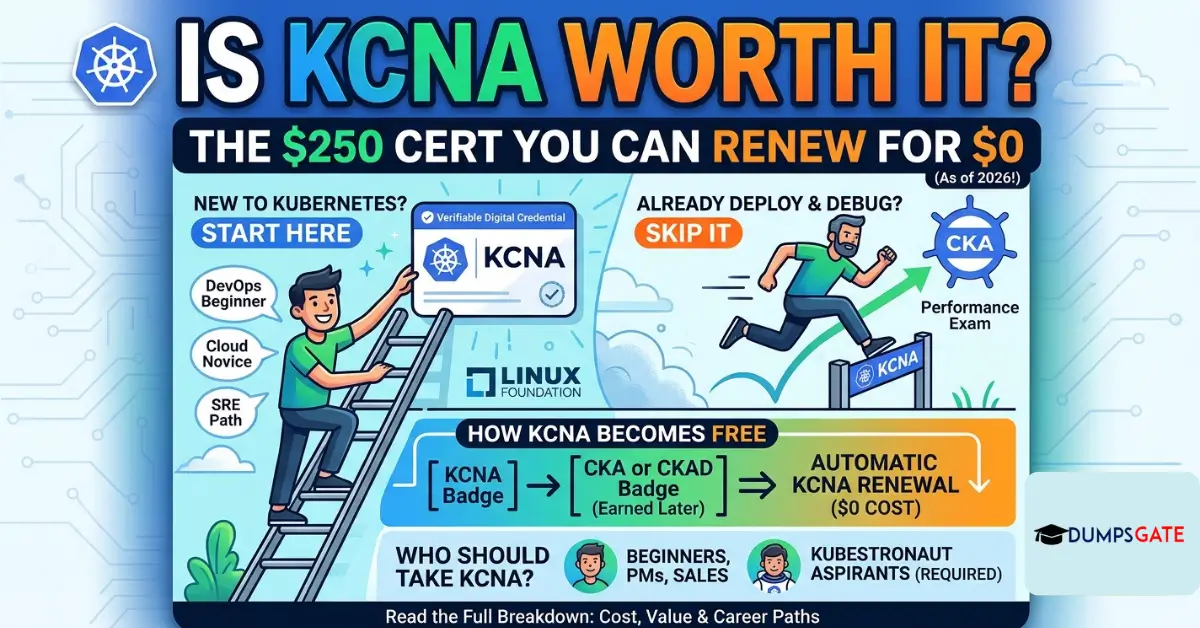
Yes, KCNA certification is worth it in 2027 if you are new to Kubernetes, work beside platform teams, or plan to earn CKA, CKAD or the Kubestronaut title. Since January 1, 2026, passing or recertifying CKA or CKAD renews an existing KCNA automatically, so for most buyers it is a one-time $250 purchase. If you already deploy and debug Kubernetes at work, skip it and book the CKA.
Who Should Take KCNA, and Who Should Skip It?
| Your situation | Verdict | Why |
|---|---|---|
| New to containers, moving into cloud, DevOps or SRE | Take it | A structured map of a sprawling ecosystem and a verifiable first credential |
| PM, sales engineer, support or technical writer working beside platform teams | Take it | Your gap is vocabulary, not cluster administration, and you may never need CKA |
| Planning CKA or CKAD within the next year, still shaky on basics | Take it | You learn the components before you have to fix them under a clock |
| Aiming for the Kubestronaut title | Required | It is one of the five mandatory exams |
| Already deploying, scaling and debugging workloads at work | Skip | It will confirm what you know; CKA tests what employers screen for |
| Developer shipping code to someone else’s cluster | Skip to CKAD | CKAD certifies the work you already do |
| Security-focused beginner | Consider KCSA too | KCSA covers threat models and cluster hardening KCNA only touches |
What Do You Get for $250 in 2027?
| KCNA | KCSA | CKA | CKAD | |
|---|---|---|---|---|
| Exam-only price | $250 | $250 | $445 | $445 |
| Format | Multiple choice | Multiple choice | Live terminal tasks | Live terminal tasks |
| Duration | 90 min | 90 min | 2 hours | 2 hours |
| Validity | 2 years | 2 years | 2 years | 2 years |
| Attempts included | 2 | 2 | 2 | 2 |
| Exam simulator sessions | None | None | 2 | 2 |
| Official level | Beginner | Beginner | Intermediate | Intermediate |
| Kept current by CARE via | CKA or CKAD | CKS | CKS | Its own retake |
Sources: official Linux Foundation pages for KCNA, KCSA, CKA and CKAD, checked November 3, 2026.
Every exam is online and proctored, and you get 12 months from purchase to sit it.
Click here: KCNA Certification Guide: $125 per Attempt, 90 Seconds per Question
What Changed in 2026 That Makes KCNA Cheaper to Keep?
The Linux Foundation’s CARE program (Certification Advancement and Recertification Experience) took effect on January 1, 2026. It renews a lower-level certification automatically when you earn or recertify a related higher one:
- CKA or CKAD → KCNA. Pass or recertify either one on or after January 1, 2026, and your KCNA becomes current with a matching expiry date.
- CKS → KCSA, CKA and KCNA. From June 18, 2026, one CKS pass cascades down to all three.
- The catch: CARE only refreshes a certification you already earned. A CKA pass will never grant you a KCNA you never sat.
Before CARE, KCNA was a two-year badge you had to buy again to keep. For anyone continuing to CKA or CKAD, that is no longer true.
Two KCNA facts that older guides still get wrong:
- Validity is 2 years, not 3. Kubernetes exams, KCNA included, moved from 36 to 24 months for passes on or after April 1, 2024, per CNCF’s announcement. Any “2 to 3 years” answer blends the old and new rules.
- The syllabus has four domains, not five. Observability no longer stands alone; it sits inside Cloud Native Architecture.
How Much Does KCNA Really Cost Over 4 Years?
We modeled four paths at current US list prices, assuming each credential is kept current for four years, and renewal means passing the exam again.
| Path | Purchases over 4 years | 4-year total |
|---|---|---|
| KCNA only | KCNA twice | $500 |
| CKA only | CKA twice | $890 |
| KCNA, then CKA (with CARE) | KCNA once, CKA twice | $1,140 |
| Same path without CARE | KCNA twice, CKA twice | $1,390 |
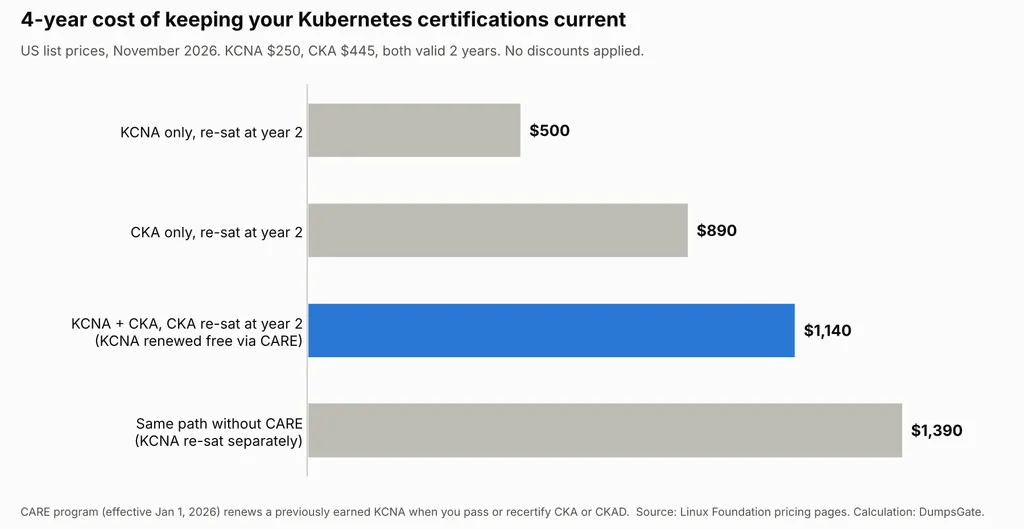
Figure: 4-year cost of keeping Kubernetes certifications current at list prices. Calculation: DumpsGate.
The takeaway: on the CKA path, KCNA adds 28% to your four-year spend ($250 on top of $890), and CARE saves you the $250 second sitting you would have paid before 2026.
Planning the next exam’s budget too? See our full breakdowns of CKA certification cost and CKAD certification cost, including bundles and discounts.
Is KCNA Worth It If You Want to Become a Kubestronaut?
Yes, because there is no way around it. The CNCF’s Kubestronaut requires KCNA, KCSA, CKA, CKAD and CKS to be active at the same time. The title then lasts until the end of the year in which the first of your five certifications expires.
The Kubestronaut program page lists what the title pays back:
- Five 50%-off certification coupons every year, for you or to share
- 20% off three CNCF events (KubeCon or KubeDays) a year
- An exclusive jacket, a Credly badge and a private Slack channel
Bundle math (our calculation from list prices):
| Starting point | Buying exams separately | Official bundle | Saving |
|---|---|---|---|
| From zero (all five) | $1,835 | $1,645 | $190 |
| Already hold CKA (four remaining) | $1,390 | $1,235 | $155 |
The maintenance math is where CARE changes everything. Keeping all five current used to mean five exams per cycle ($1,835 at list). Now a CKS retake renews KCSA, CKA and KCNA, so you only need two exams: CKS and CKAD, or $890 at list. Spend two of your annual 50% coupons on them and the cycle costs $445.
The club is still small: the Kubestronaut community passed 3,500 members in March 2026.
KCNA vs CKA: Which Should You Take First?
Take KCNA first if the concepts are new to you. Go straight to CKA if you already work hands-on. To decide, try our 5-point readiness check without notes:
- Expose a Deployment through a Service and explain how traffic reaches a Pod.
- Read a failing Pod’s events and logs and name the cause.
- Write a Deployment manifest from memory, including resource requests.
- Explain what the scheduler, kubelet and etcd each do.
- Roll back a bad rollout.
- Score 4 or 5: skip KCNA and book the CKA. Your hours go further in a live terminal, and CKA preparation gets more out of you than a multiple-choice exam will. When you get there, drill with CKA practice questions.
- Score 0 to 3: take KCNA first. You will learn the components before you have to fix them under a two-hour clock.
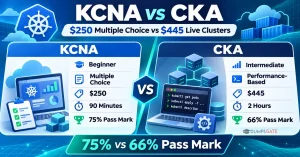
Weighing the two hands-on exams instead? KCNA vs CKA: $250 Multiple Choice or $445 Live Clusters, Scored on 9 Points
Is CKAD Certification Worth It Instead of KCNA?
For developers, usually yes. CKAD tests the work you already do (building images, configuring workloads, probes, rollouts) in a live cluster, which is the kind of evidence hiring teams read first. If you can already ship a containerized app to a cluster, it is a better use of your next exam fee than KCNA.
Our CKAD certification guide covers the five domains, task format and a study plan. Ready to practice? Start with our CKAD practice exam.
KCNA or KCSA Certification: Which Entry Exam Fits You?
The two associate exams share a price, format and duration, but test different things. KCSA certification is security-only, split across six domains:
| KCSA domain | Weight |
|---|---|
| Kubernetes Cluster Component Security | 22% |
| Kubernetes Security Fundamentals | 22% |
| Kubernetes Threat Model | 16% |
| Platform Security | 16% |
| Overview of Cloud Native Security | 14% |
| Compliance and Security Frameworks | 10% |
How to choose:
- Take KCNA first if you are new to Kubernetes itself. KCSA assumes you already know what a Pod and an API server are.
- Take KCSA first only if you already know Kubernetes basics and are moving into a security or compliance role.
- Take both if Kubestronaut is your goal. Both are required, and a future CKS pass keeps KCSA current.
How Hard Is the KCNA Exam, and How Should You Study?
It is the easiest exam in the CNCF Kubernetes family, but not a giveaway. In reviews on the official exam page, several candidates who already held CKA or CKS said some questions needed a second or third read, and others found it trickier than expected.
Study where the marks are. The first two domains carry 72% of the exam:
| KCNA domain | Weight | Covers | Hours in a 40-hour plan |
|---|---|---|---|
| Kubernetes Fundamentals | 44% | Core concepts, administration, scheduling, containerization | 17.6 |
| Container Orchestration | 28% | Networking, security, troubleshooting, storage | 11.2 |
| Cloud Native Application Delivery | 16% | Application delivery, debugging | 6.4 |
| Cloud Native Architecture | 12% | Observability, ecosystem and principles, community | 4.8 |
Hours column: our planning model, allocating a 40-hour budget by official domain weight. Scale it to your own budget.
The most common planning mistake is spending most of your time on the CNCF landscape because it is easy to read about. That material lives in a 12% domain.
What Is the Best KCNA Course?
The best KCNA course for most beginners is the official pair, because both map to the current four-domain syllabus:
| Course | Cost | Length | Best for |
|---|---|---|---|
| Introduction to Kubernetes (LFS158) | Free | 15 to 20 hours, with labs | Complete beginners who need hands-on basics first |
| Kubernetes and Cloud Native Essentials (LFS250) | $99 alone, effectively $49 in the $299 exam bundle | 8 to 10 hours | The official KCNA prep course |
| THRIVE-ONE bundle | $495 with the exam | 12 months of the full catalog | Only if you will sit more Linux Foundation exams within a year |
Together, the two official courses add up to 23 to 30 hours, which leaves the rest of a 40-hour plan for practice questions and a small local cluster.
How Should You Use a KCNA Certification Practice Test?
Use a practice test as a diagnostic, not a memory drill:
- Take one timed set before you study. It shows which of the four domains you are weakest in.
- Map every miss to its domain and weight your remaining hours toward the gaps.
- Retake a fresh timed set once a week. Read the explanation for every answer, including the ones you got right by guessing.
- Book the exam when your weakest domain stops being weak, not when your overall score looks good.
Our KCNA certification practice test is organized by domain and explains each answer, so the diagnostic in step 1 takes one sitting.
When Is the Cheapest Time to Buy KCNA?
Historically, during the Linux Foundation’s Cyber Week sale. Because your 12-month exam window starts at purchase, you can buy at the discount and sit the exam next year.
Here is what Cyber Week 2025 charged from December 1 to 9, 2025:
| Product | List price | Cyber Week 2025 price |
|---|---|---|
| KCNA exam | $250 | $125 |
| KCNA + KCSA exam bundle | $425 | $170 |
| KCNA + CKA exam bundle | $645 | $258 |
| Kubestronaut bundle (all five) | $1,645 | $823 |
The standout: at $258, the KCNA + CKA pair cost $187 less than CKA alone at list price.
The Linux Foundation had not announced 2026 sale dates when this page was updated. If the pattern holds, watch for it around Cyber Monday, November 30, 2026.
How We Checked These Numbers
- Every price, date, domain weight and program rule above was verified against official Linux Foundation and CNCF pages on November 3, 2026.
- The 4-year cost, bundle-saving and maintenance figures are our own calculations at list price, before any discount.
- The readiness check and the 40-hour plan are our planning tools, not official guidance.
Verdict: Should You Buy KCNA?
- Buy it now if you are new to Kubernetes and ready to start studying this month.
- Buy it during the Cyber Week sale if you can wait a few weeks to start.
- Buy the KCNA + CKA pair if you plan both within a year. It is the cheapest route to two credentials.
- Skip it and book CKA if you scored 4 or 5 on the readiness check.
- Skip it and take CKAD if you are a developer shipping code to Kubernetes.
- Take it no matter what if Kubestronaut is the goal.
Still unsure which group you are in? Take one timed KCNA practice set. If it reads like your normal workweek, you belong in the CKA group.
Frequently Asked Questions
Is KCNA respected by employers?
As a literacy credential, yes. It is verifiable and comes with a digital badge employers can check. Teams hiring for hands-on cluster work, though, screen for the performance-based exams first.
Can you get a job with only KCNA?
Rarely for engineering roles. It helps most in support, pre-sales and junior roles where vocabulary is the gap. Pair it with a small public project, such as an app exposed through a Service and Ingress on a local cluster, or with CKA.
Do you need KCNA before CKA?
No. KCNA, KCSA, CKA and CKAD have no prerequisites. The only Kubernetes exam that does is CKS, which requires a passed CKA.
What is the KCNA passing score, and how many questions are there?
You need 75% to pass, per the Linux Foundation’s multiple-choice exam FAQ. The question count is not published; candidate reports put it at 60, so plan on roughly 90 seconds per question.
How soon do you get your KCNA results?
Within 24 hours. The exam is scored automatically and the score report arrives by email, barring technical problems, according to the same FAQ.
Can you take the KCNA exam from home?
Yes. It is proctored online through the PSI Secure Browser, so there is no test center. You need:
- A private, well-lit room with the door closed
- One active monitor (dual monitors are not supported), a webcam and a microphone
- A valid government-issued photo ID whose name matches your exam profile exactly
Use a personal computer if you can. Locked-down work laptops often fail the PSI system check.
How long does it take to prepare for KCNA?
There is no official benchmark. Using our 40-hour plan, that is about 8 weeks at 5 hours a week or 4 weeks at 10 hours a week. If you have never run a container, add the free LFS158 course first, which adds 15 to 20 hours.
Does KCNA increase your salary?
No public dataset isolates a KCNA salary premium, so treat any percentage you see as a guess. Pay follows the job title; KCNA’s job is getting a beginner into the interview for that title.
What happens if my KCNA expires?
You can re-sit it, or let CARE bring it back. CARE reinstates an expired KCNA as current when you later pass or recertify CKA or CKAD.