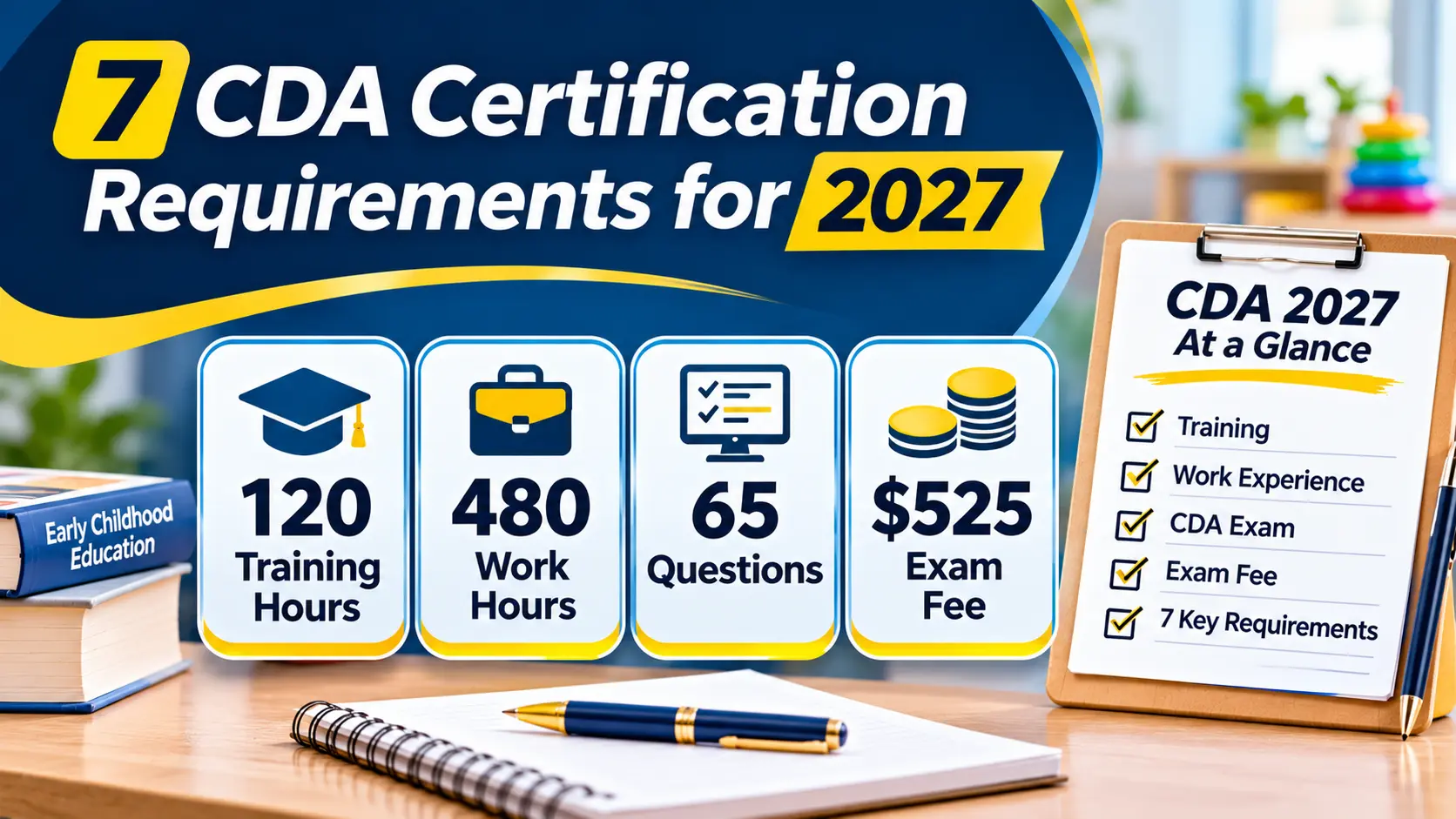
The CDA certification requirements are a high school diploma or GED (or enrollment as a high school junior or senior in an early childhood career program), 120 hours of formal early childhood training, 480 hours of work with children, a Professional Portfolio, a $525 online application, and the CDA Exam. Some candidates also need a verification visit.
CDA here means the Child Development Associate credential from the Council for Professional Recognition, not the Certified Dental Assistant credential. The Council calls it a credential; most people search for “CDA certification,” so this guide uses both terms.
The 7 CDA certification requirements in one table
Figures come from the Council’s CDA FAQs and process overview, checked November 2026.
| # | Requirement | The figure | When |
| 1 | Education background | High school diploma or GED, or a high school junior or senior in an early childhood career and technical program | Before you apply |
| 2 | Formal training | 120 clock hours, at least 10 in each of the 8 CDA Subject Areas | Any time before you apply |
| 3 | Work experience | 480 hours, paid or volunteer, with the age group of your setting | Within 3 years before you apply |
| 4 | Professional Portfolio and Competency Standards book | Portfolio built from the book for your setting | Portfolio prepared within 6 months before you apply |
| 5 | Application | $525 online, a PD Specialist and a Director’s Permission Statement | Paid in full when you apply |
| 6 | CDA Exam | 65 multiple-choice questions, up to 1 hour 45 minutes | Within 6 months of payment |
| 7 | Verification Visit | Only if your exam score is below the qualifying level | Within the same 6 months |
The rest of this guide takes each requirement in turn, then covers settings, online options, funding, California, jobs and renewal.
Dive deeper into: A Comprehensive Analysis of the Cost of CDA Certification in 2027
Which CDA requirements apply to you?
The core rules are the same for everyone, but your situation changes which setting you pick and which extra rule you need to watch.
| Your situation | Setting to choose | Extra rule to watch |
| High school junior or senior in an early childhood career program | The setting where you do your 480 hours | Your career and technical training hours can count as formal education |
| Center teacher working across infants and preschoolers | Birth-to-Five | Center group of at least 3 children under 36 months or at least 6 children aged 3 to 5 |
| Running a child care program in your home | Family Child Care | At least 2 children aged 5 or younger who are not related to you |
| Visiting families in a home-based program | Home Visitor | Separate process; no portfolio upload, reviewed onsite by a PD Specialist |
| New Head Start hire | The setting of your classroom or program | Preschool assistant teachers must finish within 2 years of hire; family child care providers within 18 months |
| Teaching in two languages every day | Your setting, plus the bilingual specialization | Write 3 reflective statements in English and 3 in the other language |
| Working toward a California permit | Any setting | The CDA counts toward the Associate Teacher Permit (see the California section) |
Requirement 2: what the 120 hours must cover
The 120 hours must include at least 10 hours in each of the eight CDA Subject Areas listed in the Council’s Competency Standards and Subject Areas chart:
- Planning a safe and healthy learning environment
- Advancing children’s physical and intellectual development
- Supporting children’s social and emotional development
- Building productive relationships with families
- Managing an effective program
- Maintaining a commitment to professionalism
- Observing and recording children’s behavior
- Understanding principles of child development and learning
Home Visitor candidates follow home-visiting versions of several areas, such as “Working across the child welfare continuum” in place of area 7.
Training must come from an agency with early childhood teacher-preparation expertise, not individual consultants or conference workshops. If your training is in college credits, the Council converts them: 1 semester credit equals 15 clock hours, and 1 CEU or 1 quarter credit equals 10 clock hours.
Requirement 4: the portfolio and the book
You must buy the Competency Standards book for your setting before you apply and have it with you at a verification visit, according to the Council’s E-Portfolio FAQs. The book sets out the 6 Competency Goals and 13 Functional Areas your portfolio must address.
The portfolio holds:
- Your education records
- Completed family questionnaires
- Six reflective statements of competence
- A resource collection of ten items, organized by Competency Goal
- A professional philosophy statement
Upload it as JPEG, PNG, or PDF files of 20 MB or less each. Password-protected or certified files are rejected. The Council’s free E-Portfolio tool is optional.
Revised editions of four Competency Standards books, in English and Spanish, are due in January 2027. If you are buying a book near that date, check which edition the Council’s store is selling.
Learn more about: Is the CDA Exam Hard? The Brutally Honest Truth for 2027 Candidates
How to find a PD Specialist (and who cannot be yours)
According to the Council’s PD Specialist FAQs, you find one in five steps:
- Log in to YourCouncil and select “Find a PDS.”
- Enter your work zip code, your setting and your teaching language.
- Pick a nearby PD Specialist from the results.
- Send a request to conduct your verification visit.
- If they accept, they send you a PD Specialist ID number, which you need to submit your application.
You cannot choose:
- a relative
- a current or past supervisor, trainer, director or co-worker from the last 3 years
- a parent of a child in your group
- someone who was your PD Specialist before
- anyone with a financial interest in your result
- a licensing agent who inspected your facility in the last 2 years
PD Specialists may not charge you any fee.
Requirement 6: the 65-question CDA Exam
The exam has 65 multiple-choice questions: 60 standard questions and 5 scenario questions with a short story and photo. You get up to 1 hour 45 minutes at a Pearson VUE testing center, and you can book only after the Council sends a “Ready to Schedule” notice. The test needs only point-and-click skills, with no typing. The Council does not publish a passing score.
The Council publishes free official sample exam questions for the Infant-Toddler, Preschool, Birth-to-Five and Family Child Care settings, in English and Spanish. Use the set for your setting together with your Competency Standards book.
If you do not pass, you can retake the exam for $125 per attempt, up to two retakes, according to the Council’s credentialing decision FAQs. After three unsuccessful attempts, you can reapply after a six-month wait.
Requirement 7: when a verification visit is needed
Since February 2, 2026, the exam comes first. If your score reaches the qualifying competence level, you skip the visit and the Council reviews your portfolio, typically within 15 business days. If it does not, your PD Specialist reviews your portfolio, observes you with children in your setting and holds a reflective discussion with you.
The Council says a complete file is usually decided in 1 to 3 business days. Errors or missing information can stretch that to 4 to 6 weeks or more. An incomplete portfolio moves your application to “Need More Information,” and you get 15 business days to send what is missing.
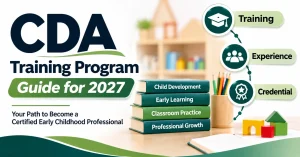
Read More: 120 Hours, 5 Settings, 1 Deadline: Your CDA Training Program Guide for 2027
Your CDA countdown: the dates that matter
Most CDA delays come from timing, not knowledge. Work backward from your application date:
| Window | What must fall inside it |
| Any time before you apply | Your 120 training hours |
| 3 years before you apply | All 480 work hours |
| 6 months before you apply | Portfolio preparation |
| 6 months after your payment clears | Exam and, if needed, verification visit |
| 15 business days | Fixing an incomplete portfolio |
| 6 months before your credential expires | The only window to submit a renewal |
How long the hours take depends on your schedule. These are straight divisions of the required hours:
| Hours per week | 480 work hours take | 120 training hours take |
| 10 | 48 weeks | 12 weeks |
| 20 | 24 weeks | 6 weeks |
| 30 | 16 weeks | 4 weeks |
| 40 | 12 weeks | 3 weeks |
Read More: CDA Certification 2027: 120 Hours, 480 Hours, 65 Questions, $525 and 1 New Rule
8 mistakes that hold up a CDA application
Each of these breaks a Council rule:
- Counting babysitting, before- and after-school programs, Sunday school, or drop-in programs toward the 480 hours
- Logging hours with a different age group from your chosen setting
- Using hours for children more than 3 years old
- Taking training from an individual consultant or conference workshop
- Having fewer than 10 hours in any one Subject Area
- Preparing the portfolio more than 6 months before applying
- Choosing a PD Specialist with a conflict of interest
- Starting the 6-month clock by paying before you are ready for the exam
What changed in 2025 and 2026, and what changes in January 2027?
Many CDA guides still show the old $425 fee. Here is what is current.
| Date | Change | What it means for you |
| August 1, 2025 | Initial online fee rose to $525 and online renewal to $250, the first increase since 2013 | Budget $525, not $425 |
| January 2026 | The Council announced it is ending paper applications | Apply and renew online through YourCouncil |
| February 2, 2026 | Exam-first process, portfolio upload before payment, visit only when needed | Have a finished digital portfolio before you pay |
| February 2, 2026 | Exam retakes at $125 each, up to two | A failed exam does not mean starting over |
| January 2027 | New training documentation requirements | Check the Council’s guidance before you apply |
| January 2027 | Revised editions of four Competency Standards books | Check which edition you need |
Sources: the Council’s 2025 pricing update, 2026 process updates and training documentation announcement.
The January 2027 training change is about paperwork, not content: the 120 hours, eight Subject Areas, Competency Standards and portfolio components stay the same. If you finish training in 2026 but apply in 2027, keep every certificate that shows hours by Subject Area.
Deep Dive into: How to Get a CDA in 7 Steps: 600 Hours, $525 and 12 to 96 Weeks
What are the types of CDA credentials?
There are four center or home settings plus a separate Home Visitor credential. Your 480 hours must be in the setting you choose, and you can only renew in that setting.
| CDA setting | Ages | Minimum group for observation |
| Preschool | 3 to 5 years | Center group of at least 6 children aged 3 to 5 |
| Infant-Toddler | Birth to 36 months | Center group of at least 3 children |
| Birth-to-Five | Birth to 5 years | Center group with at least 3 children under 36 months or at least 6 children aged 3 to 5 |
| Family Child Care | 5 and younger | Your home, with at least 2 children not related to you |
| Home Visitor | Families in home-based programs | Programs where regular home visits are the main way services are delivered |
A center-based program must have at least 10 enrolled children and at least 2 regular caregivers.
Can you get a CDA certification online?
Partly. Here is how to get a CDA certification online as far as the rules allow.
| Step | Online? |
| 120 training hours | Yes, if an agency with early childhood teacher-preparation expertise provides it |
| Application and portfolio | Yes, through YourCouncil |
| CDA Exam | No, it is taken at a Pearson VUE center. Monolingual candidates approved for an alternate language take a remotely proctored exam |
| Verification Visit (if required) | No, observation happens in your center or home setting |
| 480 work hours | No, they are hours spent working with children |
How to get a CDA for free
The Council has no free route: the $525 fee is non-refundable and due in full when you apply. Free or low-cost CDAs come from someone else paying.
- State funding. The Council says income-eligible candidates may have training, the assessment fee or both covered by their state. Its CDA scholarship directory lists programs in 39 states and Washington, DC.
- Employer funding. Head Start and other programs that must hire CDA holders are worth asking about training or fee support.
- Scholarship gaps. The 2025 fee increase did not raise existing scholarship amounts, so a scholarship written for $425 may leave you paying the difference.
So how to get a CDA for free online, realistically: online training and a fee paid by a state or employer program. The hours and exam still happen in person.
Council fees at current prices, before training and the book (which vary). For every fee in detail, see our CDA certification cost guide.
| Scenario | Council fees |
| Pass the exam on the first try | $525 |
| First try, plus one renewal after 3 years | $525 + $250 = $775 |
| Two exam retakes, plus one renewal | $525 + (2 × $125) + $250 = $1,025 |
CDA certification requirements in California
California has no separate CDA. You meet the same national requirements, then use the CDA toward a state Child Development Permit. According to the California Commission on Teacher Credentialing’s Child Development Permit leaflet (CL-797):
- A CDA is one option for the Associate Teacher Permit, in place of 12 semester units plus 50 days of experience.
- A CDA can count as 9 semester units toward the 24-unit general requirement for the Teacher, Master Teacher, Site Supervisor and Program Director permits.
- The CDA is not listed as an option for the Assistant Permit.
Some California college permit charts add that the CDA must be earned in California, so confirm with the CTC before you apply for a permit. California also has no entry in the Council’s scholarship directory, so ask your employer or local child care resource and referral agency about funding.
What jobs can you get with a CDA certification?
The clearest answer is in Head Start. Federal Head Start staff qualification rules (45 CFR 1302.91) name the CDA as a minimum for several roles:
| Role | CDA requirement |
| Early Head Start center-based teacher | At least a CDA or comparable credential, plus infant and toddler training |
| Head Start preschool assistant teacher | A CDA or a state certificate that meets or exceeds it, or enrollment in a CDA program completed within 2 years of hire |
| Head Start family child care provider | Enrollment in a Family Child Care CDA or state equivalent, earned within 18 months of starting |
| Head Start home visitor | At least a home-based CDA or comparable credential, or equivalent degree coursework |
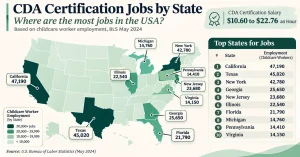
Outside Head Start, the U.S. Bureau of Labor Statistics says states most often require the CDA for childcare workers. The median pay for childcare workers (occupation code 39-9011) was $34,980 a year in May 2025. That covers all childcare workers, not only CDA holders; a CDA does not guarantee a raise.
Preschool teachers typically need at least an associate’s degree, per BLS, so a CDA is a first step there, not a substitute.
For More Information: What Jobs Can You Get With a CDA Certification? 8 Roles, 3 Limits and Pay From $16.82 an Hour
How do you renew a CDA?
A CDA is valid for 3 years. To renew, you need one of the following in your credential’s age group: 4.5 CEUs, 45 clock hours, or a 3-credit college course in early childhood education or child development. The online renewal fee is $250, and CPR and first aid are no longer required. Renewals are approved once complete, with random audits.
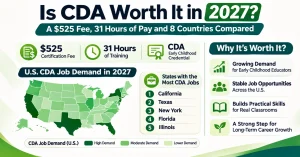
Read More: Is CDA Worth It in 2027? A $525 Fee, 31 Hours of Pay and 8 Countries Compared
Verdict: what to do next
- Already working with children: check your hours against the 3-year window, pick your setting and finish your digital portfolio before you pay.
- Starting at Head Start: you can begin as a preschool assistant teacher while enrolled, but you have 2 years from hire to finish.
- In California: compare the CDA with 12 college units as your route to the Associate Teacher Permit.
- Applying in 2027: read the Council’s new training documentation guidance and check your book edition first.
- Short on money: check the scholarship directory and ask your employer before paying yourself.
FAQs
How long does it take to get a CDA?
It depends mostly on how fast you finish 120 training hours and 480 work hours; at 20 hours a week, the work hours alone take 24 weeks. Once you pay, you have 6 months to complete the exam and any required visit. A complete file is usually decided in 1 to 3 business days.
Is there a minimum age for the CDA?
The Council’s eligibility rule is based on education, not a stated age: a high school diploma or GED, or enrollment as a junior or senior in a high school early childhood career program. Your state or employer may set its own age rules for childcare staff.
Does my PD Specialist charge a fee?
No. The Council says PD Specialists may not charge candidates any fee. Their verification visit work is covered through the Council.
Can my center director be my PD Specialist?
No. A current director, or any director, supervisor, trainer or co-worker from the last 3 years, cannot serve as your PD Specialist. Your director’s role is the Director’s Permission Statement in your application.
Do I need CPR and first aid for my CDA?
Not for renewal. The Council ended the CPR and first aid requirement for renewals in 2025. Your state or employer may still require them for licensing.
What can I do with a CDA credential?
A CDA meets the minimum for several Head Start roles, is the credential states most often require for childcare workers, per BLS, and can count toward a California Child Development Permit. It can also be a first step toward an early childhood degree.