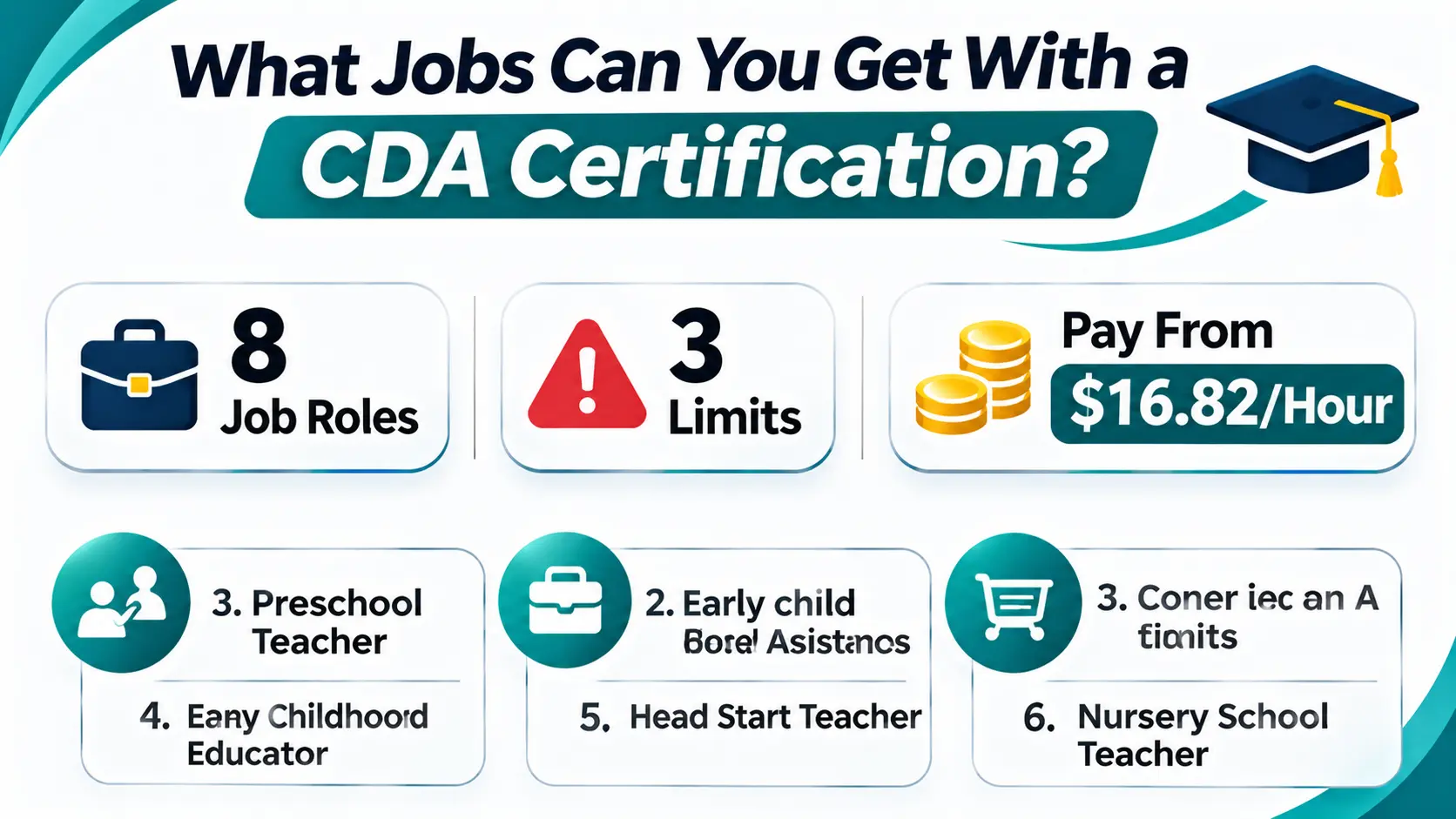
A CDA certification qualifies you for hands-on early childhood jobs: childcare worker, preschool or infant-toddler teacher in a child care center, teacher assistant, Head Start assistant teacher, family child care provider, and home visitor. On its own, it does not qualify you to lead a public school pre-K class, a Head Start preschool class, or a center.
CDA here means the Child Development Associate credential, the official name for what most people call a CDA certification. The Council for Professional Recognition issues it and says more than 800,000 have been awarded, with about 40,000 initial and renewal CDAs issued each year (Council: Learn about the CDA). A CDA is valid for 3 years from the award date.
The 8 jobs a CDA certification qualifies you for
So what jobs can you get with a CDA credential? Instead of a plain list, this table matches each role to the official rule that names the CDA and the CDA setting to choose.
| Job | Where you work | What the official rule says | CDA setting to pick |
| Childcare worker | Child care centers | The CDA is the credential states most often require when they require one | Preschool, Infant-Toddler or Birth to Five |
| Preschool teacher (child care center) | Private and child care center preschools | Some states require a professional credential; rules vary by state | Preschool or Birth to Five |
| Infant-toddler teacher (Early Head Start) | Early Head Start centers | Minimum of a CDA or comparable credential | Infant-Toddler or Birth to Five |
| Teacher assistant | Child care centers | Set by state licensing and the employer | Matches the age group you work with |
| Head Start preschool assistant teacher | Head Start centers | CDA, an equal state certificate, or a CDA earned within 2 years of hire | Preschool |
| Family child care provider | Your own home | Head Start providers must earn a Family Child Care CDA (or equivalent) within 18 months | Family Child Care |
| Home visitor | Families’ homes | Minimum of a home-based CDA or comparable credential | Home Visitor |
| CDA Professional Development Specialist | Candidates’ programs | CDA holders qualify with 6 years of experience | Your existing setting |
What can you do with a CDA in childcare centers?
The Bureau of Labor Statistics (BLS) says some states and employers require childcare workers to hold a nationally recognized credential, and that the CDA is the one states most often require. Two official examples show how differently states use it:
- Florida: for every 20 children in a licensed facility open 8 or more hours a week, at least one staff member must hold a CDA, a state child care professional credential or an equivalent (Florida Statutes, section 402.305(3), 2024 edition including 2025C).
- Washington, DC: a CDA meets the minimum for assistant teachers and home caregivers in licensed child development facilities, and a CDA holder can work as a teacher while finishing an associate degree (OSSE minimum education requirements, April 2026).
BLS also notes that where states require prior experience, preschool teachers often start as childcare workers or teacher assistants.
Learn more about: Is The CDA Exam Hard? The Brutally Honest Truth for 2027 Candidates
What does a CDA qualify you for in Head Start?
Head Start is where the CDA is written directly into federal rules. Under 45 CFR §1302.91:
- Preschool assistant teachers need a CDA or a state certificate that meets or exceeds it, or enrollment in a degree program, or enrollment in a CDA program completed within two years of hire.
- Early Head Start infant and toddler teachers need at least a CDA or comparable credential, plus infant and toddler training.
- Family child care providers must be enrolled before serving children and earn the credential within 18 months.
- Home visitors need at least a home-based CDA or comparable credential.
Jobs for CDA-certified educators with experience
After six years in the field, CDA holders can apply to become a CDA Professional Development Specialist, who reviews candidates’ portfolios and observes them at work. You need at least three years working directly with children and one year supporting another adult’s professional growth. The Council pays a $100 honorarium per candidate and aims for specialists to serve their local area, so treat it as paid side work, not a full-time job.
On military installations, the Council’s separate Military School-Age (MSA) credential covers staff who work with school-age children and youth, including family child care providers.
Start now, finish later: jobs you can take before your CDA is done
You don’t always need the credential on day one. These official rules let you work while you earn it.
| Job | Rule | Deadline to earn the CDA |
| Head Start preschool assistant teacher | 45 CFR §1302.91(e)(3) | 2 years from hire |
| Head Start family child care provider | 45 CFR §1302.91(e)(4) | 18 months from first providing services |
| DC assistant teacher (high school diploma only) | OSSE licensing rules | 2 years from first hire |
| DC associate home caregiver (high school diploma only) | OSSE licensing rules | 2 years from first hire |
In DC, the ladder keeps going: a CDA holder can work as a teacher if they finish an associate degree within four years of first being hired as a teacher (OSSE summary of August 2025 changes).
The 480 experience hours set your pace. At 40 hours a week, they take 12 weeks; at 20 hours a week, 24 weeks. Hours from a job you already hold count if they’re in the right setting.
3 jobs a CDA alone won’t get you
These are the roles people most often assume a CDA covers.
| Job | What it usually requires | Source |
| Public school pre-K teacher | A bachelor’s degree and a state early childhood teaching license | BLS |
| Head Start preschool lead teacher | At least an associate’s or bachelor’s degree in child development or early childhood education | 45 CFR §1302.91(e)(2) |
| Preschool or childcare center director | A bachelor’s degree in most states and several years of experience | BLS director profile |
A common claim online is that Head Start lead teachers only need a CDA. The regulation says otherwise: the CDA is the minimum for assistant teachers, infant-toddler teachers, family child care providers, and home visitors, while center-based preschool teachers need a degree or equivalent coursework.
Can you work in a public school with a CDA?
Yes, but usually not as the lead teacher. BLS says public school preschool teachers must hold a state license, which generally requires a bachelor’s degree and an exam.
A teacher assistant job is the more realistic route. Public schools generally want at least 2 years of college or an associate’s degree, and Title I schools also accept passing a state or local assessment. A CDA doesn’t replace those requirements, but your classroom experience helps when you apply.
Preschool teacher with CDA salary: what the pay data shows
BLS doesn’t publish pay by credential, so no official source can tell you what a CDA alone adds. The closest figures are the medians for the occupations CDA holders work in. They are May 2025 figures for all workers in each occupation, with or without a CDA.
| Role | BLS occupation used | Median pay (May 2025) |
| Childcare worker | Childcare workers | $16.82 an hour ($34,980 a year) |
| Preschool teacher in a child care center | Preschool teachers (SOC 25-2011), child daycare services | $36,850 a year |
| Teacher assistant, all settings | Teacher assistants | $36,780 a year |
| Preschool teacher, all settings | Preschool teachers (SOC 25-2011) | $38,140 a year |
| Preschool teacher in state, local and private schools | Preschool teachers (SOC 25-2011), educational services | $52,800 a year |
| Center director | Preschool and childcare center directors | $59,300 a year |
Read it as a ladder. A CDA gets you onto the first rows; the school and director rows generally need a degree. BLS projects preschool teacher jobs to grow 4% from 2025 to 2035. Childcare worker jobs are projected to decline 2%, but the occupation still expects about 150,300 openings a year as people leave the field.
Is a CDA worth it? The numbers
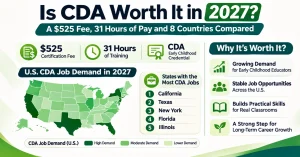
- Cost: at current Council prices, the online application is $525 and online renewal is $250. Holding a CDA for its first six years costs 775(525 + $250), or about $129 a year, before training. Our CDA certification cost breakdown covers training and other expenses.
- Training: the free iCDA Course Preparation Series from the Office of Head Start and Office of Child Care covers 80 of the 120 training hours, leaving 40 to source elsewhere.
- Access: It is the minimum for four Head Start roles and counts toward state staffing rules in places like Florida and DC.
If you plan to stay in early childhood work, those figures make it a low-cost entry point. If you are aiming straight for a public school classroom, a degree path matters more.
Dive deeper into: A Comprehensive Analysis of the Cost of CDA Certification in 2027
Where can I get my CDA certification?
Only the Council for Professional Recognition awards the CDA. Take your 120 training hours through a college, a training agency, or the iCDA series; the Council doesn’t accept training from individual consultants or conferences. For the Preschool CDA, you need a high school diploma or GED (or be a junior or senior in a high school early childhood program), 120 hours with at least 10 in each of eight subject areas, and 480 hours with children ages 3 to 5 within 3 years of applying. Then you apply online, pass the 65-question exam at a Pearson VUE site, and complete a verification visit.
Which CDA setting fits the job you want?
You earn a CDA in one setting and can only renew in that same setting, so pick it for the job you want, not just the one you have.
| CDA setting | Ages | Best for |
| Infant-Toddler | Under 3 | Infant rooms, Early Head Start |
| Preschool | 3 to 5 | Preschool rooms, Head Start assistant teacher |
| Birth to Five | Birth to 5 | Centers that move staff across age groups |
| Family Child Care | Birth to 5 | Running a home-based program |
| Home Visitor | Families | Home visiting programs |
The Office of Head Start says the infant-toddler or birth-to-five center-based CDA fully meets the Early Head Start teacher rule. The preschool CDA lacks an infant-and-toddler focus, and the family child care and home visitor CDAs lack a center-based focus.
What jobs can you get with a CDA certification without a degree, online or remote?
No degree. You can earn a CDA with a high school diploma or GED. Head Start and DC rules accept a CDA without a degree for assistant teacher, infant-toddler teacher, family child care, and home visitor roles; lead preschool roles in centers depend on your state.
Online. You can complete the training online, but the exam is taken at a Pearson VUE testing site, and the jobs are in person.
Remote. Every role in this guide involves working with children, families or candidates face-to-face. Even PD Specialists serve their local area. Be cautious with listings that promise remote CDA work.
Near me. Requirements vary by state, so check your state’s licensing agency through ChildCare.gov before applying locally.
What’s changing for CDA jobs in 2026 and 2027?
- Head Start wage rule (final): A final rule published November 16, 2026 removes Head Start wage and benefit requirements and does not modify staff qualification or credentialing requirements.
- Head Start standards rewrite (proposed): An August 2026 proposal would remove the regulations that implement staff qualifications, while the Head Start Act’s own minimums, including a CDA for Early Head Start teachers, would stay. The comment period closed October 6, 2026, and the current standards remain in place until a final rule takes effect (First Five Years Fund FAQ).
- CDA standards: the Council expects revised CDA Competency Standards books in January 2027 (Council homepage).
Verdict: which CDA job should you aim for?
- New to the field: take a Head Start or DC-style assistant teacher job that lets you earn the CDA on the job.
- Want federal-program stability: target Early Head Start infant-toddler teacher and pick the Infant-Toddler or Birth to Five setting.
- Want to work for yourself: choose the Family Child Care CDA and check your state’s home licensing rules.
- Want public school pre-K or a director role: treat the CDA as step one and plan for a degree. The Council also links the CDA to early childhood registered apprenticeships, where you earn wages while you train.
FAQs
What is a CDA certification good for?
It shows employers and regulators that you meet national competency standards for working with young children. It meets federal Head Start minimums for several roles and counts toward state staffing rules such as Florida’s one credentialed staff member per 20 children.
Can you be a preschool teacher with a CDA?
Yes, in many private and child care center preschools, depending on your state. A CDA alone is usually not enough for a public school pre-K teacher, who needs a state license, or a Head Start preschool lead teacher, who needs at least an associate’s degree or equivalent coursework.
What can I do with a CDA certificate after a few years?
You can move toward lead teacher roles where your state allows, apply to be a PD Specialist after six years of experience, or use the CDA as a base for an associate degree, as DC’s four-year teacher pathway does.
Does a CDA expire?
Yes, after 3 years. You can apply to renew up to 6 months before it expires, in the same setting, and online renewal costs $250.