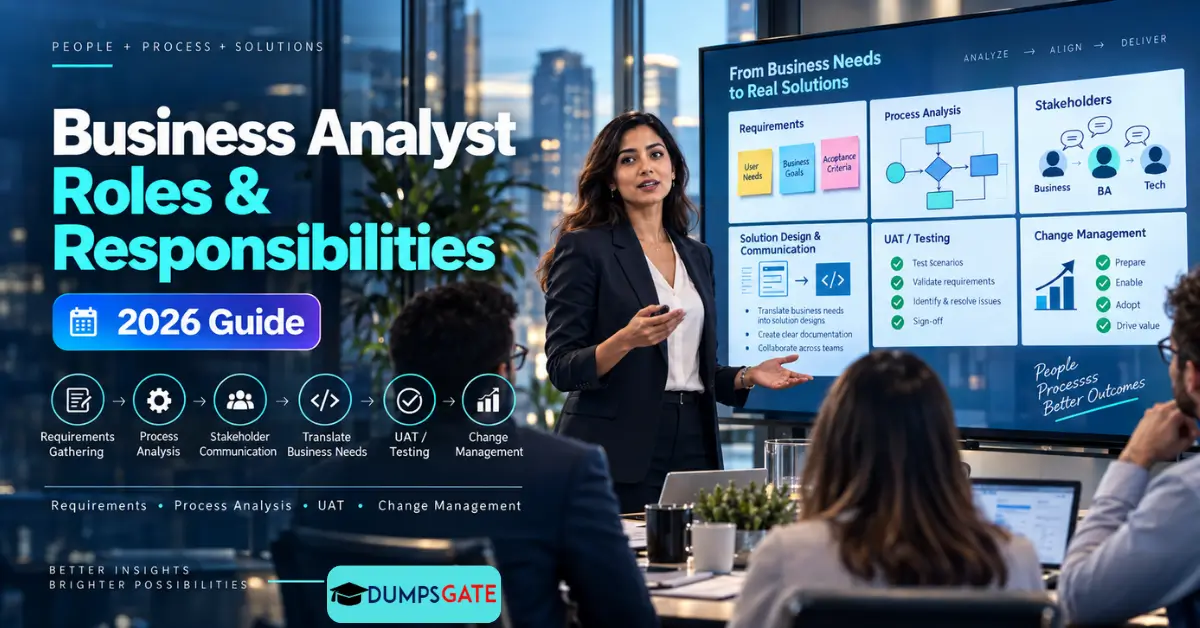
A business analyst’s roles and responsibilities center on six core functions: eliciting requirements from stakeholders, documenting them as BRDs or user stories, analyzing current-state processes for gaps, translating business needs into specifications for technical teams, supporting UAT and solution validation, and driving change management after rollout. These functions are formally scoped across six knowledge areas in IIBA’s BABOK Guide. In the United States, this work falls under the Bureau of Labor Statistics‘ “management analyst” classification, with a median pay of $101,190 USD and 9% projected job growth through 2034. Which of these responsibilities you own, and how much autonomy you get, expands sharply with seniority (see the breakdown below).
Key Facts:
- Core responsibility areas: requirements elicitation, process and gap analysis, stakeholder-to-technical translation, UAT support, change management, post-implementation tracking
- Median US pay: $101,190/year
- US job growth: 9% (2024 to 2034), about 98,100 openings projected per year
- Typical entry requirement: bachelor’s degree, no license or bar exam
- Core certifications: ECBA, CCBA, CBAP (IIBA), PMI-PBA (PMI)
What Is a Business Analyst?
A business analyst (BA) is a professional who identifies gaps between a business’s current state and its desired state, then defines the requirements needed to close that gap. The role sits between business stakeholders and delivery teams (IT, product, or operations) and is formally scoped by IIBA’s BABOK Guide into six knowledge areas: business analysis planning, elicitation, requirements life cycle management, strategy analysis, requirements analysis and design, and solution evaluation.
The job title covers multiple specializations, including IT business analyst, business systems analyst, data business analyst, and Salesforce business analyst. All share the same core function: converting ambiguous business problems into documented, testable requirements.
What Are the Core Roles and Responsibilities of a Business Analyst?
These eight responsibilities are the foundation of the role. Every specialization (Salesforce, IT, data) and every seniority level covered later in this guide is a variation on the same eight functions, scoped differently.
| # | Phase | Responsibility | What It Involves | Primary Deliverable | Common Tools |
|---|---|---|---|---|---|
| 1 | Elicitation | Elicit and document requirements | Conduct stakeholder interviews, workshops, and surveys to capture business needs | Business requirements document (BRD), user stories, use cases | Interviews, workshops, Confluence, Jira |
| 2 | Analysis | Analyze current-state processes | Map existing workflows to identify inefficiencies, bottlenecks, and redundant steps | Process maps, swimlane diagrams | Visio, Lucidchart, SIPOC |
| 3 | Analysis | Perform gap and SWOT analysis | Compare current-state and future-state processes to define what must change and quantify impact | Gap analysis report, future-state model | SWOT framework, impact matrices |
| 4 | Delivery | Prioritize and manage the requirements backlog | Rank requirements by business value and feasibility, maintain traceability to delivered features | Prioritized backlog, traceability matrix | Jira, Azure DevOps |
| 5 | Delivery | Bridge business and technical teams | Translate business language into functional specifications developers or configurators can build against | Functional specifications | Confluence, technical design sessions |
| 6 | Delivery | Support solution testing | Write test cases, coordinate user acceptance testing (UAT), validate the delivered solution against the original requirement | Test cases, UAT sign-off | TestRail, Excel, sandbox environments |
| 7 | Post-Implementation | Support change management | Create training materials, job aids, and process documentation so end users adopt the new system | Training materials, job aids | SharePoint, screen recordings |
| 8 | Post-Implementation | Track post-implementation performance | Monitor KPIs after go-live and report whether the solution delivered the expected business outcome | KPI dashboard, post-launch report | Power BI, Tableau |
The next sections break down how ownership of these eight responsibilities shifts by seniority, how they’re scoped differently on Salesforce projects, and which certifications validate which rows in this table.
How Do Business Analyst Responsibilities Change by Seniority Level?
Business analyst roles and responsibilities scale in scope and autonomy with experience. Job postings and the UK government’s Digital, Data and Technology (DDaT) capability framework consistently show four practical tiers.
| Level | Typical Experience | Core Scope | Decision Authority |
|---|---|---|---|
| Junior/Entry BA | 0 to 2 years | Requirement gathering, documentation, meeting notes, basic process mapping | Executes tasks under supervision |
| Mid-level BA | 2 to 5 years | Independent elicitation, BRD ownership, UAT coordination, stakeholder workshops | Owns one workstream or project module |
| Senior BA | 5 to 8 years | Leads requirements strategy for a full project, mentors junior BAs, manages competing stakeholder priorities | Owns project-level requirements decisions |
| Lead/Principal BA | 8+ years | Sets business analysis standards across teams, advises on portfolio-level strategy, oversees multiple senior BAs | Advises at program or organizational level |
A senior business analyst’s roles and responsibilities differ from entry-level BA work mainly in scope of ownership and stakeholder seniority, not in the underlying BABOK techniques used.
What Does a Salesforce Business Analyst Do Differently?
A Salesforce business analyst applies the same core BA responsibilities but scopes them entirely to the Salesforce platform (Sales Cloud, Service Cloud, and related tools). Salesforce’s own Trailhead learning path defines this as a project-based, business-improvement role rather than a purely technical one.
| Responsibility | General/IT Business Analyst | Salesforce Business Analyst |
|---|---|---|
| Requirements gathering | Business processes across systems | Salesforce-specific workflows, objects, and automation |
| Documentation | BRDs, use cases | User stories mapped to Salesforce configuration (Flows, validation rules, approval processes) |
| Technical collaboration | Developers, architects (varies by industry) | Salesforce admins, architects, and developers specifically |
| Testing | General UAT | UAT on Salesforce sandboxes before production deployment |
| Certification path | ECBA, CCBA, CBAP, PMI-PBA | Same core certifications, plus Salesforce Administrator or Salesforce Business Analyst certification |
What Are the Different Types of Business Analysts?
Beyond general/IT and Salesforce above, business analysts specialize across nine common variants, each scoped to a specific business function or industry need. All nine apply the same eight core responsibilities from the table earlier in this guide; only the subject matter and stakeholders change.
| Type | Focus | Example |
|---|---|---|
| IT Business Analyst | Translates business needs into technical requirements for developers and testers | Gathering CRM requirements for a software company’s new customer portal |
| Data / BI Analyst | Interprets datasets and builds dashboards to support decisions | Building a Power BI dashboard to track customer churn by region |
| Functional Analyst | Optimizes workflows within one business function such as finance, HR, or supply chain | Implementing a payroll platform that automates tax calculations for HR |
| Systems Analyst | Evaluates and designs information systems and defines system specifications | Recommending a system upgrade after identifying performance bottlenecks |
| Process Analyst | Maps and redesigns business processes for efficiency | Automating a warehouse’s shipping-sort process to cut fulfillment time |
| Strategic Business Analyst | Analyzes market trends and advises executives on long-term direction | Identifying a new market segment ahead of a product line expansion |
| Financial Analyst | Analyzes budgets, forecasts, and financial performance | Evaluating the cost-benefit case for entering a new international market |
| Regulatory / Compliance Analyst | Ensures systems and processes meet industry regulations | Verifying a bank’s system changes comply with anti-money-laundering rules |
| Marketing Analyst | Analyzes campaign performance and customer engagement data | Recommending conversion-rate fixes after a website traffic analysis |
What Tools Do Business Analysts Use Daily?
- Requirements and backlog management: Jira, Azure DevOps, Confluence
- Process mapping and diagrams: Visio, Lucidchart, Miro
- Data analysis and reporting: Excel, SQL, Power BI, Tableau
- Documentation and collaboration: SharePoint, Confluence, Google Workspace
- Analysis frameworks: SWOT, PESTLE, MOST analysis, mind mapping
- AI-assisted drafting and data prep: Microsoft Copilot (Excel, Word), ChatGPT-style tools for first-draft requirements and meeting summaries
Communication is the most frequently listed skill on US business analyst job postings, ahead of analysis skills, and Excel appears in 29.54% of postings, SQL in 22.9%, Power BI in 8.42%, and Tableau in 7.30%.
How Is AI Changing Business Analyst Responsibilities in 2026?
AI has not eliminated business analyst tasks, but it has shifted where BAs spend their time. Robert Half research cited by IIBA found that 88% of managers report their teams already use AI tools, and 51% of business leaders expect AI adoption to drive additional hiring for roles that combine technical fluency with critical thinking and communication, exactly the profile of a business analyst.
Concretely, the responsibility shift looks like this:
- Reduced time on: manual data cleaning, reconciling duplicate spreadsheets, drafting first versions of status reports
- Increased time on: validating AI-generated outputs, AI governance, stakeholder interpretation of AI-driven insights, and strategic decision support
The underlying BABOK techniques (elicitation, requirements traceability, stakeholder analysis) are unchanged. What changed is the ratio of documentation work to judgment-based work.
What Is the Business Analyst Salary by Country in 2026?
| Country | 2026 Salary Data |
|---|---|
| United States | $101,190 median |
| United Kingdom | £55,000 median |
| Canada | CAD $78,646 average |
| Australia | AUD $104,479 average |
| India | ₹9,00,137 average |
Other platforms (Glassdoor, ZipRecruiter, Salary.com) report US figures ranging from roughly $85,000 to $112,000 USD for the same job title. The spread exists because BLS measures the broader “management analyst” occupational category through employer wage surveys, while job-board averages are self-reported and often skew toward metro, tech-heavy postings. Treat the BLS figure as the most methodologically transparent baseline and platform averages as directional, location-adjusted estimates.
More on this: Business Analyst Pay/ Salary
Which Certifications Match Which Business Analyst Responsibilities?
| Certification | Body | Experience Required | Responsibilities It Validates |
|---|---|---|---|
| ECBA (Entry Certificate in Business Analysis) | IIBA | None | Foundational BABOK knowledge, entry-level elicitation and documentation |
| CCBA (Certification of Capability in Business Analysis) | IIBA | 3,750 hours of BA work (about 2 to 3 years) | Independent requirements ownership, stakeholder management |
| CBAP (Certified Business Analysis Professional) | IIBA | 7,500 hours of BA work (about 5+ years) | Senior/lead-level strategy analysis and solution evaluation |
| PMI-PBA (Professional in Business Analysis) | PMI | 60 months of BA practice (Set A) or equivalent | Requirements traceability within project-managed environments |
Official certification details, fees, and eligibility: IIBA Certifications and PMI-PBA.
To learn further about relevant certifications: Best Business Analyst Certifications
Business Analyst vs Data Analyst vs Product Owner: What’s the Difference?
| Dimension | Business Analyst | Data Analyst | Product Owner |
|---|---|---|---|
| Primary output | Requirements, process documentation | Data insights, dashboards, statistical models | Prioritized product backlog |
| Core question answered | What does the business need? | What does the data show? | What should we build next? |
| Typical background | Business process, BABOK | Statistics, SQL, Python | Product management, domain expertise |
| Decision scope | Requirements and process | Data interpretation | Feature and release priority |
Discover More: Data Analyst vs Business Analyst
Sample Business Analyst Job Description Template (Copy-Paste Ready)
Use this structure as a starting point and adjust scope, tools, and certification requirements to match the seniority tier defined earlier in this guide.
Job Title
Business Analyst
Job Summary
[Company Name] is looking for a Business Analyst to gather, document, and validate business requirements, bridge stakeholders and technical teams, and support solution testing and adoption.
Responsibilities
- Elicit and document business requirements through stakeholder interviews and workshops
- Map current-state processes and identify improvement opportunities
- Prioritize and maintain the requirements backlog
- Translate business needs into functional specifications for technical teams
- Support UAT planning, execution, and defect resolution
- Create training materials and support change management during rollout
- Track post-implementation performance against defined KPIs
Requirements
- Bachelor’s degree in business, information systems, or a related field
- [X] years of business analysis experience (adjust per seniority tier above)
- Proficiency in [Jira, Confluence, Excel, SQL, adjust per role]
- ECBA, CCBA, CBAP, or PMI-PBA certification preferred, not required
- Strong stakeholder communication and requirements documentation skills
Nice to Have
- Salesforce, SAP, or other platform-specific configuration experience
- Experience working in Agile or Scrum delivery environments
Verdict: Should You Pursue a Business Analyst Role in 2026?
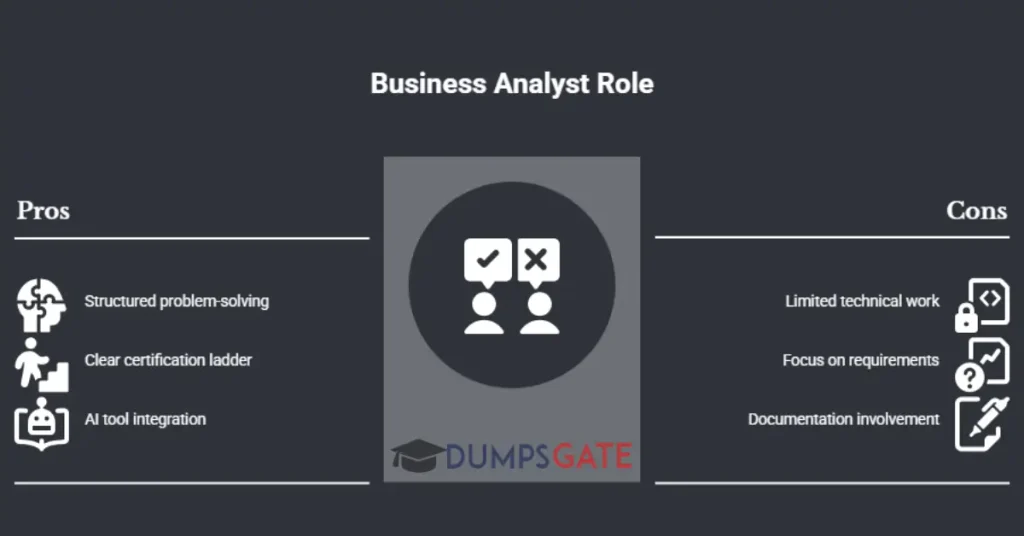
- Choose the business analyst path if:
- You prefer structured problem-solving and stakeholder communication over hands-on coding
- You want a role with a clear certification ladder (ECBA to CBAP) tied to measurable pay increases
- You are comfortable with AI tools handling routine documentation so you can focus on judgment-based analysis
- Reconsider or specialize further if:
- You want primarily technical, hands-on development work (consider a developer or data engineer path instead)
- You want a role centered on statistical modeling rather than requirements and process work (consider data analyst or data scientist)
- You want to skip documentation entirely and focus only on prioritization (consider product owner or product manager)
The job description for a business analyst varies by employer, but the core tasks (elicitation, documentation, stakeholder alignment, and solution validation) remain consistent across the US, UK, Canada, Australia, and India markets covered in this guide.
What to Do Next?
- Job seekers: Compare the certifications above against your experience level and use the seniority ladder to benchmark where you currently sit.
- Hiring managers: Copy the job description template above and adjust the experience and tool requirements to your seniority tier and industry.
- Practicing BAs: Use the AI-shift section to identify which of your current tasks are likely to be automated first, and where to build judgment-based skills instead.
Frequently Asked Questions (FAQs)
What is the main role of a business analyst?
The main role is to identify business needs, translate them into documented requirements, and ensure delivered solutions meet those requirements through testing and validation.
Do business analysts need to know how to code?
Coding is not a universal requirement. SQL is commonly expected for data-heavy BA roles, but general BA work relies more on requirements techniques, stakeholder management, and tools like Excel, Jira, and Visio than on programming.
What qualifications do you need to become a business analyst?
Most employers require a bachelor’s degree, commonly in business, IT, or a related field. No license is legally required, but an IIBA or PMI certification (ECBA, CCBA, CBAP, or PMI-PBA) improves hiring outcomes and is often listed as preferred in job postings.
Is business analyst a good career in 2026?
Demand indicators are positive: 9% projected US job growth through 2034, median pay above the national wage average, and rising employer demand for AI-fluent BAs. The role suits people who prefer structured problem-solving and stakeholder communication over deep technical coding work.
What is the difference between a business analyst and a senior business analyst?
A senior business analyst holds the same core BABOK-based responsibilities as a junior or mid-level BA but owns full project-level requirements strategy, mentors other analysts, and manages more senior stakeholders, rather than performing day-to-day documentation under supervision.
What is the difference between a business analyst and a data analyst?
A business analyst defines business requirements and improves processes, while a data analyst interprets data to answer specific business questions. The two roles often work together: the business analyst identifies what needs to be measured and why, and the data analyst determines what the underlying data actually shows.
Is a business analyst an IT job?
Not necessarily. IT business analysts specialize in technology projects, but the broader role spans finance, healthcare, retail, government, and other industries covered in the types table above. General BA work requires familiarity with IT concepts, not a formal IT job classification.