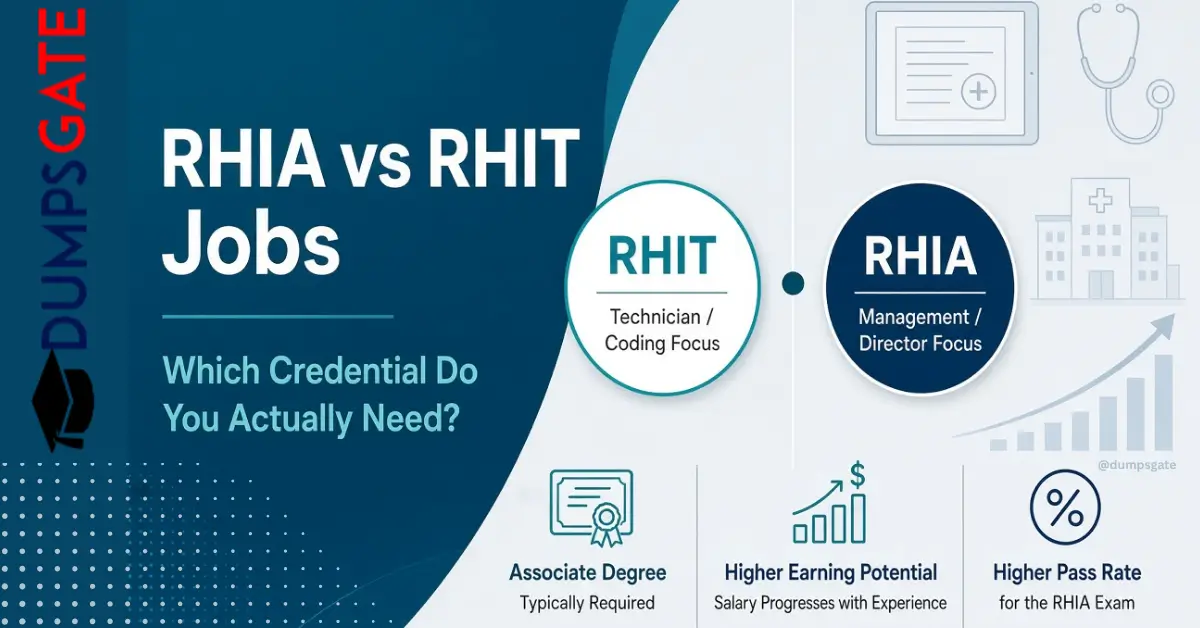
RHIT and RHIA are not competing for the same jobs, so “RHIA vs RHIT jobs” is really two separate questions in one search. RHIT (Registered Health Information Technician) satisfies technician and coding-tier postings. RHIA (Registered Health Information Administrator) satisfies management-tier postings. A meaningful share of job listings explicitly accept either one. The sections below sort real job titles into those three groups, then compare what AHIMA and the Bureau of Labor Statistics actually report about pay, difficulty, and demand for each.
How the Two Credentials Stack Up
Before sorting job titles, here’s how the two credentials compare on paper, pulled directly from AHIMA’s certification pages for RHIA and RHIT.
| Metric | RHIA | RHIT |
| Certified professionals on record (as of 12/31/2025) | 13,848 | 26,128 |
| First-time-tester pass rate, 2025 | 67% | 74% |
| First-time-tester pass rate, 2024 | 71% | 78% |
| First-time-tester pass rate, 2023 | 64% | 84% |
| Number of exam domains | 5 | 6 |
| Minimum education | Bachelor’s or master’s degree, CAHIIM-accredited | Associate’s degree, CAHIIM-accredited |
| Exam length and cost | 150 questions, 3.5 hours, $229 members / $299 non-members | 150 questions, 3.5 hours, $229 members / $299 non-members |
Two things stand out. First, there are nearly twice as many credentialed RHITs as RHIAs, which tracks with the lower entry bar. Second, RHIT has outpaced RHIA every year from 2023 through 2025, sometimes by a wide margin. That gap matters for anyone weighing which exam to prepare for, and this guide covers it in more detail later.
Both credentials also require a CAHIIM-accredited academic program. CAHIIM’s program directory is the only reliable way to confirm a school’s accreditation status before you enroll in either track.
Explore further: RHIA vs RHIT: Which Certification Should You Get in 2026?
The Job Title Sorter
Most “RHIA vs RHIT jobs” searches really want one thing: which specific titles need which credential. Real postings tend to fall into three groups.
An important note before the table: an RHIA satisfies any requirement an RHIT does, since the bar is higher, not different. So “RHIT meets the bar” below means that’s the minimum an employer is asking for, not that RHIA holders are excluded.
| RHIT Meets the Bar | Either Credential Accepted | RHIA Specifically Required |
|---|---|---|
| Coding Specialist | Coding Supervisor | HIM Director |
| Medical Records Technician | Client Services Supervisor (release-of-information vendors) | Privacy/Security Officer |
| Release of Information (ROI) Specialist | Data Quality Analyst | Compliance Manager |
| Entry-level Cancer/Tumor Registrar | Coding Manager | Revenue Cycle Director |
| Document Specialist | HIM Coordinator | Data Governance Manager |
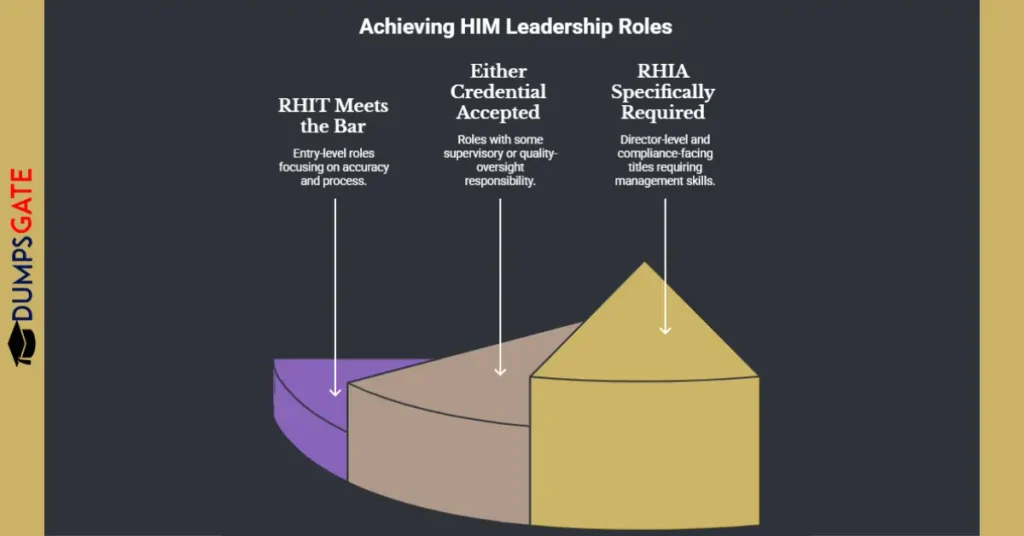
Left column, RHIT meets the bar: these roles focus on accuracy and process, not decision-making authority. A coding specialist assigns diagnosis and procedure codes to patient records for reimbursement. A release-of-information specialist processes requests for medical records while staying inside HIPAA’s disclosure rules. An entry-level cancer or tumor registrar abstracts and tracks oncology case data for a facility’s registry. None of these postings typically ask for supervisory experience, budget authority, or a bachelor’s degree, which is exactly the profile RHIT’s associate-degree eligibility rule is built for.
Middle column, either credential accepted: this is bigger than most people expect. Postings on AHIMA’s own Career Assist Job Bank regularly list requirements like “RHIA, RHIT required” or spell out both credentials as acceptable alternatives for the same role, especially at the coding-manager and supervisor level. One recent example required a bachelor’s degree as preferred but listed the RHIA as required “or” the RHIT, effectively treating them as interchangeable at that tier while still preferring the higher credential. Roles in this column typically carry some supervisory or quality-oversight responsibility (a coding supervisor reviews a team’s work for accuracy, a data quality analyst audits records for completeness) without yet requiring full department-level budget or policy authority.
Right column, RHIA specifically required: this narrows fast, and for a clear reason. Director-level and compliance-facing titles consistently specify RHIA with no RHIT alternative listed, which aligns with AHIMA’s framing of the RHIA as a management-track credential built around budgeting, policy, and cross-department decision-making rather than day-to-day data entry. An HIM director sets department-wide policy and owns the budget. A privacy or security officer carries legal and regulatory accountability for how the organization uses and discloses patient data. A revenue cycle director oversees the financial side of health information, tying documentation quality directly to reimbursement outcomes. Employers writing these postings are looking for the bachelor’s-level training in governance and leadership that only RHIA’s eligibility requirements guarantee.
Delve into the details of: Fastrack Your Healthcare IT Career: The Ultimate RHIA Certification Guide
Where RHIA Certification Actually Gets You Hired
So, what jobs can you get with an RHIA certification, beyond the titles already listed above? RHIA opens roles well beyond hospital HIM departments. AHIMA describes RHIAs as professionals who interact with clinical, financial, administrative, and information-systems teams across an organization, which is why the credential shows up in postings from a wide range of employer types, not just patient-facing healthcare settings.
| Setting | Example RHIA-Eligible Titles | What the Role Involves |
|---|---|---|
| Hospitals & Health Systems | HIM Director, Coding Manager, Privacy Officer | Running the department that governs how records are created, coded, stored, and released |
| Insurance & Payers | Compliance Analyst, Data Quality Manager | Auditing claims data and enforcing data-use compliance tied to reimbursement |
| Software & EHR Vendors | Implementation Specialist, Clinical Informatics Consultant | Configuring and rolling out electronic health record systems for provider clients |
| Consulting Firms | HIM Consultant, Revenue Cycle Consultant | Advising multiple healthcare organizations on documentation, coding, or compliance projects |
| Government Agencies | Health Data Analyst, Program Compliance Officer | Managing public health registries or agency-level HIM policy |
| Education | HIM Program Instructor | Teaching in CAHIIM-accredited HIM programs, usually after several years in the field |
That range is a genuine advantage over RHIT alone. An RHIT can and does work in many of these same settings, but RHIA certification is what unlocks the director and compliance-officer-level postings in each row, the same roles that filled the right-hand column of the job title sorter above. The underlying reason is consistent across every setting: whoever holds these titles is accountable for how sensitive data is governed under legal and ethical standards, not just how it’s entered or coded, and RHIA’s bachelor’s-level training in governance and leadership is designed to certify that accountability.
Learn more about: How Much Does an RHIA Make in 2026?
What Each Credential Tier Actually Pays
The Bureau of Labor Statistics doesn’t track RHIT, and RHIA pay directly, since it classifies workers by occupation, not by credential. But its three closest occupational profiles line up cleanly with the credential tiers already covered here.
| BLS Occupation | Roughly Corresponds To | Median Pay (May 2025) | Entry-Level Education |
| Medical Records Specialists | Entry-level, RHIT-adjacent | $51,140/year | Postsecondary nondegree award |
| Health Information Technologists and Medical Registrars | RHIT tier, bridging to RHIA | $68,020/year | Associate’s degree |
| Medical and Health Services Managers | RHIA tier | $123,860/year | Bachelor’s degree |
Read the first row with a caveat. BLS classifies Medical Records Specialists at a “postsecondary nondegree award” entry level, technically below RHIT’s associate’s-degree requirement, but it’s the closest official profile for the entry-level coding and records work many RHITs actually do first. The other two rows map more precisely: the technologist and registrar tier requires an associate’s degree, matching RHIT, and the management tier requires a bachelor’s degree, matching RHIA.
The gap between the RHIT-tier and RHIA-tier medians is substantial, roughly $56,000 to $72,000 a year depending on which two rows you compare, which is the clearest financial argument for making the RHIA jump if a management career is the goal.
Which Exam Is Actually Harder?
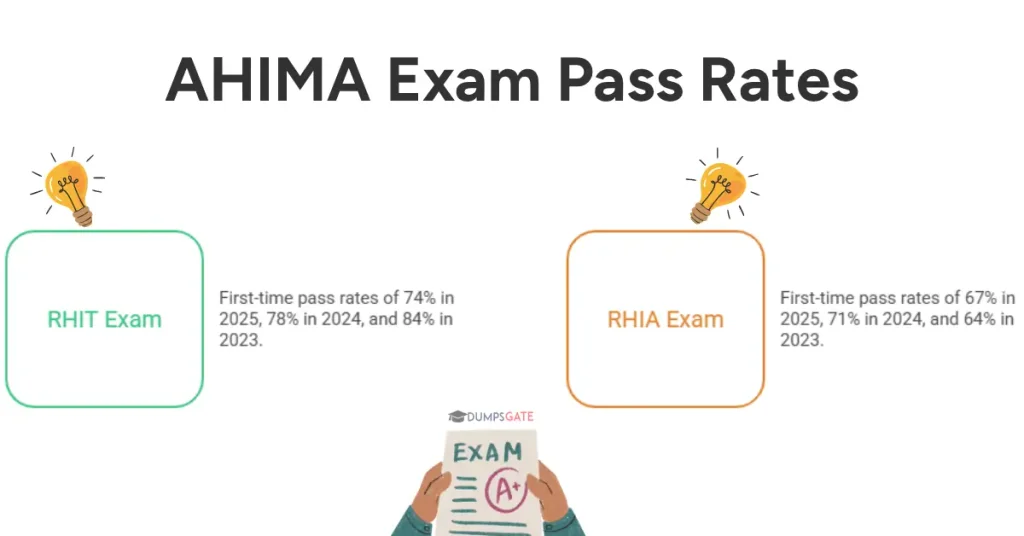
Based on AHIMA’s own published numbers, RHIT is the easier exam to pass on the first attempt. Its first-time pass rate ran 74% in 2025, 78% in 2024, and 84% in 2023, compared to RHIA’s 67%, 71%, and 64% over the same three years. That’s a consistent 7- to 20-point gap in RHIT’s favor every year.
Part of that difference is structural. RHIT’s content outline covers six domains, while RHIA’s covers five, but RHIA’s domains lean more heavily toward management, governance, and revenue strategy, subject matter that tends to require more real-world context to answer confidently than the more technical, process-driven RHIT content. Anyone comparing the two exam content outlines directly can see the domain weighting differences for themselves.
None of this should be read as “RHIA is a bad idea,” since the pass-rate gap simply reflects that it’s testing a harder, more senior skill set. It’s a reason to prepare deliberately, not a reason to avoid the credential.
Can You Have Both? The Bridge Path
Yes, and it’s a common route. Many HIM professionals earn RHIT first, work a few years in a coding or technician-level role, then complete a bachelor’s degree while employed and sit for the RHIA exam once they’re ready for management responsibility. Since RHIA’s eligibility rule only requires a CAHIIM-accredited bachelor’s or master’s degree, not a prior RHIT credential, the RHIT isn’t a mandatory stepping stone, but it’s a practical one: it gets you working and earning sooner while you complete the additional coursework RHIA requires.
For a full breakdown of what that multi-year progression looks like in practice, entry-level titles, mid-career moves, and the eventual jump into management, see our companion guide to the RHIA career path.
Decision Checklist: RHIT or RHIA for Your Target Job
Before committing to either exam, work through this:
- Pull up the actual job postings you’re targeting and check the specific credential requirement listed; don’t assume either credential is universally accepted.
- If you’re aiming for technician or coding-tier work right now, RHIT alone is often enough, and it’s faster and cheaper to earn.
- If you’re aiming for management, compliance, or director-level work, or plan to eventually get there, RHIA is very likely non-negotiable based on how the right-hand column of postings in this guide is written.
- Factor in preparation time realistically. RHIA requires a bachelor’s degree and has posted a lower first-time pass rate than RHIT every year since 2023, meaning it’s a bigger time and study investment, not just a bigger fee.
- If you already hold RHIT, weigh the bridge path in the section above rather than treating this as a one-time either-or decision.
Bottom Line
RHIA vs RHIT jobs isn’t really a competition between two credentials fighting for the same postings. RHIT covers the technician and coding-tier roles, RHIA covers the management tier, and a real slice of postings, especially at the supervisor and coding-manager level, accept either one. Check the specific credential requirement on the postings you’re actually targeting, then work backward from there to decide which exam, or which order, makes sense for your timeline.
Frequently Asked Questions
Can an RHIT do the same job as an RHIA?
For technician and coding-tier work, yes, and many postings even list the two credentials as interchangeable at the supervisor level. For director, compliance, or budget-owning roles, no. Those postings consistently specify RHIA with no RHIT alternative.
Do all RHIA jobs require a bachelor’s degree?
The RHIA credential itself always requires a CAHIIM-accredited bachelor’s or master’s degree to sit for the exam, so anyone holding the credential already meets that bar. Individual job postings may state the degree requirement explicitly or simply list “RHIA required,” which implies the same thing.
Which pays more, RHIT or RHIA?
Based on BLS’s closest occupational matches, the RHIA-aligned tier (Medical and Health Services Managers, median $123,860 in May 2025) pays substantially more than the RHIT-aligned tier (Health Information Technologists and Medical Registrars, median $68,020). The gap reflects the jump from technical to management responsibility, not the credential fee itself.
Is it worth getting RHIA if I already have RHIT?
If your goal is to move into HIM leadership, compliance, or director-level work, yes, since those postings consistently require RHIA specifically. If you’re satisfied at the technician or coding-supervisor tier, the RHIT alone may already cover everything your target roles ask for.
If a job posting lists “RHIT or RHIA,” does having the RHIA give me an edge?
Usually, yes. When a posting accepts either credential, it’s typically signaling that the associate-level RHIT meets the minimum bar, not that both are equally preferred. Since RHIA satisfies the same requirement at a higher level, holding it can still work in your favor even in postings that don’t require it outright.