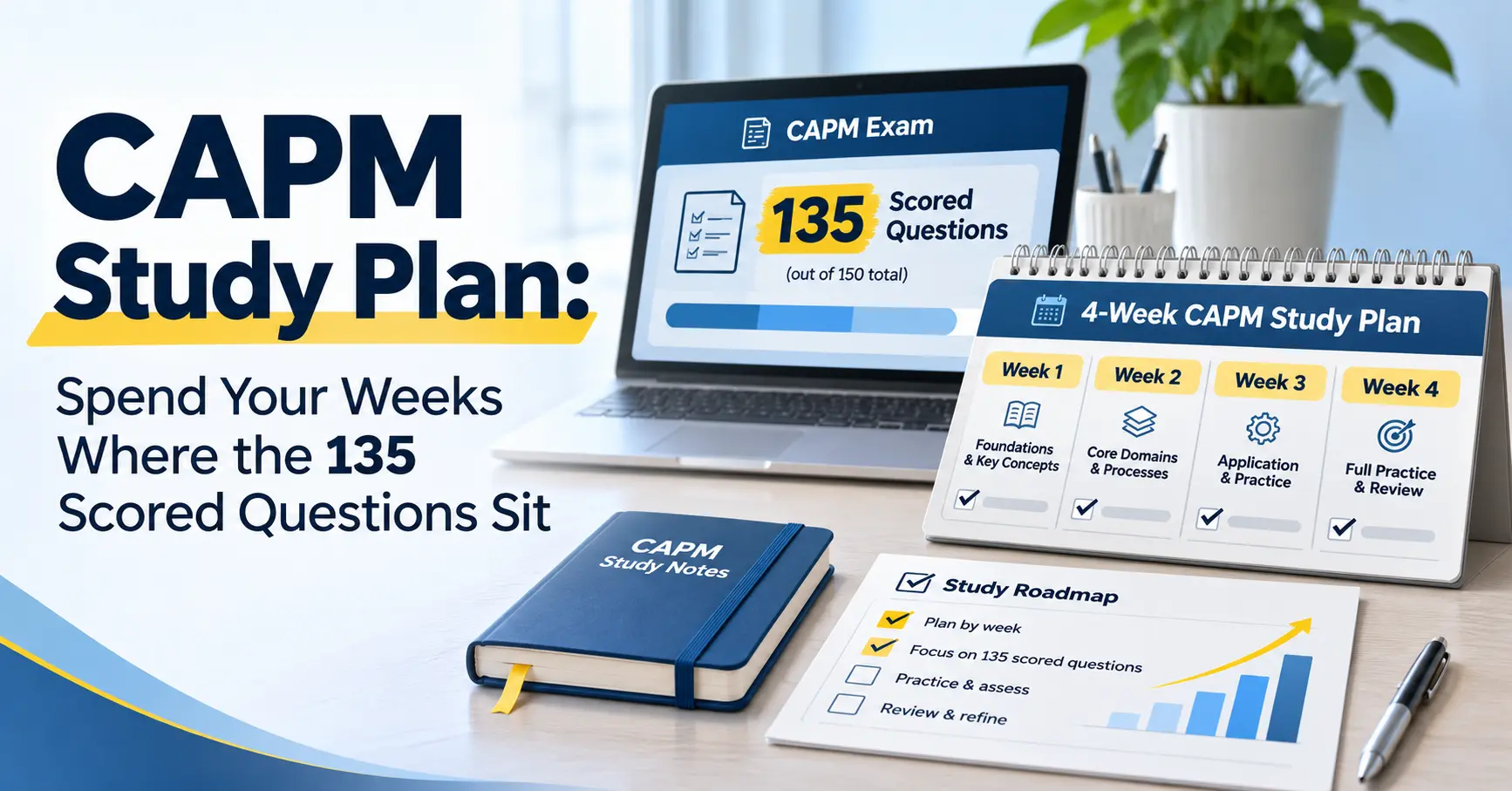
A strong CAPM study plan follows PMI’s exam outline week by week. Spend about two weeks on Fundamentals (36% of questions), two on Business Analysis (27%), and one each on Agile (20%) and Predictive (17%). Then do a timed 150-question run and a repair week. PMI’s outline sets no study-hour target, so stretch or compress the weeks to fit you.
As of November 2026, the outline PMI publishes for the CAPM Certification is its 2023 CAPM Examination Content Outline. Everything below is built on it. If you are booking a 2027 date, open the outline on PMI.org first and confirm it has not been replaced.
What does the CAPM exam test?
These are the facts your plan has to fit, taken from PMI’s outline and its CAPM page.
| Item | What PMI says |
| Questions | 150 total: 135 scored, 15 unscored pretest |
| Time | 180 minutes (3 hours) |
| Break | 10 minutes, after questions 1 to 75; you cannot return to that section afterward |
| Question types | Multiple choice, drag-and-drop, hot spot, animation and comic strip (online proctored candidates see comic strips only) |
| Eligibility | At least 18 years old, a secondary degree (high school diploma, GED or global equivalent), and 23 hours of project management education |
| Attempts | Up to three within a 1-year eligibility period |
| Exam fee (US) | $225 for PMI members, $300 full price |
| Renewal | 15 Professional Development Units (PDUs) in each 3-year cycle |
Fees vary by country, so confirm yours on PMI’s CAPM certification page when you pay.
PMI also notes that predictive, adaptive and business analysis approaches appear across all four domains, not only in their own. So a Fundamentals question can still hinge on whether a project is agile.
Delve into the details of: CAPM Certification Salary in 2026-27: What You’ll Actually Earn by Role, City and Country
Where do the CAPM points sit? The 19 tasks ranked
The outline splits each domain into tasks. Dividing the domain weight by its task count shows how much each task is worth. Multiply the weight by the 135 scored questions to get a rough question count.
| Domain | Weight | Tasks | Approx. scored questions | Weight per task |
| 1. Project Management Fundamentals and Core Concepts | 36% | 5 | about 49 | 7.2% |
| 4. Business Analysis Frameworks | 27% | 6 | about 36 | 4.5% |
| 3. Agile Frameworks/Methodologies | 20% | 5 | 27 | 4.0% |
| 2. Predictive, Plan-Based Methodologies | 17% | 3 | about 23 | 5.7% |
| Total | 100% | 19 | 135 |
PMI says the exact mix of question types varies by exam form, so treat these counts as planning figures, not a promise.
Each Fundamentals task carries about 1.8 times the weight of an Agile task (7.2 ÷ 4.0). Predictive has only three tasks, so each one outweighs any single Agile or Business Analysis task. The weeks below follow these weights.
Dive deeper into: CAPM Certification Cost 2026-27: Spend $400 or $1,800?
How long should you study for CAPM?
The only time figure PMI sets is the 23 hours of project management education, and that makes you eligible, not ready. The outline gives no study-hour target, and the hour ranges published by prep providers cite no PMI data.
So build the calendar from three measures you control: your diagnostic score by domain, the weekly hours you can protect, and how fast your miss log shrinks. Someone who already uses risk registers at work can compress the weeks. A beginner should keep all eight, or stretch to twelve.
Learn more about: Is the CAPM Exam Hard? Here’s the Real Answer No One Gives You
The 8-week CAPM study plan, week by week
Each week names the outline tasks it covers, so you study to PMI’s list rather than a textbook’s chapters.
| Week | ECO tasks | What to study | Checkpoint by Sunday |
| 1 | Setup; Domain 1, tasks 1 to 2 | Download the outline and PMI’s reference list, confirm your 23-hour course, take a diagnostic set, start a miss log. Then study life cycles; project versus program, portfolio and operations; predictive versus adaptive; issues, risks, assumptions and constraints; risk and stakeholder registers; closure | You can label a scenario as a risk, issue, assumption or constraint |
| 2 | Domain 1, tasks 3 to 5 | Project manager versus sponsor versus team roles, leadership versus management, emotional intelligence, the PMI code of ethics, following planned strategies, initiation and benefit planning, meetings and problem-solving tools | You can name who owns the decision in a scenario |
| 3 | Domain 4, tasks 1 to 3 | Stakeholder roles (product owner, process owner and others), internal versus external roles, communication channels, requirements gathering, user stories versus use cases, traceability matrix and backlog | You can match a gathering technique to a situation |
| 4 | Domain 4, tasks 4 to 6 | Product roadmaps and releases, the business analyst’s role in predictive and adaptive work, acceptance criteria, readiness for delivery | You can judge delivery readiness from a traceability matrix or backlog |
| 5 | Domain 3, tasks 1 to 5 | When adaptive fits, iteration planning, turning a WBS into iterations, adaptive artifacts, Scrum, XP, SAFe and Kanban components, prioritization | You can choose predictive or adaptive for a scenario and say why |
| 6 | Domain 2, tasks 1 to 3, then mixed | Critical path, schedule and cost variance, WBS and work packages, quality and integration plans, predictive artifacts. End the week with mixed sets that switch approaches, plus drag-and-drop and hot spot items | You can solve critical path and variance questions without notes |
| 7 | All 19 tasks | One full run: 150 questions in 3 hours, break after question 75, no going back. Review every miss and every guess | Your miss log is tagged by task number |
| 8 | Weakest tasks | Look up only those tasks in PMI’s reference list, retest old misses, add no new sources, book the exam | The readiness check below passes |
For a weight-matched split of any study week, give about 3.6 of every 10 hours to Fundamentals, 2.7 to Business Analysis, 2.0 to Agile and 1.7 to Predictive. Then shift time toward the tasks your miss log flags.
The weekly rhythm
Run five sessions a week, in this order:
- Learn: the week’s tasks.
- Practice: a set on those tasks the same day.
- Review: read every explanation and update the miss log.
- Mix: a set drawn from earlier weeks.
- Retest: old misses only.
Add one longer weekend block for timed practice. Open every session by retesting yesterday’s misses.
The miss log that powers the plan
| Column | What to write |
| ECO task | Domain and task number, for example “Domain 4, task 3” |
| Why missed | Vocabulary, wrong approach (predictive versus adaptive), wrong role, or misread |
| Correct rule | One sentence you can apply next time |
| Retest date | When you will try it again |
Tagging by task number lets you open PMI’s CAPM reference list and read only the book sections mapped to that task.
4-week and 12-week versions
- 4 weeks: combine two weeks into one (1 and 2, 3 and 4, 5 and 6, 7 and 8). Keep the order and the full timed run.
- 12 weeks: keep the eight weeks, add the four extra weeks to the two weakest domains from your diagnostic, and do a second full timed run in week 11.
Readiness check before you book
- You have practiced every one of the 19 tasks.
- You have finished a full 150-question timed run under the break rule.
- Your miss log shrinks week over week.
- You can explain why each wrong option is wrong.
- No domain trails the others.
Distinguish Between: PMP VS CAPM: What Sets Them Apart?
How do you practice for CAPM exam day?
- Pace: 180 minutes across 150 questions averages 72 seconds per question, or 90 minutes per 75-question section if split evenly.
- Break rule: review and flag everything in section one before you pause, because it locks.
- Item types: practice drag-and-drop, hot spot, and comic-strip items. Online testers see comic strips, not animations.
- Extras: the optional 5- to 15-minute tutorial and survey do not count against the 3 hours.
Common mistakes that waste CAPM study time
- Old structures: studying from material organized around the ten knowledge areas, which predates the four-domain exam.
- Course as plan: treating the 23-hour course as the whole plan.
- Late Business Analysis: leaving it for last, though it is 27% of the exam.
- No predictive math: skipping it, though each Predictive task carries 5.7% of the exam.
When should you apply and book?
You record all 23 education hours in your application, and the coursework must be complete by your exam. PMI processes registrations in 24 hours or less unless it selects yours for audit.
Approval opens a 1-year eligibility period with up to three attempts. A failed attempt means paying again. PMI’s outline says retakes within your eligibility period are discounted, but it doesn’t publish the amount. That’s the practical reason the plan holds booking until the readiness check passes.
Apply once your course certificate is in hand, which keeps an audit out of week 8. Book when the readiness check passes.
For More Information: Is CAPM Certification Worth It in 2027? 1 Day’s Pay in the US, 7.5 in India.
Verdict: which CAPM study plan pace fits you?
- New to projects: run all 8 weeks, or the 12-week version.
- Already on a project team: use the 4-week version, and let the diagnostic tell you which weeks to compress.
- Comparing project management certifications or other PMI certifications: CAPM’s eligibility lists no work-experience requirement, so this plan can start today.
CAPM study plan FAQs
Is the 23-hour course enough to pass CAPM?
It meets PMI’s education requirement, but it is not a readiness test. Most of a CAPM study plan is the practice and review that come after the course.
Do you need project management experience for CAPM?
No. PMI’s eligibility rules list a minimum age of 18, a secondary degree, and 23 hours of project management education. PMI also says people without project experience can benefit from the certification.
Is the CAPM exam based on the PMBOK Guide?
Not only on it. PMI says each question can be found in at least two references, the PMBOK Guide Seventh Edition among them, and that the task force that shaped the outline was not bound by the PMBOK Guide. Study the outline and use the books for support.
How many times can you take the CAPM exam?
Up to three times within your 1-year eligibility period. After a third attempt, you must wait one year from your last exam before reapplying.
Can you go back to questions after the CAPM break?
No. The break comes after questions 1 to 75, once you have reviewed your answers. After it starts, that section is closed.
How do you keep your CAPM?
Earn 15 PDUs in each 3-year cycle. PMI counts one PDU per hour of activities such as learning, teaching, reading, or volunteering.