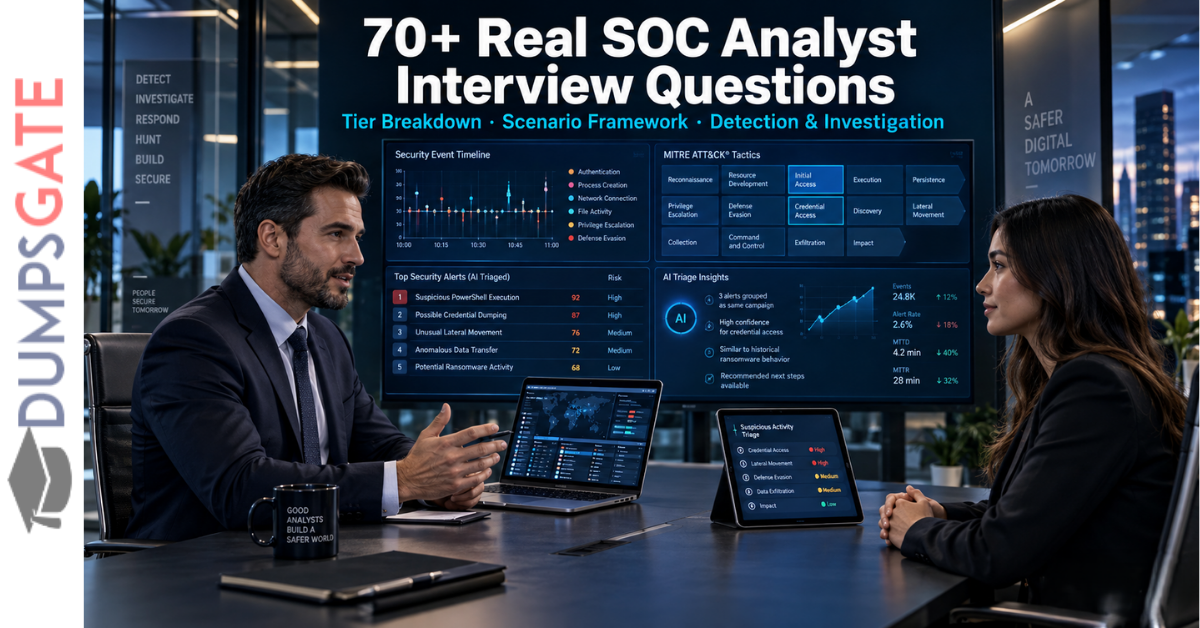
SOC analyst interview questions in 2026 test three things: security fundamentals (CIA triad, TCP/IP, log sources), live investigation reasoning (scenario walkthroughs, SIEM queries), and judgment under an AI-assisted workflow (knowing when to override an automated triage verdict).
Difficulty rises sharply by tier: Tier 1 loops are fundamentals-heavy and typically clear in one or two rounds, while Tier 2 and Tier 3 loops add live query writing, log walkthroughs, and detection-engineering exercises across three or more rounds. Below are 73 real SOC analyst interview questions and answers, organized into 7 categories, plus the tier breakdown, salary data, certification guidance, and practical interview tips you need to decide how much prep you actually need.
Demand for the role remains strong regardless of difficulty: the U.S. Bureau of Labor Statistics projects information security analyst employment to grow 21% from 2025 to 2035, with about 14,100 openings projected annually.
SOC Analyst Interview Snapshot (2026)
| Factor | Reality |
|---|---|
| Difficulty | Moderate at Tier 1 (definitions, basic networking). Hard at Tier 2/Tier 3 (live SIEM queries, detection rules, cloud log analysis). |
| Formal pass rate | Not published. This is a private employer interview, not a standardized exam. The closest official benchmark is GIAC’s GCIH certification passing bar, set at 69% for exam versions released after May 10, 2025. |
| Realistic prep window | 2 to 3 weeks for Tier 1 fundamentals. 4 to 6 weeks if the loop includes live query writing or a scenario-based investigation round. |
| Job market context | 21% projected growth, 2025 to 2035, and roughly 14,100 annual openings for information security analysts (BLS). |
| Median pay (US, all information security analysts) | $129,180/year as of May 2025, range $75,090 to $199,850+ (BLS). |
Explore this SOC Analyst Roadmap to understand the skills, tools, certifications, and career steps needed to become a SOC Analyst.
What Is Different About SOC Analyst Interview Questions in 2026?
SIEM platforms now ship built-in AI triage layers that pre-rank alerts before an analyst sees them. This changed what interviews test.
- Fundamentals questions (CIA triad, ports, TCP handshake) still open most loops but rarely decide the outcome alone.
- Cloud-native log analysis (AWS CloudTrail, GuardDuty findings, Azure Sentinel with KQL) now appears in Tier 2/Tier 3 loops that used to be Splunk/on-prem only.
- A newer question pattern checks whether a candidate can disagree with an AI-generated alert verdict and justify the disagreement with evidence, rather than accepting it by default.
- Detection engineering (writing or reviewing a Sigma rule, mapping behavior to a MITRE ATT&CK technique) has moved from a Tier 3 “nice to have” into a standard part of senior technical screens.
💡 Interview Tip: If asked whether you’d trust an AI triage verdict, never say yes by default. This question specifically filters out candidates who defer to automation without verifying it themselves.
How Do SOC Analyst Interview Questions Differ by Tier (L1, L2, L3)?
Interview questions for SOC analyst roles are not uniform. The tier of the role determines both the format and the depth of what is asked.
| Tier | Interview Focus | Common Question Format | Example Question |
|---|---|---|---|
| Tier 1 (Monitoring/Triage) | Fundamentals, alert triage logic | Verbal Q&A, short scenarios | “Here’s an alert. What do you check in the first 10 minutes?” |
| Tier 2 (Investigation) | Log correlation, SIEM query writing | Live query exercise, walkthrough | “Write a query to find failed logins followed by a success from the same IP within 5 minutes.” |
| Tier 3 (Threat Hunting/Detection Engineering) | Hypothesis-driven hunting, rule authoring, cloud SOC | Written exercise, cloud scenario | “Draft a detection rule for PowerShell using EncodedCommand to pull a payload from SharePoint.” |
Tier 1 loops usually run 1 to 2 rounds and close fastest. Tier 2 and Tier 3 loops commonly run 3 or more rounds, including at least one live technical exercise.
The Complete List: 73 SOC Analyst Interview Questions and Answers
The questions below are grouped into 7 categories that mirror how real SOC hiring loops are structured, from fundamentals through scenario-based investigation to behavioral fit.
Networking & Security Fundamentals Interview Questions
1. What is the CIA triad?
Answer: Confidentiality, integrity, and availability: the three core properties every security control is designed to protect.
2. What is the difference between a threat, a vulnerability, and a risk?
Answer: A threat is a potential cause of harm. A vulnerability is a weakness that could be exploited. Risk is the likelihood and impact of a threat actually exploiting a vulnerability.
3. Explain the TCP three-way handshake.
Answer: SYN, SYN-ACK, ACK. The client sends a SYN with a sequence number, the server replies with SYN-ACK acknowledging it, and the client sends a final ACK to establish the connection.
4. What is the difference between TCP and UDP?
Answer: TCP is connection-oriented and reliable, retransmitting lost packets. UDP is connectionless and faster, but delivery is not guaranteed.
5. What happens when you type a URL into a browser?
Answer: DNS resolution finds the IP address, a TCP handshake and TLS negotiation establish a secure channel, then an HTTP request and response render the page.
6. What do ports 22, 25, 53, 80, 443, 445, and 3389 correspond to?
Answer: SSH, SMTP, DNS, HTTP, HTTPS, SMB, and RDP. An unexpected alert on any of these should be checked against the asset’s normal role.
7. What is the difference between symmetric and asymmetric encryption?
Answer: Symmetric encryption uses one shared key for both encryption and decryption. Asymmetric encryption uses a public and private key pair. TLS uses both together: asymmetric to exchange a key, symmetric for the session.
8. What is a firewall and how does it work?
Answer: A control that filters network traffic based on rules such as IP, port, and protocol. Stateful firewalls also track the context of active connections.
9. What is defense-in-depth?
Answer: A layered security strategy where multiple independent controls compensate for each other, so a single failure does not lead to a full compromise.
10. What is the difference between an IDS and an IPS?
Answer: An IDS monitors traffic and generates alerts. An IPS monitors traffic and can actively block it in real time.
11. What is a VPN, and why does it matter to a SOC analyst?
Answer: A VPN encrypts traffic between endpoints. VPN logs are a common source for spotting anomalous remote access, such as logins from unexpected locations.
12. What is DNS tunneling?
Answer: Using DNS queries to exfiltrate data or maintain a covert command-and-control channel, since DNS traffic is rarely blocked by default.
13. What is the difference between authentication and authorization?
Answer: Authentication verifies who a user is. Authorization determines what that authenticated user is allowed to access or do.
14. What is Zero Trust?
Answer: A security model that assumes no implicit trust for any user or device, requiring continuous verification for every access request regardless of network location.
💡 Interview Tip: If you don’t know a fundamentals answer, say so directly, then explain how you’d find it. This signals research instinct, which interviewers weight heavily for entry-level candidates, more than a confident but wrong guess.
SIEM, Logging & Detection Interview Questions
15. What is a SIEM, and how does it work end to end?
Answer: Logs are generated by systems, ingested and normalized into a common format, run against correlation rules, and any match generates an alert for an analyst to review.
16. What is the difference between an IOC and an IOA?
Answer: An IOC (indicator of compromise) is a static artifact such as a hash, IP, or domain. An IOA (indicator of attack) is a behavioral pattern showing an attacker technique in progress, defined within the MITRE ATT&CK framework. IOAs are generally more durable since attackers rotate IOCs easily.
17. Differentiate true positive, false positive, and false negative.
Answer: A true positive correctly flags a real threat. A false positive incorrectly flags benign activity as malicious. A false negative misses a real threat entirely, which is the most costly outcome for a SOC.
18. What is alert fatigue, and how do you manage it?
Answer: Overexposure to a high volume of low-value alerts, which increases the risk of missing real threats. Managed through rule tuning, suppression of known-benign patterns, and severity-based prioritization.
19. What event logs are available by default on Windows?
Answer: System, Application, Security, Setup, and Forwarded Events logs, each covering a different category of activity.
20. What is log correlation?
Answer: Combining events from multiple log sources to identify a pattern that no single log would reveal on its own, such as linking a failed login to a later privilege change.
21. What is the difference between signature-based and behavior-based detection?
Answer: Signature-based detection matches known patterns and is fast but blind to new threats. Behavior-based detection flags deviations from a baseline, which can catch novel attacks but requires more tuning.
22. What does the detection rule tuning process look like?
Answer: Review the alert’s recent firings, cluster them by source and pattern, apply a targeted suppression for confirmed noise, and set a review date rather than disabling the rule outright.
23. What is MITRE ATT&CK, and how is it used in a SOC?
Answer: A publicly maintained knowledge base of adversary tactics and techniques, used to map existing detections against real attacker behavior and identify coverage gaps.
24. What is a Sigma rule?
Answer: A generic, platform-agnostic format for writing detection logic, which can then be converted into SIEM-specific query syntax such as Splunk SPL or Microsoft Sentinel KQL.
25. What is baseline behavior, and why does it matter?
Answer: The normal activity pattern for a given user, host, or network segment. Deviations from that baseline are one of the primary triggers for behavior-based detection.
26. What is the difference between a SOC and a NOC?
Answer: A SOC (Security Operations Center) focuses on detecting and responding to security threats. A NOC (Network Operations Center) focuses on network performance and uptime.
💡 Interview Tip: When asked to define IOC vs. IOA, go beyond the textbook definition and explain why IOAs are harder for attackers to evade. Interviewers are testing detection philosophy here, not vocabulary recall.
Incident Response & Forensics Interview Questions
27. What are the phases of the incident response lifecycle?
Answer: NIST SP 800-61 defines four phases: Preparation, Detection and Analysis, Containment/Eradication/Recovery, and Post-Incident Activity. A SOC analyst’s core responsibility sits mainly in Detection and Analysis, plus early Containment.
28. What is the difference between containment and eradication?
Answer: Containment limits the spread or impact of an incident. Eradication removes the root cause, such as malware, a backdoor, or a compromised credential.
29. What is chain of custody, and why does it matter?
Answer: The documented handling of evidence from collection to storage, which preserves its integrity and legal admissibility if the incident leads to legal or HR action.
30. What is a memory dump, and when would you collect one?
Answer: A snapshot of a system’s memory at a point in time. Useful for detecting fileless malware or capturing the state of running processes before a system is rebuilt.
31. What is the MFT (Master File Table) used for in forensics?
Answer: It stores metadata for every file on an NTFS volume, which can help identify deleted, renamed, or hidden files during an investigation.
32. What are Windows Prefetch files, and why are they useful?
Answer: They track recently executed applications on a system, which helps investigators establish an execution timeline during an incident.
33. What forensic artifacts would you collect from a Linux host?
Answer: Bash history, system logs, package manager logs, the contents of /tmp, and a memory dump if the incident warrants deeper analysis.
34. What is root cause analysis in incident response?
Answer: Identifying the true underlying cause of an incident rather than just resolving its immediate symptom, so the same issue does not recur.
35. What is a post-incident review or lessons-learned session?
Answer: A structured review after an incident to document what happened, what worked, and what should change in process, tooling, or detection coverage.
36. What is the difference between an event and an incident?
Answer: An event is any observable occurrence on a system or network. An incident is an event that has been confirmed to violate security policy or cause actual harm.
37. How do you prioritize incidents in a SOC?
Answer: Based on severity, potential business impact, and the criticality of the affected system or data, so the most dangerous threats are addressed first.
38. What should an incident report include?
Answer: A clear timeline, the nature and scope of the incident, its impact, the response actions taken, and the final resolution, kept as a record for compliance and future prevention.
💡 Interview Tip: Name all four NIST IR phases even if you can’t recall the exact SP 800-61 wording. Missing a phase entirely looks worse than paraphrasing its label in your own words.
Malware, Attacks & Threats Interview Questions
39. What is the difference between a virus, a worm, and a trojan?
Answer: A virus needs a host file and user action to spread. A worm self-replicates across a network without user action. A Trojan disguises itself as legitimate software to gain access.
40. What is ransomware, and how should a SOC respond?
Answer: Malware that encrypts data and demands payment for its release. Response includes isolating affected systems, identifying the infection vector, and restoring from clean, verified backups.
41. What is a zero-day exploit?
Answer: An exploit that targets a vulnerability unknown to the vendor, meaning no patch exists at the time of the attack.
42. What is a DDoS attack?
Answer: A Distributed Denial of Service attack overwhelms a system or network with traffic, making it unavailable to legitimate users.
43. What is lateral movement?
Answer: An attacker moving between systems after initial access, often using stolen credentials, remote execution tools, or shared administrative access.
44. What is credential dumping?
Answer: Extracting stored credentials, often from a process such as LSASS memory, to enable further access or privilege escalation across an environment.
45. What is a supply chain attack?
Answer: Compromising a trusted third-party vendor, library, or software update in order to reach the intended target indirectly.
46. What is business email compromise (BEC)?
Answer: A social engineering attack that impersonates an executive, vendor, or partner to redirect payments or extract sensitive data.
47. What is data exfiltration, and how is it detected?
Answer: The unauthorized transfer of data outside the organization, typically detected through unusual outbound data volume, an unfamiliar destination, or abnormal timing.
48. What is a kerberoasting attack?
Answer: Requesting service tickets for accounts configured with weak encryption, then cracking them offline to obtain service account credentials.
💡 Interview Tip: Don’t stop at the definition for ransomware or DDoS questions. Add the specific response action (isolate, identify the vector, restore from a clean backup) since that is usually what’s actually being scored.
SOC Analyst Scenario-Based Interview Questions and Answers
Scenario questions decide most SOC analyst hiring outcomes, more than fundamentals recall. Apply one repeatable structure to every scenario instead of memorizing separate answers: Verify → Scope → Correlate → Decide → Document.
- Verify: Confirm what the alert is actually detecting and whether the asset/user involved is real and in scope.
- Scope: Establish the time window, source, destination, and whether the activity is isolated or spreading.
- Correlate: Check supporting evidence across identity logs, endpoint telemetry, and network logs.
- Decide: Choose to close, escalate, or contain, based on the evidence gathered, not on instinct.
- Document: Record what was checked and why, so the decision is auditable and the detection can be tuned.
💡 Interview Tip: Never open a scenario answer with “I would escalate to Tier 2.” Escalating without first walking through Verify and Scope signals you skipped the investigation, even if escalation is the right eventual call.
A weak answer to “an IP address appears in an alert, what do you do” is simply “I would block it.” A strong answer applies the framework: classify the IP as internal/external and new/known, scope which hosts contacted it, correlate with DNS and authentication logs, decide whether to escalate with evidence, then document the classification. The same structure applies to every question below.
49. An alert shows 2,000 failed logon attempts in a short window. What do you do?
Answer: Identify the logon type and targeted account, confirm the pattern is automated rather than human, scope the source host, and check for a subsequent successful logon before recommending containment.
50. A user reports clicking a phishing link. What is your first step?
Answer: Verify exactly what was clicked or entered, then scope for follow-on activity such as new logins, mailbox rule changes, or execution, before deciding on containment.
51. You see an unfamiliar IP address in an alert. What do you check first?
Answer: Classify the IP as internal or external and known or new, then correlate it with DNS and authentication logs before deciding whether to escalate or block.
52. Suspicious PowerShell activity appears on an endpoint. How do you investigate?
Answer: Determine whether it matches expected admin activity, then check the parent process, command-line arguments, and any external network connections it made.
53. A privileged account logs in from a new country at 3 a.m. What do you do in the first 10 minutes?
Answer: Pull the source IP, check for other authentication events from that IP, review the user’s normal access pattern, and check MFA activity before escalating with that evidence attached.
54. The SIEM’s AI-based triage marks an alert as a false positive, but you disagree. What do you do?
Answer: Identify the specific indicators the model may have missed, gather corroborating evidence from another log source, and escalate with a documented justification so the rule can be returned.
55. A noisy alert fires 200 times a day, and Tier 1 is starting to ignore it. How do you fix it?
Answer: Review the last 100 firings, identify the common noise pattern, apply a targeted suppression, and set a review date, without disabling the underlying detection.
56. You find a potentially malicious Windows binary. What are your first steps?
Answer: Check its hash against a tool such as VirusTotal, then consider sandboxed execution and process monitoring if the initial check is inconclusive.
57. A domain controller shows signs of compromise. What do you weigh before isolating it?
Answer: The trade-off between stopping the attacker immediately and preserving live evidence, against the operational cost of isolating production infrastructure.
58. How would you investigate a suspicious AWS console login from an unusual region?
Answer: Review CloudTrail for the session, check the IAM policy and recent API calls tied to the user, and look for newly created access keys or unexpected role assumptions.
SOC Analyst Tools, Cloud & Interview Questions
59. What SIEM platforms should a SOC analyst be familiar with?
Answer: Splunk, Microsoft Sentinel, IBM QRadar, and Elastic are the platforms most commonly referenced in SOC analyst interviews.
60. What is the difference between EDR and XDR?
Answer: EDR focuses on endpoint telemetry and response. XDR correlates data across endpoints, network, and cloud sources for broader, cross-layer detection.
61. What is a SOAR platform used for?
Answer: Automating repetitive response actions, such as blocking an IP or disabling an account, through predefined playbooks triggered by specific alert types.
62. What cloud-native security tools are commonly tested in interviews?
Answer: AWS GuardDuty and CloudTrail, Azure Sentinel and Defender for Cloud, and Google Cloud Security Command Center are the most frequently referenced.
63. What is a case management or ticketing system used for in a SOC?
Answer: It tracks an incident from initial detection through resolution, giving the team accountability and an auditable record of every response action.
64. What is the difference between a vulnerability scanner and a penetration test?
Answer: A vulnerability scanner automates the discovery of known weaknesses. A penetration test simulates an actual attack to validate whether those weaknesses are exploitable and what impact they’d have.
65. What is threat intelligence, and how is it used in a SOC?
Answer: Contextual information about threats, threat actors, and indicators, used to prioritize alerts and inform proactive defensive measures.
66. What is the NICE Cybersecurity Workforce Framework?
Answer: A framework used to define cybersecurity roles, tasks, and required skills, commonly referenced in U.S. federal and federally aligned training programs.
💡 Interview Tip: If you’ve only used one SIEM platform, say so directly and describe a specific query or dashboard you built in it. A specific answer about one tool beats a vague answer that name-drops three you’ve barely touched.
Behavioral & Soft-Skill SOC Analyst Interview Questions
67. How do you stay current with security news and threats?
Answer: Strong answers name specific sources, such as vendor threat research blogs, CISA advisories, or practitioner communities, rather than a vague reference to “reading the news.”
68. Tell me about a time you made a mistake during an investigation.
Answer: Strong answers describe what was missed, the consequence, and the specific change made to the workflow afterward, rather than avoiding the question.
69. How do you explain a technical incident to a non-technical stakeholder?
Answer: Focus on what happened, what it means, what was done, and what is recommended next, avoiding jargon and leading with business impact.
70. How do you handle a shift where alert volume is far above normal?
Answer: Prioritize by severity and business impact, communicate likely delays proactively, and document clearly what was deferred and why.
71. How do you respond to a frustrated user whose device you just isolated for forensics?
Answer: Acknowledge the disruption directly, briefly explain why isolation was necessary, and give a realistic timeframe for resolution.
72. What would you do if you disagreed with a Tier 3 lead’s decision on an incident?
Answer: Present the evidence supporting your view clearly and calmly, then defer to the final decision once made, while documenting the disagreement for the record.
73. Why do you want to work in a SOC?
Answer: Strong answers reference specific, demonstrable interest, such as home lab work, CTF experience, or prior IT exposure, rather than generic enthusiasm for cybersecurity.
💡 Interview Tip: For the “tell me about a mistake” question, pick an error with a clear, specific fix afterward. A mistake with no described process change reads as unresolved, not humble.
Which Certifications Help You Pass a SOC Analyst Interview?
Certifications do not replace a live technical screen, but they set the vocabulary and depth an interviewer will expect a candidate to already know.
| Certification | Issuing Body | Best Aligned Tier |
|---|---|---|
| Security+ | CompTIA | Tier 1 entry point |
| Certified SOC Analyst (CSA) | EC-Council | Tier 1 to Tier 2 |
| GIAC Certified Incident Handler (GCIH) | GIAC | Tier 2 to Tier 3 |
GCIH’s exam uses a hands-on, lab-based format (CyberLive) rather than pure multiple-choice, with a passing score of 69% for exam versions released after May 10, 2025, per GIAC’s own certification page linked above. This lab-based format mirrors the live-query and scenario exercises used in Tier 2/Tier 3 interviews.
💡 Interview Tip: Listing a certification you can’t speak to in depth is a bigger red flag than not having it at all. Be ready to explain one specific concept from each certification you list on your resume.
What Does a SOC Analyst Earn in 2026, and Should You Discuss Salary in the Interview?
The BLS reports a $129,180 median annual wage for information security analysts as of May 2025, with the lowest 10% earning under $75,090 and the highest 10% earning over $199,850 (BLS). This figure covers the full information security analyst occupational category, which spans SOC roles across all three tiers, so entry-level Tier 1 pay typically sits below the median and senior Tier 3/detection-engineering pay sits above it.
When salary comes up, give a range rather than a single number or a non-answer like “negotiable.” Interviewers use vague responses as a weak signal regardless of technical performance.
💡 Interview Tip: Anchor your number to the tier you’re interviewing for, not the occupation-wide median. Quoting the $129,180 median for a Tier 1 role signals you haven’t researched the pay band for the seat itself.
Learn about the expected pay, influencing factors, and career growth in this Entry-Level SOC Analyst Salary Guide.
Do SOC Analyst Interview Questions Differ Across the US, Europe, Australia, India, and Canada?
Core technical questions (SIEM logic, the MITRE ATT&CK framework, NIST-style incident response phases) are consistent globally, since SOC tooling and frameworks are largely US-developed and internationally adopted. What differs by region is the compliance and regulatory layer layered on top of scenario questions.
| Region | Regulatory Context Likely to Come Up | Authority |
|---|---|---|
| United Kingdom / EU | GDPR breach-notification timelines, NIS2 reporting obligations | UK National Cyber Security Centre |
| Australia | Essential Eight mitigation strategies, mandatory breach reporting | Australian Cyber Security Centre |
| India | CERT-In’s 6-hour incident reporting mandate | CERT-In |
| Canada | PIPEDA breach obligations | Canadian Centre for Cyber Security |
Candidates interviewing outside the US should expect one regulatory-context question added to an otherwise identical technical loop, not a fundamentally different interview.
Want These 73 Questions as a Printable PDF?
Everything above is also available as a formatted, offline-ready PDF, organized by the same 7 categories with the 5-step scenario framework included as a quick-reference page. Useful for studying without a screen or printing for a final review before an interview.
Do You Need to Memorize a List of 100 SOC Analyst Interview Questions?
No. “Top 100” question banks are almost always the same 20 to 25 root concepts rephrased at different difficulty levels, not 100 distinct topics. The 73 questions above already cover every major category that a typical “Top 100” list draws from:
| Root Category | Approx. Share of a Typical “Top 100” List | Covered Above |
|---|---|---|
| Networking and protocols | ~20% | Questions 1-14 |
| SIEM, logging, and detection concepts | ~25% | Questions 15-26 |
| Incident response and forensics | ~20% | Questions 27-38 |
| Malware and attack types | ~15% | Questions 39-48 |
| Tools (EDR, threat intel platforms) | ~10% | Questions 59-66 |
| Behavioral/soft-skill questions | ~10% | Questions 67-73 |
Studying the categories above with real depth covers the same ground as memorizing 100 individual questions, in a fraction of the time.
Frequently Asked Questions (FAQs)
What questions are asked in a SOC analyst interview?
Interviews combine networking and security fundamentals (CIA triad, TCP handshake, IOC vs. IOA), a walkthrough of the incident response lifecycle, and one or more scenario-based questions such as phishing triage or suspicious login investigation.
Is the SOC analyst interview hard?
Tier 1 interviews are moderate difficulty and fundamentals-focused. Tier 2 and Tier 3 interviews are harder, adding live SIEM query writing, log walkthroughs, and detection-engineering exercises across multiple rounds.
What is the difference between SOC Analyst L1, L2, and L3 interview questions?
L1 questions test triage and fundamentals. L2 questions test investigation depth and query writing. L3 questions test threat hunting, detection rule authoring, and cloud SOC scenarios.
What certifications help with a SOC analyst interview?
CompTIA Security+ supports Tier 1 readiness, EC-Council’s CSA targets Tier 1/2 SOC-specific workflows, and GIAC’s GCIH supports Tier 2/3 incident-handling depth. Links to each official certification page are listed above.
Do I need a degree to become a SOC analyst?
Employers commonly list a bachelor’s degree as a typical entry requirement for information security analyst roles, per BLS occupational data, but certifications and demonstrable SIEM/log-analysis skills are frequently accepted as equivalent by individual employers.