Pick SailPoint if any part of your identity governance must run on-premises, you have mainframe or heavily customized applications, or you want the largest partner and talent ecosystem. Pick Saviynt if you are cloud-first and want identity governance (IGA), privileged access management (PAM), and application-level segregation of duties (SoD) on one platform under one contract.
Both are enterprise-grade. The decision turns on three things: where the platform must run, whether you are buying PAM in the same deal, and how your identity data is shaped.
How does Saviynt IGA vs SailPoint compare at a glance?
| Factor | SailPoint | Saviynt |
|---|---|---|
| Products | IdentityIQ (IIQ, self-hosted) and Identity Security Cloud (ISC, multi-tenant SaaS) | Saviynt Identity Cloud (cloud-native SaaS) |
| Company | Public (Nasdaq: SAIL), larger installed base | Private, venture and growth-equity backed |
| Privileged access | Governs PAM tools such as CyberArk through integrations; just-in-time elevation in Agentic tiers | Native PAM on the same platform as IGA |
| SAP and ERP SoD | Access Risk Management add-on | Application Access Governance solution |
| AI agents and non-human identities | Agentic Fabric, plus Entro (acquired 2026) | Zuma (launched 2026) |
| Best fit | Hybrid estates, legacy apps, deep customization | Cloud-first estates consolidating IGA and PAM |
SailPoint vs Saviynt market share: who is bigger in 2027?
SailPoint is roughly four times Saviynt’s size by recurring revenue (our calculation from the figures below). Neither Gartner nor KuppingerCole publishes free IGA market-share figures, so annual recurring revenue (ARR) is the cleanest public proxy.
- SailPoint: ARR reached $1.231 billion in the quarter ended July 31, 2026, up 25% year over year, with $847 million from SaaS.
- Saviynt: ARR passed $300 million in July 2026, with bookings up more than 80% and 96% customer retention.
Read the growth numbers carefully. SailPoint reports ARR growth; Saviynt reports bookings growth. They measure different things, so “80% vs 25%” is not a like-for-like comparison.
What size means for a buyer: a larger installed base usually means more certified consultants, more community answers and more pre-built integrations. A smaller, fast-growing vendor usually means more negotiating leverage and faster roadmap response to your requests.
Saviynt vs SailPoint cost: is Saviynt cheaper?
Nobody can prove Saviynt is cheaper, because Saviynt publishes no prices. SailPoint publishes one per-identity rate and has real buyer-spend data. A typical SailPoint contract is a six-figure annual commitment. For Saviynt, expect to need a quote before you can compare.
What do SailPoint and Saviynt actually cost?
SailPoint (published and buyer-reported figures):
- Published rate: SailPoint’s Identity Security Accelerator, which pairs its governance engine with application discovery, costs $5.65 per identity per month with a 2,500-identity minimum through the AWS Security Hub Extended plan.
- What buyers pay: the median SailPoint buyer pays $109,835 per year, across 39 purchases tracked by Vendr, with a range of $21,086 to $528,594.
- By company size: SpendHound’s data from 160 SailPoint customers puts average annual spend at $56,258 for companies with 50 to 1,000 employees and $720,393 for those above 1,000, with enterprise pricing up 14.04% year over year.
Saviynt: no list price, no per-identity rate, and its AWS Marketplace listings are private offer only. When we checked on November 2, 2026, neither Vendr nor SpendHound published Saviynt transaction data.
What the SailPoint rate means at your size (our calculation, Accelerator bundle only):
| Identities | Monthly | Annual | Per identity per year |
|---|---|---|---|
| 2,500 (minimum) | $14,125 | $169,500 | $67.80 |
| 5,000 | $28,250 | $339,000 | $67.80 |
| 10,000 | $56,500 | $678,000 | $67.80 |
Two things stand out. First, the median Vendr contract ($109,835) would cover only about 1,620 identities at the published rate, below the bundle’s own minimum, so many buyers clearly enter through smaller direct contracts instead. Use $67.80 per identity per year as a public benchmark: if a direct quote for comparable scope comes in above it, you have a documented reason to push back. Second, the bundle is scoped to core governance and application discovery, so budget ERP SoD, PAM, extra non-human identity packs and implementation as separate lines. Those are also the lines where the two vendors package the bill differently:
| Cost driver | SailPoint | Saviynt |
|---|---|---|
| Tiers | Standard, Agentic Business, Agentic Business Plus | Essentials, Pro, Premium |
| Non-human identities | Allotment per licensed human identity, with capacity packs for more | Pricing flexes by number and type of identities |
| Connectors | Broad catalog; Accelerated Application Management is an add-on | Saviynt-built connectors included; partner connectors sold separately |
| ERP SoD | Access Risk Management add-on | Application Access Governance, sold as a specialized solution |
| PAM | Third-party PAM licence plus integration | Specialized PAM solution on the same platform |
SailPoint’s suite page states an initial allotment of 2 non-human identities per licensed human on the entry package and 5 per human on the Agentic Business tiers. Saviynt’s pricing page confirms its three tiers and that Saviynt-developed connectors carry no extra charge.
How do you normalize two IGA quotes?
Use this checklist before you compare totals:
- Count identities the same way. Employees, contractors, service accounts and AI agents, listed separately for both vendors.
- Ask which connectors are included. Map your top 20 applications to “included”, “add-on” or “custom build”.
- Price ERP SoD as its own line. Access Risk Management and Application Access Governance are not bundled in every tier.
- Price PAM both ways. Saviynt’s bundle against SailPoint plus the PAM vendor you already own or would buy.
- Request non-production tenants. Sandboxes for testing upgrades and connectors are often extra.
- Model year three. Non-human identities grow faster than headcount, and renewals rise too, so cap both the overage rate and the renewal uplift in the contract.
- Get the integrator quote now. Implementation services are a separate contract and can rival the licence.
Read More: Saviynt Certification Decoded: 8 Exams, 2 Doors In, and the $300 Question
Saviynt vs SailPoint IIQ vs ISC: which deployment model fits?
SailPoint sells two different products, so “Saviynt vs SailPoint” is really a three-way decision.
| SailPoint IdentityIQ | SailPoint ISC | Saviynt Identity Cloud | |
|---|---|---|---|
| Where it runs | Your infrastructure, or SailPoint’s managed service | SailPoint multi-tenant SaaS | Saviynt SaaS |
| Upgrades | You schedule and test them | Continuous; every tenant on the same version | Scheduled per customer data instance |
| Customization | Deep (Java and BeanShell rules) | Configuration, transforms and cloud rules | Configuration-first |
| On-prem app reach | Native | Virtual appliance in your network | Connectors and integration agents |
The architecture trade-off, translated. SailPoint describes ISC as true multi-tenant SaaS where every customer runs the same version. Saviynt describes a multi-tenant control plane with isolated customer data instances. These are two sides of one design choice: SailPoint gives you continuous updates with less control over timing; Saviynt gives you data isolation and upgrade scheduling, with more regression testing on your side. In a pure Saviynt vs SailPoint ISC decision, this trade-off usually matters more than any single feature.
Should you migrate from SailPoint IIQ to Saviynt or ISC?
In a SailPoint IIQ vs Saviynt decision, the migration effort now matters as much as the destination.
- Staying on IIQ is a supported choice. SailPoint released IdentityIQ 9.0 at Navigate 2026 on October 6, 2026, rebuilt on current enterprise standards, with time-based access controls and tooling that automates much of the upgrade.
- Moving to Saviynt is being made cheaper on purpose. Saviynt’s Migration Workbench targets IdentityIQ and Oracle Identity Manager, automatically migrates the 60 to 70% of objects that have direct parity, and is included in the subscription.
- Moving to ISC keeps your role model, policies and team skills in the SailPoint vocabulary, which shortens retraining.
Price all three paths before your IIQ renewal, not after.
Which is better for PAM and SAP segregation of duties?
Saviynt wins on consolidation; SailPoint wins if you already own a PAM vault you like.
Saviynt was named a Challenger in the 2026 Gartner Magic Quadrant for Privileged Access Management, its third consecutive year in that research. Its PAM shares one platform and data model with IGA.
SailPoint’s privileged-access story runs through integrations. Its CyberArk integration governs vault accounts and safes with full lifecycle management, and requires additional licensing. SailPoint’s Agentic Business tiers add just-in-time provisioning for elevated access.
If your team runs CyberArk today, its credential path matters too; see the CyberArk certification exams.
For SAP and ERP SoD, test at the transaction and authorization-object level, not the role level. Load a sample of your real SAP roles into both proofs of concept and compare which conflicts each one catches and blocks at request time.
What hard limits should you test before you sign?
Both platforms have fixed schema ceilings that rarely appear in a demo but surface during HR data mapping.
| Limit | What vendor staff or practitioners report | Who it hurts | How to test |
|---|---|---|---|
| Saviynt user custom properties | A Saviynt employee states there are 65 user custom properties that cannot be extended further | Organizations with multi-employment records or many transformed HR values | Map every HR attribute you need before the POC |
| SailPoint ISC searchable identity attributes | Practitioners describe a hard limit of 6 custom identity attributes that can be made searchable for correlation | Organizations correlating many authoritative IDs across sources | List every identifier your correlation logic needs |
Workarounds exist on both sides (packing values with delimiters in Saviynt, correlation rules in ISC). They work, but they add maintenance you should price in.
Do analyst rankings settle Saviynt vs SailPoint?
No. Both vendors hold the same top-line badges, so the badges cancel out.
- KuppingerCole: the 2026 Leadership Compass for IGA, published May 19, 2026, rated 30 vendors and named 18 of them Overall Leaders, including SailPoint and Saviynt. Its summary places both in the upper-right of the leaders.
- Gartner: the most recent IGA research is a Market Guide for Identity Governance and Administration dated October 2, 2025. A Market Guide lists representative vendors without quadrant rankings, so there is no current IGA “Leader” position to cite.
Use analyst reports to build a shortlist. Use your own applications to make the decision.
How do they handle AI agents and non-human identities?
This is where both vendors spent 2026, and their approaches differ.
- SailPoint builds on Agentic Fabric and completed its acquisition of Entro on June 29, 2026; Entro discovers more than 1,200 types of non-human identities, including keys, tokens and certificates, across 70+ cloud and developer sources. Non-human identity capacity is built into its packaging.
- Saviynt launched Zuma in July 2026 as a separate AI identity platform with three parts: Zuma Insights for discovery, Zuma Access for runtime authorization and Zuma Governance for ownership and reviews.
The practical test: ask each vendor to discover one real AI agent in your environment, assign it a human owner and run an access review on it during the POC.
Where does Okta fit? Saviynt vs SailPoint vs Okta
Okta is an access management platform first (single sign-on, MFA, directory) that added governance. SailPoint vs Okta is rarely either-or: many enterprises run Okta for sign-in and SailPoint or Saviynt for governance.
Okta is the one vendor of the three that publishes governance pricing. Its Essentials suite, at $17 per user per month, includes Access Governance, while the $14 Core Essentials suite does not; a $1,500 annual minimum applies.
Consider Okta Identity Governance first when most applications already sit behind Okta, segregation-of-duties needs are light and there is no on-premises or mainframe estate to govern.
Which should you learn for your IAM career?
Both credential programs are tied to vendor ecosystems, and both favor people already working with a customer or partner.
| SailPoint | Saviynt | |
|---|---|---|
| Entry exam | Identity Security Administrator | Saviynt Certified IGA Professional (SCIP, Level 100) |
| Advanced exams | Identity Security Engineer, IdentityIQ Engineer | Saviynt Certified Advanced IGA Professional (SCAIP, Level 200) |
| Who can sit | Customers and partners | Affiliated partners and customers only |
| Preparation | Recommended training paths on Identity University | Mandatory Level 100 or Level 200 training before scheduling |
Program facts worth knowing:
- SailPoint reported more than 12,000 certified professionals in February 2026, a number that quadrupled in a year, and launched a recertification program that extends certifications by two years.
- Saviynt’s SCIP exam has 70 multiple-choice questions over 2 hours, and Saviynt University issues the voucher after the mandatory training.
- The SCAIP exam has 60 questions over 2 hours with a 65% passing score.
Our recommendation: learn SailPoint first for job volume, then add Saviynt as a differentiator once you are at a partner or customer that runs it. Joiner-mover-leaver flows, certifications and SoD transfer directly between the two. If you are preparing now, start with the SailPoint Identity Security Administrator practice questions, move on to the Identity Security Engineer practice questions, or use the IdentityIQ Engineer practice test if your employer runs IIQ.
For Saviynt, see the SCAIP practice questions. Identity and access management is also one of the eight CISSP domains if you want a vendor-neutral credential alongside.
What mistakes do teams make in a Saviynt vs SailPoint evaluation?
- Scoring demos instead of a proof of concept. Both vendors demo well on their own data. Test your three hardest applications.
- Applying IIQ complaints to ISC. They are different products with different architectures. Check which product a review or reference describes.
- Comparing headline quotes. Totals mean nothing until identity counts, connectors, SoD and PAM are normalized.
- Discovering schema limits after signing. Map HR attributes and correlation identifiers first.
- Treating badges as a tiebreaker. Both hold the same analyst designations.
- Ignoring the implementation partner. Ask for named consultants and references on your specific connectors. The partner is half of what you are buying.
Saviynt vs SailPoint: which is better for your organization?
Run the decision flow below. Stop at the first YES.
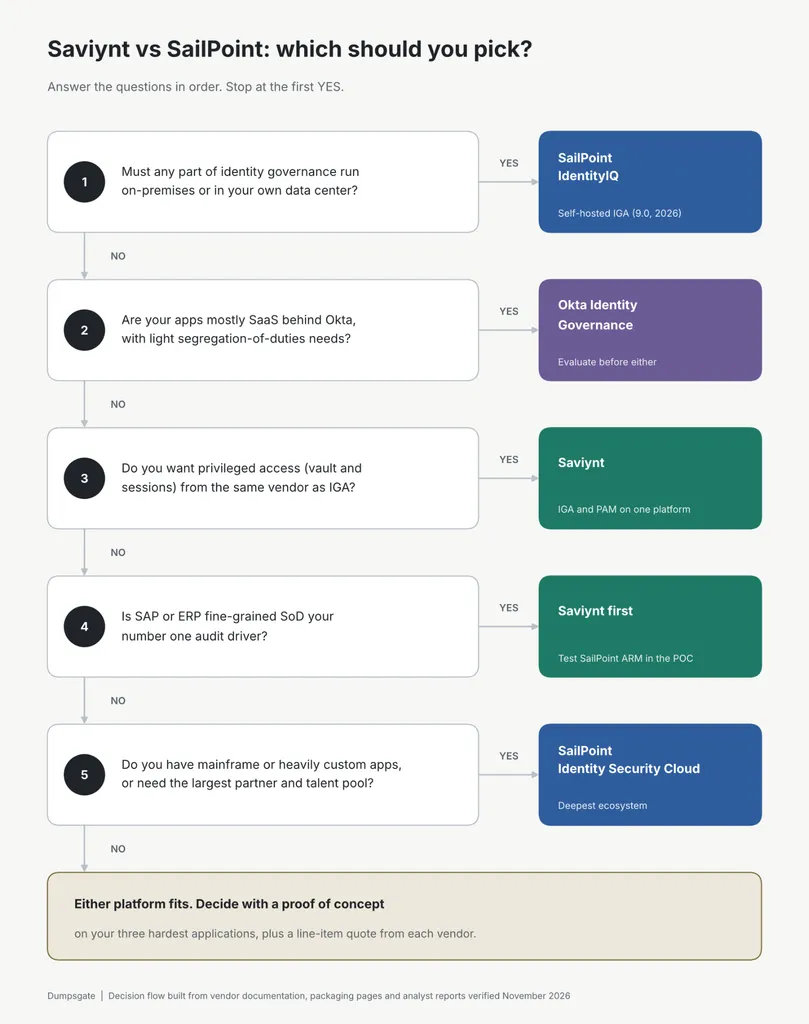
This SailPoint vs Saviynt comparison flow is original to Dumpsgate and based on the vendor sources cited in this article.
Saviynt vs Sailpoint: the verdict
Starting fresh with a cloud-first estate and a PAM purchase on your roadmap? Shortlist Saviynt first and make SailPoint ISC prove it can match the combined cost.
Running IdentityIQ today? Do not renew on autopilot. Price the IIQ 9.0 upgrade, an ISC migration and Saviynt’s Migration Workbench side by side, and let the migration effort on your own applications decide.
Heavy on mainframe, custom apps or on-premises data residency, or hiring a large IAM team? Choose SailPoint. Its deployment options and ecosystem depth are the safest bet for that profile.
Whichever path you take, the winner is the platform that passes a proof of concept on your hardest applications, under a quote you normalized yourself.
Frequently asked questions
What is the difference between IGA and PAM?
IGA decides who should have access to what and proves it to auditors through provisioning, access reviews and SoD policies. PAM controls how elevated access is used through credential vaulting, session recording and time-limited elevation. Saviynt sells both on one platform; SailPoint focuses on IGA and governs PAM tools through integrations.
Is Saviynt approved for US federal workloads?
Yes. Saviynt achieved FedRAMP Class D (High) certification on October 27, 2026, covering IGA, PAM and Application Access Governance, building on a FedRAMP Moderate authorization in place since 2019. Federal buyers comparing vendors should request each one’s current authorization package.
Who owns Saviynt?
Saviynt is private. It raised a $700 million Series B led by KKR on December 9, 2025, at a valuation of about $3 billion, and reported more than 600 enterprise customers at the time. SailPoint is listed on Nasdaq and files quarterly results with the SEC.
Can you trial Saviynt or SailPoint before buying?
Not the full IGA platform. Both offer trials of narrower tools (SailPoint’s Discovery Tool and Saviynt’s Zuma), plus guided demos. Plan for a scoped, vendor-supported proof of concept instead, and put success criteria in writing before it starts.
Are Saviynt and SailPoint only for large enterprises?
Mostly, yes. Both are built for organizations with dedicated IAM staff and regulated audits. Saviynt positions its Essentials tier for organizations earlier in their identity security journey, and SailPoint’s Standard suite covers core lifecycle automation and audit readiness, but implementation still requires a trained team or partner on either platform.
Can you learn Saviynt or SailPoint for free?
Partly, and only at the introductory level. Saviynt opened all introductory-level product courses on Saviynt University to the public at no cost in September 2024. SailPoint offers a free, public Identity Security Leader training path of about 4.5 hours, with a free Knowledge Credential exam. Hands-on admin and engineer training, and the professional certification exams, still sit behind customer or partner access.
Can you buy AI-agent security without the full IGA suite?
Yes, on both sides. SailPoint sells standalone Agentic Fabric packages priced by non-human identity volume tiers, with no human-identity licence attached. Saviynt sells Zuma as its own platform alongside Identity Cloud. This matters if your immediate problem is shadow AI agents and your IGA renewal is still years away.
How long does a Saviynt or SailPoint implementation take?
It depends far more on your estate than on the vendor. The four drivers are: how clean your HR source data is, how many applications need custom connectors, whether a role model already exists, and how many SOX or HIPAA applications must be certified in the first audit cycle. A safe plan on either platform starts with one authoritative source, your directory and a handful of audited applications, then expands in waves after the first certification campaign closes.