
Oracle Cloud Infrastructure (OCI) is cheaper than AWS for Oracle Database workloads and for anything that sends a lot of data to the internet. AWS is the better pick for nearly everything else, because it offers far more managed services, a bigger ecosystem, and a much larger hiring pool.
In our November 2027 price check, the same 4 vCPU, 16 GB server cost $67.16 a month on OCI versus $126.14 on AWS on-demand. A small app stack sending 20 TB of data to the internet costs $394 a month on OCI versus $2,326 on AWS.
In 2026, there is also a third option. You can run OCI-managed Oracle databases inside AWS data centers, which changes the decision for Oracle shops already on AWS.
Quick verdict:
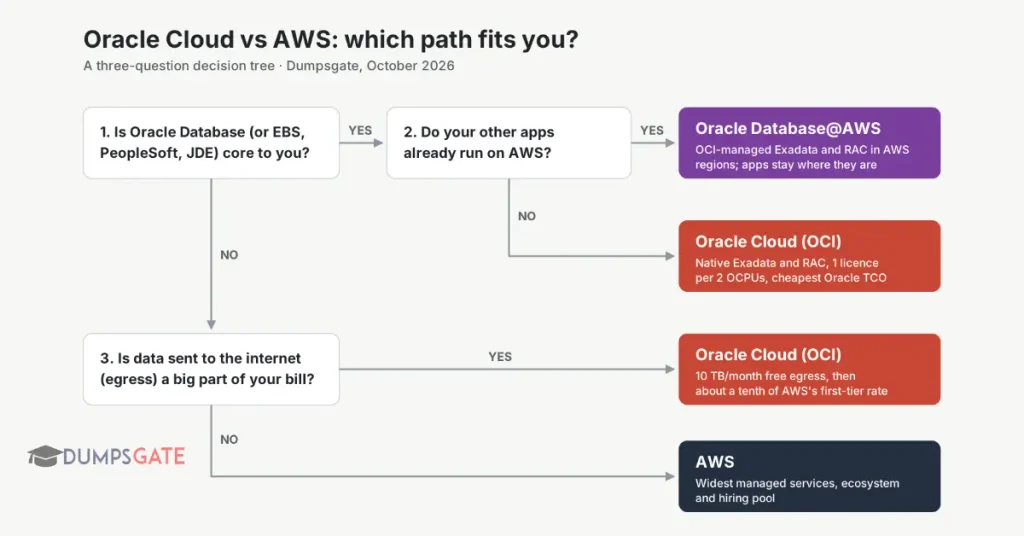
- Pick OCI if Oracle Database, EBS, PeopleSoft or JD Edwards is core to your business, or if your monthly egress runs into terabytes.
- Pick AWS if you are building cloud-native apps, need serverless, NoSQL or AI services, or want the most hireable skill set.
- Pick Oracle Database@AWS if your Oracle databases matter but your applications already live on AWS.
Oracle Cloud vs AWS comparison at a glance
| Factor | Oracle Cloud (OCI) | AWS |
|---|---|---|
| Core strength | Oracle Database, Exadata, RAC, low-cost networking | Service breadth, ecosystem, global scale |
| Internet egress | 10 TB/month free, then $0.0085/GB (US/EU) | 100 GB/month free, then $0.09/GB tiered down |
| Traffic between zones in a region | Free | Billed |
| 4 vCPU / 16 GB server, monthly | $67.16, no commitment | $126.14 on-demand, $63.98 with a 3-yr plan |
| Compute sizing | Flexible shapes: choose cores and memory separately | Fixed instance sizes |
| Oracle licence count (Enterprise Edition) | 1 licence per 2 OCPUs (2 physical cores) | 1 licence per 2 vCPUs (1 physical core) |
| Oracle RAC / Exadata | Native | Via Oracle Database@AWS |
| Free tier | $300 for 30 days plus Always Free resources | Up to $200 credits, free plan up to 6 months |
| Market share (2026) | About 4% | 28% |
| Best for | Oracle-centric enterprises, data-heavy workloads | Cloud-native apps, startups, global SaaS |
Every figure above is sourced in the sections below.
What is the difference between Oracle Cloud and AWS?
The main difference between Oracle Cloud and AWS is design focus. OCI is built to run enterprise infrastructure, above all Oracle Database, at a low and predictable price. AWS is built to give developers a managed service for almost every job.
That difference shows up in four places:
- Pricing model. OCI uses simpler, flatter pricing with large free network allowances. AWS offers more pricing options (on-demand, Savings Plans, Spot) but rewards active cost management.
- Database strategy. OCI is the home of Exadata and Oracle RAC. AWS covers many engines, including Aurora, DynamoDB, and PostgreSQL.
- Ecosystem. AWS has the larger marketplace, partner network, and talent pool.
- Compute units. OCI bills by OCPU, and one x86 OCPU equals two vCPUs. Comparing “4 OCPUs” with “4 vCPUs” understates OCI’s capacity by half.
Is Oracle Cloud cheaper than AWS?
Yes, in most like-for-like infrastructure comparisons, and by the widest margin on data transfer and Oracle licensing. A 3-year AWS Savings Plan closes the compute gap, and small apps that stay inside AWS’s free allowances may see no difference at all.
Oracle’s own comparison page claims its compute is 57% cheaper than equivalent EC2 instances, but that test was run on June 11, 2024 by Oracle itself. Treat it as a vendor claim. Our own October 2026 check, using both providers’ published list prices, found a smaller but still large gap: about 47% on on-demand compute.
How do Oracle Cloud vs AWS cost numbers compare on egress?
Egress is where the Oracle Cloud vs AWS cloud cost gap is largest and easiest to verify.
- OCI: the first 10 TB of internet egress each month is free, and data moving between availability domains in a region costs nothing.
- OCI beyond 10 TB: $0.0085 per GB for traffic originating in North America, Europe and the UK.
- AWS: 100 GB per month free across all services, then $0.09/GB for the first 10 TB, $0.085/GB for the next 40 TB and $0.07/GB for the next 100 TB.
Our monthly egress calculation (US regions, list prices, October 2026):
| Data sent to the internet per month | AWS | OCI | AWS costs |
|---|---|---|---|
| 1 TB | $81 | $0 | $81 more |
| 5 TB | $441 | $0 | $441 more |
| 10 TB | $891 | $0 | $891 more |
| 25 TB | $2,167 | $125 | 17x |
| 50 TB | $4,292 | $338 | 13x |
| 100 TB | $7,793 | $763 | 10x |
Method: 1 TB = 1,000 GB. AWS tiers applied cumulatively after the 100 GB allowance. OCI’s free allowance is 10,240 GB in Oracle’s own price API, so the $0.0085 rate applies above that. Excludes negotiated discounts and private connectivity.
The pattern matters more than any single row. Below 10 TB, OCI egress is free while AWS is already charging. Above 10 TB, AWS still costs roughly 10x to 17x more.
Does a CDN close the egress gap on AWS?
Partly. On AWS, data transfer from AWS origins to CloudFront is waived, and CloudFront’s flat-rate plans bundle delivery with no overage charges. A cache-friendly website served through CloudFront pays far less than the table above suggests.
The gap stays wide for traffic a CDN cannot cache: API responses, database replication to another cloud, backups sent off-site, and bulk data exports. Those are exactly the workloads where OCI’s pricing pays off.
How do Oracle Cloud vs AWS pricing models differ for compute?
We priced the same general-purpose AMD server on both clouds on October 15 and 16, 2026: 4 vCPUs and 16 GB of RAM, Linux, US East (N. Virginia) for AWS and OCI’s US list price. AWS rates come from its EC2 on-demand feed (linked above) and its Compute Savings Plans rates. OCI rates come from Oracle’s price list (linked below).
| Server: 4 vCPU, 16 GB RAM (AMD) | Hourly | Monthly (730 hrs) | vs OCI |
|---|---|---|---|
| AWS m6a.xlarge, on-demand | $0.1728 | $126.14 | 88% more |
| AWS m6a.xlarge, 1-yr Compute Savings Plan, no upfront | $0.12695 | $92.67 | 38% more |
| AWS m6a.xlarge, 3-yr Compute Savings Plan, no upfront | $0.08764 | $63.98 | 5% less |
| OCI VM.Standard.E5.Flex, 2 OCPUs + 16 GB, no commitment | $0.092 | $67.16 | baseline |
OCI’s rate is $0.03 per OCPU-hour plus $0.002 per GB of memory per hour. Two takeaways:
- Without a commitment, OCI costs about 47% less than AWS on-demand and 28% less than a 1-year AWS Savings Plan.
- A 3-year AWS commitment slightly beats OCI on compute alone. OCI gets there with no lock-in, but if you are sure of three years on AWS, compute is roughly a tie.
On Arm, OCI’s Ampere A1 rate is $0.01 per OCPU-hour and $0.0015 per GB-hour, so a 4-core, 16 GB A1 server lists at $46.72 a month. Every tenancy’s first 3,000 A1 OCPU-hours and 18,000 GB-hours each month are free, which covers one such server entirely. The closest AWS match, m7g.xlarge, lists at $119.14 a month on-demand.
Three details change compute comparisons more than headline rates:
- OCPU math. On OCI, 1 x86 OCPU equals 2 vCPUs, Ampere A1 OCPUs equal 1 vCPU, and preemptible instances cost 50% of regular price. Always convert to vCPUs before comparing.
- Flexible shapes. OCI lets you set cores and memory independently. AWS makes you jump to the next instance size, so workloads that sit between sizes pay for idle capacity.
- Commitments. AWS Savings Plans cut compute rates in exchange for one- or three-year commitments. Compare OCI on-demand against AWS with Savings Plans if your usage is steady.
To check your own workload, price it in both the AWS Pricing Calculator and the OCI Cost Estimator, with the same region, vCPU count, and memory.
What does a full monthly bill look like on each cloud?
Unit prices hide how the lines add up, so we priced a realistic small SaaS stack: 4 of the servers above, 1 TB of block storage and 20 TB of internet egress per month. Storage uses AWS gp3 at $0.08 per GB-month and OCI Block Volume at the balanced level ($0.0425 per GB-month).
| Monthly line item | AWS on-demand | AWS 1-yr Savings Plan | AWS 3-yr Savings Plan | OCI |
|---|---|---|---|---|
| Compute (4 servers) | $504.58 | $370.69 | $255.91 | $268.64 |
| Block storage (1 TB) | $80.00 | $80.00 | $80.00 | $42.50 |
| Internet egress (20 TB) | $1,741.50 | $1,741.50 | $1,741.50 | $82.96 |
| Total | $2,326.08 | $2,192.19 | $2,077.41 | $394.10 |
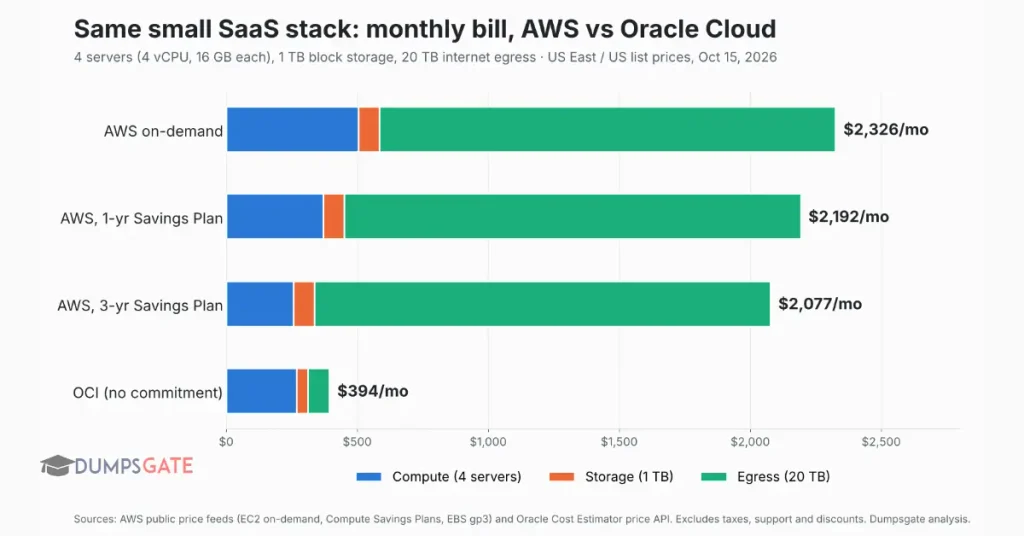
Egress is about 75% of the AWS on-demand bill in this scenario, and commitments do nothing to reduce it. Remove the 20 TB of egress and the totals become $584.58 on AWS on-demand versus $311.14 on OCI. OCI still costs less, but the gap shrinks from roughly 6x to about 2x.
How much does Oracle licensing change the math?
For Oracle Database Enterprise Edition, licensing usually costs more than the cloud infrastructure underneath it. This is where OCI’s biggest advantage hides.
- On AWS: Oracle’s policy counts two vCPUs as one Processor licence when multi-threading is enabled, and the core factor table does not apply.
- On OCI: one Enterprise Edition Processor licence covers 2 OCPUs, which is 2 physical cores.
Worked example: a database that needs 16 physical cores
| AWS (EC2 or RDS) | OCI | |
|---|---|---|
| Compute provisioned | 32 vCPUs | 16 OCPUs |
| Counting rule | 2 vCPUs = 1 licence | 1 licence = 2 OCPUs |
| Enterprise Edition licences needed | 16 | 8 |
Same hardware, half the licences on OCI. Each licence also carries annual Oracle support fees, so the saving repeats every year. This is the real source of the “2x licensing penalty” people mention when discussing Oracle on AWS.
Can you run Oracle Database on AWS in 2027?
Yes, in three ways, and the newest one changes the decision.
- Amazon RDS for Oracle. Fully managed, with replicas that support Oracle Data Guard switchover. It does not run Oracle RAC, and AWS licence counting applies.
- Oracle on EC2. Full control, but you manage everything and still pay the AWS licence ratio.
- Oracle Database@AWS. OCI-managed Exadata systems running inside AWS data centers, with RAC support. As of May 29, 2026, it is available in 20 AWS regions, and its pricing matches Exadata Database Service on OCI.
This means “we need RAC” is no longer an automatic reason to leave AWS. It is now a reason to evaluate Oracle Database@AWS.
Which is better: the Oracle Cloud free tier or AWS Free Tier?
The Oracle Cloud free tier is better for long-running projects. The AWS Free Tier is better for exploring many services quickly.
| Oracle Cloud free tier | AWS Free Tier | |
|---|---|---|
| Credits | $300, valid up to 30 days | $100 at sign-up, plus up to $100 more earned |
| How long it lasts | Always Free resources never expire | Free plan ends after 6 months or when credits run out |
| Free compute | 4 Arm OCPUs and 24 GB RAM, plus 2 AMD micro VMs | Covered by credits |
| Best for | A permanent small server, homelab, side project | Learning and testing many AWS services |
Practical warnings before you sign up:
- OCI Arm capacity. Free Ampere A1 instances often show “out of capacity” in busy regions. Pick your home region carefully, because Always Free resources are tied to it.
- OCI idle reclamation. Oracle can reclaim Always Free instances that sit idle, so keep real workloads running on them.
- AWS legacy accounts. Accounts created before July 15, 2025 stay on the old Free Tier program, not the $200 credit plan.
How do OCI vs AWS vs Azure and Google Cloud compare?
Most buyers comparing Oracle Cloud vs AWS vs Azure vs Google Cloud, or the wider AWS vs Azure vs Google Cloud vs IBM Cloud vs Oracle Cloud field, are really comparing two things: market position and data transfer cost. IBM Cloud does not make the top five by share, so the realistic Oracle Cloud vs AWS vs GCP vs Azure shortlist is four providers.
Oracle Cloud vs AWS vs Azure market share:
| Provider | Share of cloud infrastructure market |
|---|---|
| AWS | 28% (Q2 2026) |
| Microsoft Azure | 20% (Q2 2026, same source) |
| Google Cloud | 15% (Q2 2026, same source) |
| Oracle Cloud | 4% (Q1 2026), ranked fourth ahead of Alibaba |
Oracle is small but growing fast. Its cloud infrastructure revenue rose 121% year over year to $7.4 billion in the quarter reported September 10, 2026, driven mostly by AI capacity contracts.
Internet egress, first paid tier (North America):
| Provider | Free each month | First paid tier |
|---|---|---|
| Oracle Cloud | 10 TB | $0.0085/GB |
| AWS | 100 GB | $0.09/GB |
| Azure | 100 GB | $0.087/GB |
| Google Cloud | 1 GB (Premium Tier) | $0.12/GB |
On Oracle Cloud vs Google Cloud specifically, the pattern matches AWS: Google Cloud has stronger data analytics and AI tooling, while OCI wins on Oracle workloads and network cost. Oracle Database is also offered inside Azure and Google Cloud through Oracle’s multicloud partnerships, so the “Oracle Cloud vs Google Cloud vs AWS” choice increasingly comes down to where your applications live.
Look Further: Oracle vs Azure in 2027: Cost, Databases, Compliance, and Careers Compared
Where does AWS clearly win over OCI?
OCI’s price advantage does not cover these areas:
- Managed services. Lambda, DynamoDB, Aurora, Bedrock, SageMaker and hundreds of other services have no direct equivalent on OCI.
- Ecosystem and talent. AWS skills are far easier to hire for, and almost every SaaS tool integrates with AWS first.
- Mature tooling. Infrastructure-as-code examples, tutorials and community answers are much more plentiful for AWS.
- Sovereignty is no longer an OCI-only feature. AWS made its European Sovereign Cloud generally available with a first region in Brandenburg, Germany, operated by EU residents.
If your architecture depends on these, a cheaper OCI bill can cost more in engineering time.
What are the most common misconceptions about OCI vs AWS?
| Myth | Fact (October 2026) |
|---|---|
| “You can’t run Oracle RAC on AWS.” | You can, through Oracle Database@AWS in 20 regions. RDS for Oracle still does not support RAC. |
| “OCI is cheaper for everything.” | A 3-year AWS Savings Plan edges out OCI on compute alone ($63.98 vs $67.16 a month in our test), and small CDN-fronted apps may cost about the same on either cloud. |
| “The OCI free tier is 4 VMs.” | It is a pool of 4 Arm OCPUs and 24 GB RAM you can split across up to 4 VMs, plus 2 AMD micro VMs. |
| “OCI has around 50 services.” | Oracle lists more than 100 services. AWS still offers far more managed options. |
Should you learn OCI or AWS for your career?
Learn AWS first if you want the most job options. Add OCI if you work with, or want to work for, Oracle-centric employers.
- AWS first suits developers, DevOps engineers and anyone targeting startups or SaaS companies. Its market share alone means more job listings.
- OCI as a second cloud suits DBAs, ERP consultants and engineers at banks, telecoms and government agencies that run Oracle. Fewer people hold OCI skills, which can make them stand out in those roles.
- Both is the strongest profile for multicloud roles, now that Oracle Database runs inside AWS, Azure and Google Cloud.
For most learners, an AWS foundational or associate certification followed by an OCI foundations certification is a sensible sequence.
Verdict: Should you choose Oracle Cloud or AWS?
Make the call with these rules:
- Your Oracle Database is the center of your business and your apps are not on AWS yet: choose OCI. The licence count alone can fund the migration.
- Your Oracle Database matters, but your applications already run on AWS: choose Oracle Database@AWS and keep your apps where they are.
- You send more than a few terabytes of uncacheable data out each month: price the workload on OCI first, because egress is where AWS bills climb fastest.
- You are building a cloud-native product, need managed services, or want to hire easily: choose AWS. A 3-year Savings Plan brings its compute price level with OCI’s, and a CDN keeps egress in check.
- You only want a permanent free server: use the Oracle Cloud free tier.
If none of these fits cleanly, run your real workload through both pricing calculators for one month of expected usage. The cheaper bill, adjusted for the engineering time each platform will cost your team, is your answer.
Frequently asked questions
Is Oracle Cloud cheaper than AWS?
Usually, yes. In our October 2026 pricing, a 4 vCPU, 16 GB server cost $67.16 a month on OCI against $126.14 on AWS on-demand, and a small stack with 20 TB of egress cost $394 versus $2,326. A 3-year AWS Savings Plan roughly ties OCI on compute alone, but it does not reduce egress.
What is the difference between OCI and AWS?
OCI focuses on low-cost enterprise infrastructure and Oracle Database. AWS focuses on breadth, offering a managed service for almost every workload. OCI wins on cost and Oracle workloads; AWS wins on ecosystem.
Is Oracle Cloud free tier really free forever?
The Always Free resources are, as long as your account stays active and the instances are not idle long enough to be reclaimed. The $300 trial credit expires after 30 days.
Can I move from AWS to OCI without rewriting my apps?
Virtual machine and container workloads usually move with modest changes. Apps built on AWS-specific services, such as Lambda or DynamoDB, need rework because OCI has no identical equivalents.
Is OCI good for startups?
OCI suits startups with heavy data transfer or GPU needs on a tight budget. Most startups still choose AWS for its services, credits programs and the ease of hiring engineers who already know it.
Does OCI have as many regions as AWS?
Both run global networks of regions. OCI keeps prices the same across its regions, while AWS prices differ by region, which matters if you deploy outside the US.
Which is better for AI workloads?
AWS offers more managed AI services, such as Bedrock and SageMaker. OCI’s AI growth has come from renting large GPU clusters, which suits teams training or serving their own models.


