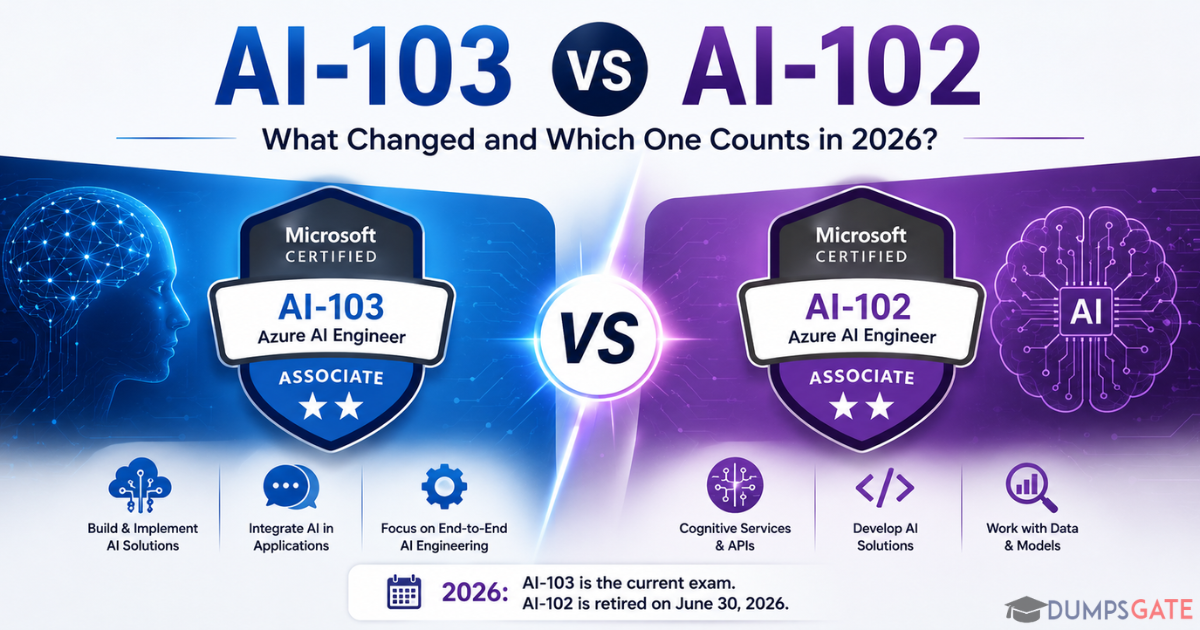
TL;DR: AI-102 was retired on June 30, 2026.Microsoft Certified: Azure AI Apps and Agents Developer Associate is its active replacement. The exam costs $165 USD, requires a passing score of 700, runs 120 minutes, and is currently available in English only. No official practice assessment exists yet. Generative AI and agentic solutions now account for 30-35% of the exam. Python is the only supported language.
If you were preparing for AI-102, that preparation was not wasted. The exam you need to book has changed, though. This post covers the full AI-103 vs AI-102 comparison so you can make a sound decision about which credential to pursue and how to prepare. Microsoft retired AI-102 on June 30, 2026, at 11:59 PM Central Standard Time and replaced it with AI-103, a credential rebuilt around the tools and workflows that define Azure AI development in 2026. The skills weighting has shifted, the tooling requirements have changed, and Python is now the only supported implementation language.
This post covers every material difference between AI-102 and AI-103, assesses realistic difficulty by candidate background, and lays out exactly what to prioritize in your preparation. One clarification before proceeding: several searches surface comparisons between AI-103 and something called AI-200. There is no Microsoft certification with the code AI-200. Any content making that comparison references a non-existent credential and should be disregarded.
What Was the AI-102 Certification, and Why Did Microsoft Retire It?
AI-102 was the Microsoft Certified: Azure AI Engineer Associate credential, positioned at the intermediate level. It targeted engineers building AI solutions using Azure Cognitive Services, Azure Bot Service, and Azure Machine Learning, and supported both Python and C#.
Skills were distributed across six domains:
- Plan and manage an Azure AI solution: 20 to 25%
- Implement natural language processing solutions: 15 to 20%
- Implement knowledge mining and information extraction solutions: 15 to 20%
- Implement generative AI solutions: 15 to 20%
- Implement computer vision solutions: 10 to 15%
- Implement agentic AI solutions: 5 to 10%
The exam ran 180 minutes and required a passing score of 700. It was available in multiple languages and had an official practice assessment on Microsoft Learn.
Microsoft retired AI-102 because its skills framework no longer reflected how Azure AI development works in practice. Generative AI and agentic architectures have moved from peripheral concerns to the center of most production AI work on Azure. A 5- to 10-percent weighting of agentic solutions was no longer defensible as a representation of the field.
Professionals who earned AI-102 before June 30, 2026, retain the credential on their Microsoft transcript. Because Microsoft associate certifications require annual renewal, holders approaching their renewal date should evaluate whether Microsoft AI-103 better represents their current competency. You can review the requirements on the Microsoft certification renewal page.
What Is the AI-103 Certification, and What Skills Does It Measure?
AI-103 is the Microsoft Certified: Azure AI Apps and Agents Developer Associate certification, also at the intermediate level. The official study guide was last updated April 14, 2026. The credential targets developers and AI engineers who build production-grade AI applications and agentic solutions using Azure services.
Microsoft AI-103 requires experience with Python and familiarity with Microsoft Azure AI Foundry, which were not central requirements under AI-102. Organizations exploring how AI development capability fits into a broader digital transformation strategy should consider how credentials like AI-103 map to the technical roles those initiatives require.
Skills are distributed across five domains:
- Implement generative AI and agentic solutions: 30 to 35%
- Plan and manage Azure AI solutions: 25 to 30%
- Implement text analysis solutions: 10 to 15%
- Implement computer vision solutions: 10 to 15%
- Implement information extraction solutions: 10 to 15%
The exam runs 120 minutes, costs $165 USD, and requires a passing score of 700 on a scale of 1 to 1000. It is currently available in English only. Candidates who do not pass on the first attempt may retake the exam 24 hours later. The exam may include interactive lab-style components.
Get insights on the complete AI-103 guide: Can You Actually Build Production AI on Azure After Passing the AI-103 Exam?
How Do Microsoft AI-103 vs AI-102 Compare Side by Side?
Here is the direct AI-103 vs AI-102 comparison across the details that affect a booking and study decision.
| Feature | AI-102 (Retired) | AI-103 (Active) |
| Exam Code | AI-102 | AI-103 |
| Status | Retired June 30, 2026 | Active |
| Credential Name | Azure AI Engineer Associate | Azure AI Apps and Agents Developer Associate |
| Certification Level | Intermediate | Intermediate |
| Largest Skills Domain | Plan and manage (20 to 25%) | Generative AI and agentic solutions (30 to 35%) |
| Languages Supported | Python and C# | Python only |
| Passing Score | 700 | 700 |
| Exam Duration | 180 minutes | 120 minutes |
| Exam Price | $165 USD | $165 USD |
| Available Languages | Multiple | English only (current) |
| Key Platform | Azure Cognitive Services, Bot Service | Azure AI Foundry, Azure AI Services |
| Practice Assessment | Available | Not yet available |
| Agentic AI Weighting | 5 to 10% | 30 to 35% (merged with generative AI) |
Delve into the details of: Are Microsoft AI Certifications The Key To Your Next Big Career Move In 2026?
What Specifically Changed Between Microsoft AI-102 and AI-103 by Skills Domain?
The most significant structural shift is the consolidation and elevation of generative AI and agentic solutions. In AI-102, these areas were treated as separate domains: generative AI at 15 to 20 percent and agentic solutions at just 5 to 10 percent, for a combined total of roughly 20 to 25 percent.
In Microsoft AI-103, both areas merge into a single domain that carries 30 to 35 percent of the total exam weight. That single change makes generative AI and agentic architecture the defining focus of the credential.
The second structural change is the removal of C# support. AI-102 was language-flexible. AI-103 is not. Candidates who built their Azure AI skills primarily in C# will need to demonstrate Python competency before sitting the exam.
The third shift involves tooling. Microsoft AI-103 centers Microsoft Azure AI Foundry as the primary development platform. Candidates unfamiliar with Foundry should prioritize it in their preparation, as it underpins the agentic and generative AI workflows that now anchor the exam.
The narrower domains, including computer vision, text analysis, and information extraction, each carry weighting similar to their AI-102 equivalents. However, their relative importance has increased because the overall number of domains is smaller.
Key takeaway: The core difference between Microsoft AI-103 and AI-102 lies in a shift toward generative and agentic work, a Python-only requirement, and Foundry-centered tooling.
Read More: How Much Does the Microsoft AI-103 Exam Cost in 2026?
Is AI-102 Officially Retired, or Can You Still Book It Somewhere?
AI-102 is officially retired. The exam was retired on June 30, 2026, at 11:59 PM Central Standard Time and can no longer be booked or sat. This is a confirmed retirement, not a scheduled one.
Holders of AI-102 who earned the credential before that date retain it on their Microsoft transcript. The annual renewal requirement still applies. Professionals approaching their renewal date should assess whether renewing a retired credential or pursuing Microsoft Certified: Azure AI Apps and Agents Developer Associate better serves their role and organization.
Organizations evaluating team credentials should treat AI-102 as historical context rather than a current benchmark. Microsoft AI-103 reflects the skills Microsoft considers relevant to Azure AI development as of 2026.
Thinking of pursuing Azure certs? Explore what it takes to earn them: Azure Certifications Cost in Current Year: How much does it cost to get Azure certified in 2026?
How Hard Is the Microsoft AI-103 Exam for Candidates With Different Backgrounds?
Microsoft Certified: Azure AI Apps and Agents Developer Associate exam carries an intermediate classification, but difficulty depends on the candidate’s starting point. Here is a realistic breakdown by background.
For candidates with production Azure AI experience and active Python skills: The exam is manageable. The 120-minute duration is shorter than AI-102, and the domain structure is cleaner. The primary challenge is familiarity with Azure AI Foundry if that platform has not been part of your daily work.
For candidates transitioning from AI-102 preparation, the existing study material covers meaningful ground, particularly in the domains of planning, text analysis, computer vision, and information extraction. The generative AI and agentic solutions domain, which accounts for 30 to 35 percent of the exam, requires targeted, up-to-date study. Material prepared for AI-102’s lighter agentic coverage is not proportionally complete for AI-103.
For candidates without Python fluency, the skills gap cannot be closed through studying exam content alone. Python proficiency is a prerequisite, not a study topic.
For all candidates: The absence of an official practice assessment is a real constraint. Practice assessments on Microsoft Learn are among the most reliable tools for identifying knowledge gaps before exam day. Until one is available for AI-103, the official study guide and Microsoft Learn learning paths serve as the primary calibration tools. A practice assessment is typically published within approximately eight weeks of an exam leaving beta. Monitor the official Microsoft Learn certification page for updates.
Who Is the Right Candidate for Microsoft AI-103 in 2026?
Microsoft Certified: Azure AI Apps and Agents Developer Associate ceritfication is designed for:
- Software developers and AI engineers building AI applications on Azure, particularly those working with large language models, prompt engineering, or agentic architectures
- Cloud professionals expanding into applied AI development who already hold foundational Azure credentials such as AZ-900 or AI-900
- AI practitioners currently holding AI-102 who need to demonstrate current, post-retirement competency
- Career builders targeting roles such as AI developer, Azure AI engineer, or ML engineer at organizations deploying Azure-based AI solutions
- Team leads and managers evaluating whether their team’s AI certification reflects Microsoft’s current competency framework
Microsoft AI-103 is not an appropriate starting point for professionals without development experience or Python skills. Those candidates would benefit from building foundational fluency in Python and Azure AI before attempting the exam. For organizations assessing broader technology readiness, IT consulting services can help evaluate how AI skill gaps map to current and planned system requirements.
What Should You Study for Microsoft AI-103, Organized by Domain Priority?
Microsoft’s official study guide, last updated April 14, 2026, is the authoritative source for exam coverage. Structure your preparation around the five domains in proportion to their weighting.
Priority 1: Generative AI and Agentic Solutions (30 to 35%)
This domain demands the most preparation time. Study areas include prompt engineering, grounding techniques, Azure OpenAI Service integration, building and orchestrating AI agents, and multi-agent architecture patterns within Microsoft Azure AI Foundry.
Priority 2: Plan and Manage Azure AI Solutions (25 to 30%)
This domain covers solution design, resource selection, security, monitoring, and compliance. Candidates familiar with AI-102’s planning domain will find meaningful overlap, though Foundry-specific management concepts require targeted study.
Priority 3: Text Analysis, Computer Vision, and Information Extraction (10 to 15% each)
These three domains carry equal weighting. Study resources from AI-102 preparation remain largely applicable. Focus on the service capabilities and implementation patterns for:
Tooling to prioritize:
- Microsoft Azure AI Foundry (required for the two highest-weighted domains)
- Azure AI Services (formerly Azure Cognitive Services)
- Python SDK implementations across all domains
Microsoft Learn provides structured learning paths aligned to Microsoft AI-103 objectives. These paths are free and represent the most accurate study resource currently available. For teams integrating AI-certified professionals into existing application ecosystems, system integration planning can help clarify how new AI capabilities connect with current infrastructure.
Learn more about: Microsoft AI-500 Certification: Everything You Need to Know Before Registering
What Does the Job Market Look Like for Certified Azure AI Professionals?
The labor market for certified Azure AI professionals is growing. According to the U.S. Bureau of Labor Statistics (May 2024 data), software developers earn a median annual wage of $133,080. The BLS projects that software developer employment will grow 16 percent from 2024 to 2034, with approximately 129,200 annual job openings over that period.
AI-specific roles within that broader category typically carry premium compensation relative to the median, particularly for professionals with certified, demonstrable competency in production AI development on major cloud platforms.
Microsoft Certified: Azure AI Apps and Agents Developer Associate positions credential holders at the intersection of two high-demand areas: cloud infrastructure expertise and applied AI development. Organizations building Azure-based AI applications need professionals who can design, implement, and manage those systems. A current, active Microsoft certification in this domain provides verifiable evidence of that competency. Teams looking to act on business intelligence solutions or data-driven reporting initiatives may find that AI-103-certified professionals bring directly applicable skills to those projects.
What Is the Most Useful Next Step If You Are Preparing for Microsoft AI-103?
Begin with the official Microsoft Learn study guide and the skills domain breakdown on the Microsoft AI-103 certification page. Map your current Python and Azure AI Foundry proficiency against the exam objectives before committing to a study timeline. Candidates without Foundry experience should allocate dedicated time to that platform before addressing the broader generative AI and agentic solutions domain.
If you are an organization assessing your team’s AI certification currency, AI-102 credentials should be evaluated for renewal status and compared with the AI-103 framework to identify gaps in the team’s current competency. Software consulting can support that evaluation when the goal is matching certified skill sets to specific platform or application requirements.
The exam is bookable through Pearson VUE at $165 USD. Retakes are available 24 hours after a first attempt. A practice assessment will be available on Microsoft Learn, typically within 8 weeks after the exam leaves beta.
Frequently Asked Questions
What is the difference between Microsoft AI-103 vs AI-102?
AI-102 was the Microsoft Certified: Azure AI Engineer Associate credential, retired on June 30, 2026. Microsoft AI-103 is its replacement: the Microsoft Certified: Azure AI Apps and Agents Developer Associate. In the AI-103 vs AI-102 comparison, the key differences include a shift of the largest domain weight to generative AI and agentic solutions (30 to 35 percent), removal of C# support in favor of Python only, a new focus on Microsoft Azure AI Foundry as the primary development platform, and a shorter exam duration of 120 minutes versus 180. Both exams require a passing score of 700 and cost $165 USD.
Was Microsoft AI-102 difficult to pass?
AI-102 had an intermediate difficulty rating and required broad competence in NLP, computer vision, knowledge mining, and generative AI. Its 5-10 percent weighting for agentic solutions was the lightest domain. Candidates with hands-on Azure AI development experience and working skills in Python or C# generally found it achievable with structured preparation. Because AI-102 is now retired, this question is largely a reference point for candidates assessing how the two exams compare in relative difficulty.
Is the Microsoft AI-102 certification still available to book?
No. Microsoft AI-102 was officially retired on June 30, 2026, at 11:59 PM Central Standard Time. The exam can no longer be booked. Existing credential holders retain AI-102 on their Microsoft transcript, subject to the annual renewal requirement. Professionals who maintain active competency in Azure AI development should plan to pursue the Microsoft AI-103 certification.
How hard is the Microsoft AI-103 exam, and what makes it challenging?
Microsoft AI-103 is classified as intermediate. Practical difficulty depends on three factors: Python proficiency, familiarity with Microsoft Azure AI Foundry, and prior experience building generative AI or agentic solutions in production. The 30-35 percent weight given to generative AI and agentic solutions makes this the defining domain. The absence of an official practice assessment complicates preparation. Candidates without Foundry experience or solid Python skills should plan for a more structured and extended preparation period.