The Certified Public Accountant exam is often described as one of the toughest professional financial certification exams in the world, yet thousands of candidates underestimate it every year. With pass rates frequently sitting near 50%, the numbers tell a story that most preparation guides do not fully explain.
Understanding how hard is the CPA exam requires looking beyond surface-level difficulty. It is important to understand that the challenge is mainly strategic, mental, and deeply tied to how the exam is designed. The CPA exam pass rate highlights a critical reality. Success depends less on intelligence and more on preparation style, time investment, and the ability to handle pressure across multiple sections. This guide breaks down the real difficulty of the CPA exam to help you prepare more effectively and improve your chances of success on the first go.
What Is The CPA Exam?
The CPA exam is the licensing exam required to become a Certified Public Accountant in the United States. It is created by the American Institute of Certified Public Accountants and is designed to test whether candidates are ready to handle real-world accounting work.
The exam is designed to evaluate whether candidates have the knowledge and skills required to perform real-world accounting tasks. It focuses on:
- Financial reporting
- Auditing and assurance
- Taxation and regulation
- Business concepts and analysis
To learn more about the CPA certification, check out: Your Roadmap to CPA Certification: Steps, Tips, and Requirements
What Makes The CPA Exam So Difficult?
There are multiple factors that contribute to the difficulty of the CPA exam. Here are some of the major reasons why you might find it hard to prepare and pass the exam:

1. Multi-Section Structure That Demands Consistency
The Certified Public Accountant (CPA) exam includes four separate sections, each testing a different area of accounting and business knowledge. Passing one section does not make the other easier. Candidates must maintain momentum across months of preparation, which creates cumulative pressure. This structured design is a major reason behind what makes the CPA exam so difficult.
2. Massive Content Volume Across Disciplines
Each section covers a wide range of topics. From financial reporting to taxation and auditing, the depth alone can overwhelm candidates. Unlike university exams, there is no narrow syllabus focus. Candidates must understand concepts across multiple domains at once.
3. Application-Based Questions
The Certified Public Accountant (CPA) exam mainly tests how well candidates are able to apply underlying knowledge, not just recall it. Here is what you can expect:
- Task-based simulations require multi-step problem-solving
- Questions that often combine multiple concepts
- Real-world scenarios instead of theoretical questions
This shift is where many candidates struggle the most and often lose out on precious marks and their chance of passing the exam as well.
4. Time Pressure and Exam Fatigue
Each section is time-bound, and many candidates report running out of time with a significant portion of the exam still left unattempted. The exam demands:
- Quick decision-making
- Accuracy under pressure
- Sustained focus for several hours
Even well-prepared candidates find timing to be a challenge in the CPA exam due to the depth and scenario-based nature of the questions.
5. Professional-Level Expectations
The CPA exam reflects real accounting work. It assumes candidates can think like professionals, not students. This expectation creates a gap between preparation and performance, especially for first timers taking the exam.
6. Adaptive Testing Format Increases Difficulty Mid-Exam
Another overlooked factor behind what makes the CPA exam so difficult is its adaptive nature. The exam adjusts question difficulty based on performance in the earlier testlets. If a candidate performs well initially, the next set of questions becomes more challenging. This creates two key challenges:
- Candidates can not rely on a steady difficulty level
- Strong performance early on leads to tougher questions later
As a result, even well-prepared candidates may feel the exam is getting harder as they progress, which can impact confidence and pacing.
7. Scoring System Is Not Fully Transparent
The CPA exam scoring system adds another layer of difficulty that many candidates overlook. While scores are reported on a scale, the exact weighting of the following is not always clear to candidates:
- Multiple choice questions
- Task-based simulations
- Written communication (where applicable)
This matters because:
- Candidates can not easily identify where they lost marks
- It becomes harder to optimize the preparation strategy
- Uncertainty adds psychological pressure
This lack of transparency contributes to what makes the CPA exam so difficult, especially for repeat exam-takers trying to improve their scores.
Read More: CFA vs CPA: Which Is Better For Your Finance Career?
What Is The Current CPA Pass Rate?
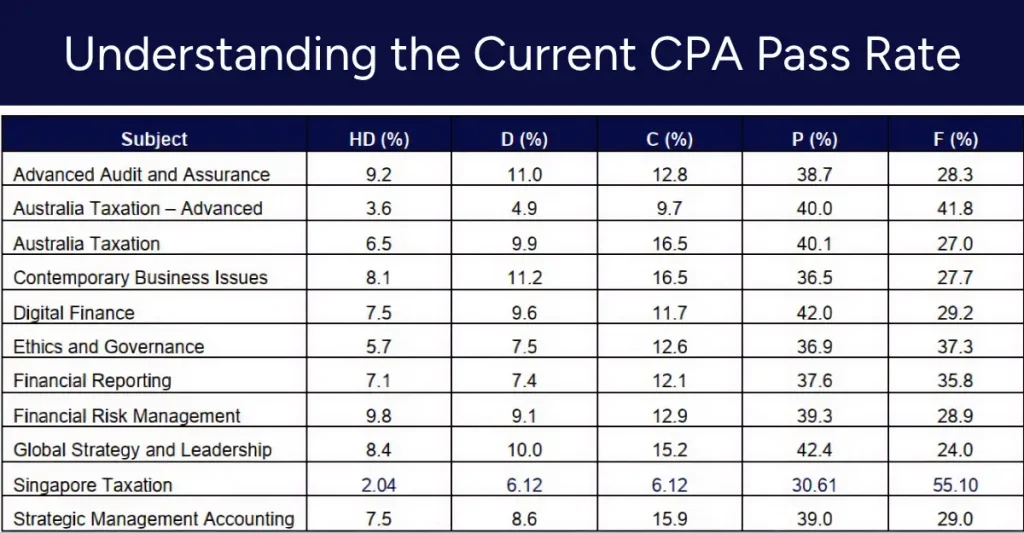
The CPA exam pass rate typically ranges between 45% and 55%, depending on the section. Some sections consistently fall below average, which signals higher difficulty levels.
How Many People Pass The CPA Exam First Try?
When analyzing how many people pass the CPA exam on the first try, the numbers drop significantly.
- Many candidates fail at least one section
- Passing all four sections on the first attempt is relatively rare
- Most candidates require multiple attempts
This does not indicate failure. It reflects the exam’s demanding nature.
Why Pass Rates Stay Consistent Over Time
Pass rates for the CPA exam have remained stable for years. This shows that the exam is intentionally calibrated to maintain a consistent difficulty level. It is not getting easier or harder randomly. It is designed to filter for competency.
Discover More: FMVA Certification
Which CPA Exam Section Is The Hardest?
i) Financial Accounting and Reporting (FAR)
FAR is consistently ranked as the hardest part of the CPA exam, and the reasons go beyond just difficulty level. This section covers:
- Financial statements
- Government accounting
- Nonprofit accounting
- Complex reporting standards
The real challenge lies in volume and retention. Candidates are expected to remember a wide range of topics and apply them accurately under time pressure.
Another key issue is cognitive overload. FAR requires switching between multiple accounting frameworks within a single exam session, which increases mental fatigue.
ii) Auditing and Attestation (AUD)
AUD is often underestimated because it appears less calculation-heavy. However, it introduces a different kind of difficulty. Here is why AUD trips most candidates up:
- Questions rely heavily on judgment
- Answer choices are often very similar
- Multiple answers may seem correct
This creates confusion, especially for candidates who prefer numerical answers. Success in AUD depends on understanding the reasoning behind audit procedures.
iii) Taxation and Regulation
The Regulation (REG) focuses on taxation and legal frameworks, making it highly detail-oriented. Here is what makes REG difficult for candidates:
- Constantly evolving tax laws
- Highly specific rules and exceptions
- Need for precise application
Even small mistakes can lead to incorrect answers, which increases pressure during the exam. Candidates without prior tax experience often need significantly more preparation time for this section.
iv) Discipline Sections (Focused but Demanding)
The newer discipline sections are more specialized, which changes the difficulty dynamic. Here are some key characteristics of the newer sections:
- Narrower content scope
- Deeper conceptual understanding required
- More application-focused
These sections may feel easier in terms of volume, but can be challenging due to their depth.
| Understanding the CPA exam sections' difficulty is less about identifying the “hardest” section and more about recognizing personal strengths. ➜ FAR challenges memory and endurance ➜ AUD challenges reasoning and interpretation ➜ REG challenges accuracy and technical knowledge For most candidates, FAR remains the biggest hurdle, but the difficulty ultimately depends on background and preparation style. |
Explore More: Certified Cost Professional (CCP) Certification Guide: Salary, Jobs And How To Earn One
How Many Hours Do You Really Need To Study?
It is recommended that you spend 300 to 400 total cpa exam study hours. This breaks down to:
- 75 to 100 hours per section
- More for FAR if needed
How Long Does It Take To Study For The CPA Exam?
The answer to how long it takes to study for the CPA exam depends on the schedule and consistency. Typical timelines include:
- 6 to 9 months for full-time focus
- 9 to 12 months for working professionals
Understanding study time is one of the biggest reasons candidates fail. Consistent preparation leads to:
- Better retention
- Improved confidence
- Higher pass probability
Why Many Smart Candidates Still Fail The CPA Exam
★ The Strategy Problem, Not The Intelligence Problem
One of the biggest misconceptions is that failing the CPA exam reflects a lack of ability. In reality, most failures come from ineffective preparation strategies. Highly capable candidates often:
- Rely too much on reading
- Delay practice exams
- Underestimate application-based questions
This disconnect explains a large part of what makes the CPA exam so difficult.
★ Overconfidence After Academic Success
Candidates who performed well in university often assume similar strategies will work. However, the CPA exam differs significantly:
- Questions are more complex
- Concepts are integrated across topics
- Application is more important
This overconfidence may lead to underpreparation, which, in turn, may adversely affect your performance in the CPA exam.
★ The Simulation Factor
Task-based simulations are one of the biggest reasons why candidates fail. Here is why simulations are challenging:
- They require multi-step problem-solving
- They combine multiple topics in one question
- They test real-world decision-making
Many candidates spend too little time practicing simulations, which directly impacts their scores.
★ Inconsistent Study Patterns
Consistency plays a critical role when it comes to retention. Common issues include studying in bursts instead of daily, as this can break up everyday topic revision. Long gaps between sessions can also do a lot of damage to the content you recently prepared, since there is no revision happening. This leads to a weaker understanding and lower exam performance.
The key is to form a structured study plan, including daily hours dedicated to preparation.
★ Burnout and Mental Fatigue
The CPA journey is mentally demanding. Preparing for multiple sections over several months can lead to burnout. Here are some effects of burning out:
- Reduced focus
- Lower accuracy
- Decreased motivation
Even well-prepared candidates can underperform due to fatigue and exhaustion, which is why it is essential that you’re well-rested and take sufficient breaks.
How Hard Is The CPA Exam Compared To Other Professional Exams?
When thinking about investing in a certification, it doesn’t hurt to look at how it compares with other similar finance certifications:
➥ CPA vs CFA
When analyzing how hard is the CPA exam compared to other exams, the CFA is one of the most common comparisons. The difference mainly comes down to structure:
- CPA covers a broad range of accounting topics
- CFA focuses deeply on finance, investments, and analysis
While CFA is often considered more mathematically intensive, the CPA exam requires candidates to master multiple disciplines at once. This makes it mentally demanding in a different way.
➥ CFA va Bar Exam
The debate around whether the CPA exam is harder than the bar exam is common, but the answer depends on how difficulty is defined. The bar exam emphasizes learning legal principles, whereas the CPA exam emphasizes application and interpretation.
CPA candidates must apply knowledge across simulations and real-world scenarios, which adds complexity beyond simple recall. Both exams have similar pass rate ranges, which reflects that they are similar in terms of difficulty level.
➥ CPA vs ACCA
Compared to ACCA, the CPA exam feels more compressed. ACCA is a globally recognized UK-based credential and focuses primarily on IFRS, whereas CPA primarily focuses on US GAAP, making it localized
- CPA has fewer exams but higher intensity per section
- ACCA spreads content across more exams over a longer period
This makes CPA preparation more demanding in shorter timeframes, especially for working professionals.
Instead of asking which exam is harder, a better question is how difficulty is experienced. The CPA exam stands out because it combines:
- High content volume
- Strict time limits
- Real-world application
This combination is what elevates its difficulty compared to many other certifications.
Is the CPA Exam Harder Today Than It Used To Be?
The Shift Toward Real-World Skills
The CPA exam today feels different from what it used to be, even if pass rates have not changed dramatically. The biggest shift comes from how the exam tests candidates. It now focuses far more on real-world challenges and applications.
According to AICPA guidance, candidates are expected to interpret data, analyze scenarios, and make decisions that mirror actual accounting work. This makes the exam more practical, but also more challenging for those used to rote learning.
Continuous Testing
Continuous testing has made scheduling easier, but it has also changed how candidates approach preparation. Without strict deadlines, many candidates delay exams or stretch their timelines too far. This often leads to weaker retention and a loss of momentum. In practice, flexibility can sometimes make the process harder rather than easier.
The Disciple Model Adds A Strategic Layer
The introduction of discipline sections adds a new dimension to the CPA journey. Candidates now need to choose a specialization, which requires careful planning based on strengths and career goals. This decision alone can impact overall performance. The exam is no longer just about studying hard but also making the right strategic choices early on.
The CPA exam is not necessarily harder than before in terms of raw difficulty. It is simply more demanding in how it evaluates candidates. It rewards deeper understanding and punishes surface-level preparation more than ever.
Is The CPA Worth It Despite The Difficulty?
Career Growth That Compounds Over Time
The question is the CPA worth it becomes easier to answer when looking at long-term outcomes. The CPA designation consistently opens doors across public accounting, corporate finance, and advisory roles. It shows a level of expertise that employers actively look for, especially when hiring for senior or leadership positions.
The Financial Upside Is Hard To Ignore
Over time, CPAs tend to earn more than those without such a professional certification. The difference is not always immediate, but it becomes more noticeable as careers progress. Higher salaries, faster promotions, and access to specialized roles all contribute to a strong return on investment.
Credibility That Goes Beyond The Resume
The COA license carries weight in the industry. It builds trust with employers, clients, and stakeholders. Beyond compensation, it also strengthens professional confidence. Candidates often find that the process itself improves how they think, analyze, and approach complex problems.
Discover Further: CFA vs CPA Salary: Which is paying the highest for moving ahead in the Financial Department?
So, How Hard Is The CPA Exam Really?
The most straightforward answer to how hard is the cpa exam is that it is challenging, but very manageable with the right approach. It is not designed to trick candidates but to test whether they are ready for real-world responsibilities.
Putting The Difficulty Into Perspective
Compared to typical academic exams, the CPA is significantly more demanding. However, it is still more structured than some other professional certifications. What makes it stand out is the combination of content depth, application-based questions, and the need for sustained focus over time.
What Separates Those Who Pass
The difference between passing and failing usually comes down to preparation habits. Candidates who focus on consistent study, active practice, and realistic timelines tend to perform much better. It is less about natural ability and more about execution.
Final Verdict: Should You Be Worried About CPA Difficulty
The CPA exam has a reputation for a reason. It is demanding, structured to challenge even strong candidates. A more honest answer to how hard is the CPA exam is this: it is difficult enough to filter out unprepared candidates, but very achievable for those who approach it with the right strategy.
What makes the biggest difference is not intelligence but how candidates prepare. Those who rely only on passive learning often struggle, while those who actively practice, especially simulations, tend to perform significantly better. In practical terms, the CPA exam sits in a unique category. It is harder than most academic exams, comparable to top-tier professional certifications, and heavily dependent on discipline rather than raw ability. For candidates willing to commit the time and stay consistent, the difficulty becomes manageable. The challenge is real, but it is not a barrier. It is a filter.
Frequently Asked Questions (FAQs)
Is the CPA exam harder than a master’s degree?
In many situations, yes. A master’s degree typically provides structured learning, guided coursework, and continuous assessment. The CPA exam requires independent preparation across multiple complex subjects, often while managing work or other responsibilities. This makes it more intense and mentally demanding for many candidates.
How many people pass the CPA exam each year?
The CPA exam pass rate usually ranges between 45% to 55% for individual sections. This means a significant portion of candidates do not pass on their first attempt, which reflects the exam’s controlled difficulty level rather than unpredictability.
How many people pass the CPA exam first try?
When looking at how many people pass the CPA exam fist try, the number is relatively low for all four sections combined. Most candidates pass some sections on their first attempt to complete the entire exam. This is considered normal and part of the process.
Which CPA section should be taken first?
Many candidates choose to start with FAR because it is often considered the hardest part of the CPA exam. Clearing the most difficult section early can build confidence for the remaining sections. Others prefer starting with a more manageable section to gain momentum. The best choice depends on individual strengths and study style.
Is the CPA worth it in 2026 and beyond?
Yes, the answer to whether the CPA is worth it remains strongly positive. The certification continues to offer long-term carer growth, higher earning potential, and strong professional credibility across industries. Demand for qualified accounting professionals remains steady, making the CPA a valuable investment.