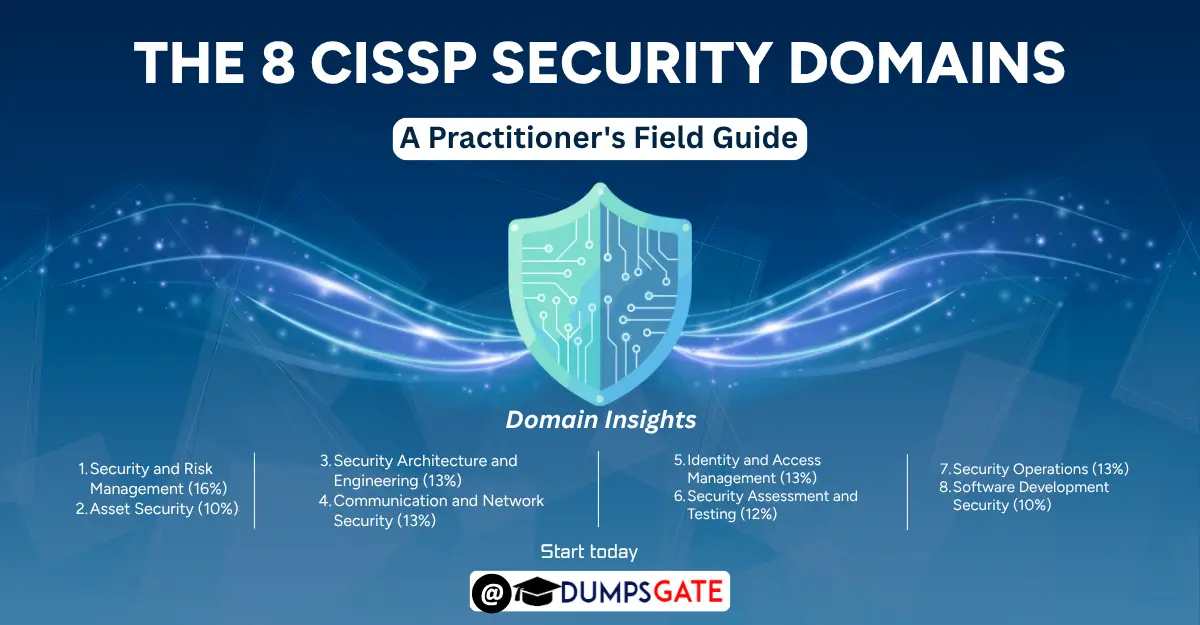
Quick answer: The CISSP certification is one of the most recognized cybersecurity certifications in the industry and is built on eight security domains, each weighted differently on the exam. The current weights, effective April 15, 2024, are: Security and Risk Management (16%), Asset Security (10%), Security Architecture and Engineering (13%), Communication and Network Security (13%), Identity and Access Management (13%), Security Assessment and Testing (12%), Security Operations (13%), and Software Development Security (10%). Passing requires a score of 700 out of 1,000 points on a 100–150-question adaptive exam administered by Pearson VUE.
This guide covers the official domain weights, cross-domain dependency maps, manager-level decision frameworks, 2026 threat gaps that span multiple domains, operational KPIs to track in each area, and a study prioritization model based on both exam weight and difficulty. If you already know what CISSP is, jump straight to the domain table below.
The 8 CISSP Domains At A Glance
This is the core CISSP domains list candidates search for the eight cybersecurity domains that make up the current CISSP objectives:
| Domain | Name | Exam Weight |
|---|---|---|
| 1 | Security and Risk Management | 16% |
| 2 | Asset Security | 10% |
| 3 | Security Architecture and Engineering | 13% |
| 4 | Communication and Network Security | 13% |
| 5 | Identity and Access Management (IAM) | 13% |
| 6 | Security Assessment and Testing | 12% |
| 7 | Security Operations | 13% |
| 8 | Software Development Security | 10% |
Old 10-Domain Model vs. Current 8-Domain Structure
Before 2015, the CISSP Common Body of Knowledge (CBK) consisted of 10 domains. To reduce overlapping content and better reflect the responsibilities of modern cybersecurity professionals, ISC2 consolidated these into the current 8-domain structure. The 8-domain model has remained the standard since 2015, with periodic updates to ensure alignment with evolving industry practices. The most recent revision, effective April 15, 2024, increased the emphasis on Domain 1 and slightly reduced the weight of Domain 8 to reflect current cybersecurity risk management priorities. Here’s how the legacy 10 domains map to the current 8 domains of CISSP:
| Legacy Domain (pre-2015) | Current Domain (2015–present) |
|---|---|
| Information Security Governance and Risk Management | Domain 1: Security and Risk Management |
| Legal, Regulations, Investigations, and Compliance | Domain 1: Security and Risk Management |
| Access Control | Domain 5: Identity and Access Management |
| Telecommunications and Network Security | Domain 4: Communication and Network Security |
| Cryptography | Domain 3: Security Architecture and Engineering |
| Security Architecture and Design | Domain 3: Security Architecture and Engineering |
| Physical (Environmental) Security | Domain 3: Security Architecture and Engineering |
| Operations Security | Domain 7: Security Operations |
| Business Continuity and Disaster Recovery Planning | Domain 7: Security Operations |
| Software Development Security | Domain 8: Software Development Security |
(Asset Security and Security Assessment and Testing were carved out as standalone domains during the 2015 consolidation to give data governance and audit/testing functions dedicated coverage.)
Delve into the details to have complete insights on the CISSP certification guide: A Complete Guide to CISSP Certification | 2026 Updated
Why Domain Weights Are Not The Whole Story
Treating exam weight as study priority is the most common CISSP prep mistake. Domain 1 is weighted at 16% and is also conceptually foundational, so the weight and difficulty align. But Domain 3 (Security Architecture and Engineering) carries 13% weight while consistently ranking as the hardest domain for candidates. It is scenario-based, requires multi-stakeholder reasoning, and covers everything from cryptographic models to physical facility design. Spending study time proportional to weight will leave you undercooked on the domain most likely to fail you.
The practical prioritization model
- Domain 1 — Highest weight, foundational for all other domains. Master this first.
- Domain 3 — Equal weight to others at 13%, but greatest difficulty. Spend 20–25% of your time here.
- Domains 4, 5, 7 — 13% each, mid-range difficulty. Cover methodically.
- Domain 6 — 12%, operationally familiar for practitioners. High ROI for those with SOC or audit backgrounds.
- Domains 2, 8 — 10% each. Lower weight, but Domain 8 traps candidates who lack a software background. Do not skip it.
Domain-By-Domain Breakdown
1) Security and Risk Management (16%)
This domain is where the CISSP distinguishes itself from technical certifications. The exam does not test whether you can configure a firewall. It tests whether you understand why the firewall decision was made, who approved it, what risk it accepts, and how that risk connects to business objectives.
Core coverage
- CIA triad plus authenticity and non-repudiation (the five pillars)
- Governance frameworks: ISO, NIST, COBIT, SABSA, PCI, FedRAMP
- Risk management: identification, analysis, response, and continuous monitoring
- Supply Chain Risk Management (SCRM): software bills of materials, silicon root of trust, third-party assessment
- Legal, regulatory, and compliance: GDPR, CCPA, cross-border data flows
- Personnel security: hiring, onboarding, termination, vendor controls
- Business continuity: BIA, external dependencies
- Security awareness and training, including AI and cryptocurrency awareness
Manager-level frame: Every risk decision in this domain incurs downstream costs. Accepting residual risk in vendor contracts (Domain 1) creates exploitable gaps that Domain 6 audits will surface and Domain 7 SOC teams will respond to. That chain matters on the exam and in production.
KPIs worth tracking: Risk maturity score by framework, mean time to update risk register after threat intelligence updates, percentage of vendors with completed third-party assessments, phishing simulation click-through rates post-training.
2026 relevance: ISC2 now explicitly embeds AI governance here. Managing ML models and large language models (LLMs) as third-party risk vectors, governing algorithmic bias, and ensuring AI decision-making aligns with legal and privacy requirements are current exam subtasks, not future additions.
2) Asset Security (10%)
Asset security sounds like inventory management. The CISSP treats it as a data governance discipline with significant legal exposure.
Core coverage:
- Information and asset classification: data owners, controllers, custodians, processors
- Data lifecycle: collection, storage, retention, remanence, destruction
- Data states: in use, in transit, at rest
- Protection methods: DLP, DRM, CASB
- End-of-life (EOL) and end-of-support (EOS) asset handling
- Privacy protections for PII within AI environments
Common gap: Candidates conflate data classification with data protection. Classification determines sensitivity labels. Protection determines technical controls. The CISSP tests both independently.
KPIs worth tracking: Percentage of data assets with assigned ownership, volume of unclassified data in active systems, mean time from EOL designation to asset decommission.
3) Security Architecture and Engineering (13%)
This is the hardest domain, and it earns that reputation. Candidates who think architecturally and consider multi-stakeholder trade-offs pass. Candidates who think technically and look for the “most secure” answer fail.
Core coverage:
- Secure design principles: least privilege, defense in depth, fail securely, zero trust, privacy by design, shared responsibility
- Security models: Biba, Bell-LaPadula, Star Model
- Cryptographic solutions: symmetric, asymmetric, elliptic curves, post-quantum, PKI, quantum key distribution
- Cryptanalytic attacks: side-channel, fault injection, timing, MITM, ransomware
- Vulnerability assessment across cloud, ICS, IoT, containerized, serverless, and edge environments
- Physical security: data centers, wiring closets, environmental controls, power redundancy
2026 relevance: Post-quantum cryptography is no longer theoretical. Domain 3 includes quantum key distribution and algorithm lifecycle management as part of the current exam content. Organizations still running RSA-2048 exclusively need a migration roadmap. The CISSP tests whether you can build one.
KPIs worth tracking: Percentage of systems with documented architecture reviews, cryptographic algorithm inventory versus NIST post-quantum migration timeline, patch coverage for ICS and embedded systems (where traditional patch cycles fail).
Where do candidates go wrong? Choosing the most secure cryptographic solution without considering the cryptographic lifecycle, key management complexity, or regulatory requirements. On the exam, “most secure” is rarely the answer. “Most appropriate given business constraints” is almost always the answer.
4) Communication and Network Security (13%)
This domain is one of the four most technically detailed, alongside Security Architecture and Engineering, Identity and Access Management, and Security Operations, and it’s weighted at 13%. It covers the OSI model, TCP/IP, and network architecture, but the CISSP angle is governance and design, not configuration.
Core coverage:
- Network architecture: micro-segmentation, VLANs, VPNs, software-defined networking (SDN), zero trust network overlays
- Secure protocols: IPSec, SSH, TLS
- Wireless and cellular: Bluetooth, Wi-Fi, 5G, satellite
- Edge networks, CDNs, virtual private clouds
- Network monitoring: observability, traffic shaping, fault detection
Manager-level frame: Zero Trust Architecture (ZTA) is embedded here. The exam tests whether you understand micro-segmentation not as a product but as a design decision that isolates AI training environments, prevents lateral movement, and supports east-west traffic inspection, not just north-south perimeter defense.
KPIs worth tracking: Mean time to detect lateral movement events, percentage of network segments with east-west traffic inspection, micro-segmentation coverage across cloud and on-premises environments.
5) Identity and Access Management (13%)
IAM is described as the first line of defense in the CISSP framework. The 2024 exam outline reflects how much that boundary has expanded.
Core coverage:
- Physical and logical access control
- Authentication strategies: MFA, passwordless, just-in-time access
- Federated identity: on-premises, cloud, hybrid
- Authorization mechanisms: RBAC, ABAC, MAC, DAC, risk-based access control
- Identity provisioning lifecycle: onboarding, transfers, deprovisioning
- AI agent identity: managing non-human service accounts under least privilege
2026 relevance: AI agents and automated service accounts now require identity governance. An AI system that escalates its own privileges during execution is a real attack vector. The CISSP exam includes this under identity provisioning lifecycle management.
KPIs worth tracking: Percentage of accounts with MFA enforced, orphaned account detection rate, time to deprovision access after employee offboarding, service account audit frequency.
The real problem IAM solves: Most breaches involve compromised credentials, not zero-day exploits. Domain 5 tests whether you can architect IAM to limit blast radius when credentials are compromised, not just prevent the compromise itself.
6) Security Assessment and Testing (12%)
Practitioners with audit or penetration testing backgrounds often find this domain the most intuitive. The CISSP treats testing not as a technical exercise but as a governance function with defined scope, reporting obligations, and remediation accountability.
Core coverage:
- Assessment strategies: internal, external, third-party, on-premises, cloud, hybrid
- Security control testing: vulnerability assessments, penetration testing, red/blue/purple team exercises, breach attack simulations
- Code review and testing: SAST, DAST, IAST
- Audit types: internal and external
- KPI and risk indicator collection: account management, backup verification, DR and BC testing
- Ethical disclosure and exception handling
What the exam actually tests: Most candidates assume Domain 6 is about running scans. The exam asks who authorizes testing, how results are reported, what remediation accountability looks like, and when exception handling is appropriate versus when a control failure occurs. Those are management decisions, not technical ones.
KPIs worth tracking: Mean time to remediate critical vulnerabilities post-penetration test, percentage of high-risk findings resolved within SLA, audit finding recurrence rate.
7) Security Operations (13%)
Security Operations is the largest domain in terms of subtopic volume. It covers incident management, disaster recovery, physical security, logging, threat intelligence, and more. Candidates who rush this domain because they recognize the terminology usually underperform.
Core coverage:
- Incident management: detection, response, mitigation, reporting, recovery, remediation, lessons learned
- SIEM, IDPS, UEBA, threat intelligence feeds, threat hunting
- SOAR: AI and ML-based automation, alert correlation, model drift monitoring
- Configuration management and change management
- Privileged account management: job rotation, SoD, service accounts
- Disaster recovery: backup strategies, recovery sites, RTO/RPO, DR plan testing (tabletop through full interruption)
- Physical security: perimeter and internal controls, duress procedures, travel security
- Business continuity planning
Manager-level frame: AI in the SOC is a force multiplier, but it creates new failure modes. Model drift, where an AI’s detection performance degrades over time, is a Domain 7 operational risk. So is overreliance on automated triage, which generates false confidence. The exam tests your ability to govern AI-augmented operations, not just deploy them.
KPIs worth tracking: Mean time to detect (MTTD), mean time to respond (MTTR), false positive rate in SIEM alerting, DR test frequency and recovery time objective (RTO) adherence, privileged account access review cadence.
2026 data point: According to SecurityScorecard’s 2026 Supply Chain Cybersecurity Trends Report, 60% of organizations take 8 or more days to remediate high-severity issues, largely due to reliance on manual communication like email and phone calls. The CISSP frames SOAR automation as the structural solution to that lag.
8) Software Development Security (10%)
Domain 8 carries the least exam weight, but it catches candidates who lack a software development background. The CISSP tests software security as a design and governance discipline, not a coding skill.
Core coverage:
- SDLC integration: Agile, DevSecOps, Scaled Agile Framework
- Maturity models: CMM, SAMM
- CI/CD security: SAST, DAST, software composition analysis
- Acquired software risk: COTS, open source, SaaS, managed services
- Secure coding guidelines: API security, input validation, source-level vulnerability classes
- AI-assisted development risks: hallucinated vulnerabilities, insecure LLM-generated code snippets
KPIs worth tracking: Percentage of CI/CD pipelines with automated security testing gates, mean time to remediate SAST-identified critical vulnerabilities, open-source library audit frequency, percentage of third-party APIs with documented security assessments.
The gap most candidates miss: Software supply chain security now includes ML libraries, model weights, and LLM APIs as attack surfaces. Model hijacking and inference attacks target the software layer. The CISSP exam expects you to govern these alongside traditional SDLC risks.
Learn more about: Critical Analysis of CISSP and CCSP
Cross-Domain Interconnections That Matter
The eight domains are not independent. Every practical security decision crosses domain lines, and the exam tests whether you can see those crossovers.
Supply chain risk spans Domains 1, 2, and 8. Domain 1 sets SCRM policy and requires software bills of materials. Domain 2 classifies AI training datasets and model weights as high-value assets. Domain 8 governs secure acquisition of ML libraries and third-party models. A supply chain breach that skips one of those layers typically exploits the gap between them.
Zero Trust Architecture cuts across Domains 3, 4, and 5. Domain 3 establishes the design principle. Domain 4 implements micro-segmentation and network overlay controls. Domain 5 enforces identity-driven access decisions at the policy enforcement point. ZTA fails in practice when organizations implement network controls (Domain 4) without updating identity governance (Domain 5). The CISSP tests your ability to see that gap.
Incident response connects Domains 6 and 7. Domain 6 defines what testing and auditing looks like before an incident. Domain 7 handles the response after one occurs. Candidates who understand how pre-incident assessment findings feed into Domain 7 playbooks score better on scenario questions than those who treat testing and operations as separate functions.
AI governance threads through all eight domains. ISC2 explicitly embeds AI security throughout the CISSP Exam Outline rather than isolating it to a single domain. Domain 1 governs AI risk and ethics. Domain 2 classifies training datasets. Domain 3 architects explainable AI systems. Domain 4 secures AI network traffic. Domain 5 manages AI agent identities. Domain 6 red-teams AI models for adversarial robustness. Domain 7 monitors for model drift and adversarial attacks in production. Domain 8 secures AI-assisted development pipelines.
2026 Threat Landscape Gaps Mapped to CISSP Domains
AI-Driven Threats
SecurityScorecard’s 2026 Supply Chain Cybersecurity Trends Report found that cybersecurity leaders now rank AI-driven threats as their top supply chain risk, yet 67% still rely on static security audits for assessment. That gap maps directly to the CISSP. Domain 1 sets the governance framework for AI risk. Domain 6 requires evolving test strategies to include adversarial AI robustness testing. Domain 7 requires SOCs to move from point-in-time audits to continuous, automated monitoring. Candidates who can connect those three domains in a scenario answer perform measurably better.
Post-Quantum Cryptography
NIST finalized its first set of post-quantum cryptographic standards in 2024. Organizations that have not yet begun algorithm inventory and migration planning already face a governance gap that the CISSP exam will test. See the Domain 3 breakdown above for the specific exam content this covers.
Supply Chain Resilience
The same SecurityScorecard report found that 78% of organizations cover less than 50% of their vendor ecosystem with internal cybersecurity programs. The CISSP addresses this through Domain 1’s SCRM requirements, Domain 8’s software supply chain security controls, and Domain 2’s asset classification requirements for third-party AI services. All three must work together for meaningful coverage.
Automated Security Operations
Domain 7 explicitly includes AI and ML-based detection tools, SOAR platforms, and alert correlation as current content. The managerial question the exam asks is not “what does SOAR do” but “how do you govern model drift, false positive rates, and human oversight in an automated SOC?”
Real-World Decision Frameworks and Trade-offs
Choose Zero Trust over perimeter defense when: Your environment includes cloud-native workloads, remote access, or AI agents operating across distributed systems. Perimeter defense can work for small, physically bounded environments with stable network topology. Once your product operates at hybrid scale, perimeter models create the blind spots that lateral movement exploits.
Accept residual risk when: The cost of control implementation exceeds the annualized loss expectancy (ALE) of the threat scenario, and the risk is documented, approved by governance, and reviewed on a defined schedule. The CISSP exam never presents “eliminate all risk” as the right answer. It always asks which risk response is proportionate given business context.
Prioritize DR over BCP testing when: Your organization has clean RTO and RPO targets but no validated recovery procedures. BCP without tested DR infrastructure is a plan that fails at the worst possible moment. The CISSP tests whether you understand the dependency chain: DR processes must be proven before BC exercises can be meaningful.
Flag Domain 8 AI-assisted development risk when: Your engineering team uses LLM-generated code without SAST/DAST gates in the CI/CD pipeline. Hallucinated code from LLMs frequently includes API misuse, insecure random number generation, and improper input validation. Automated testing gates are not optional in that environment.
Worried about how you can pass the CISSP exam? Dig into the blog: Pass the CISSP Exam 2026: A Comprehensive Study Plan
CISSP Exam & Certification Practical Guide
| Aspect | Detail |
|---|---|
| Format (English) | Computerized Adaptive Testing, ~100–150 items, up to 3 hours |
| Format (other languages) | Linear form, ~250 items, up to 6 hours |
| Passing score | 700 / 1000 |
| Experience requirement | 5 years paid experience in 2+ of the 8 domains (4 years with approved degree/credential) |
| Alternate path | Associate of ISC2 — pass the exam first, gain experience within 6 years |
| Endorsement window | 9 months after passing |
| Maintenance | 120 CPE credits over a 3-year cycle, plus annual maintenance fee |
To know what it takes to earn the CISSP certification, delve into the details below: Everything You Need to Know About CISSP Certification Requirements
CISSP Certification Cost
The exam fee is $749. That number is what most candidates budget for, and it is only part of the total CISSP cost.
| Cost Item | Amount |
|---|---|
| Exam fee | $749 |
| CISSP Exam with Peace Of Mind Protection | $998 |
| Rescheduling fee | $50 |
| Cancellation fee | $100 |
| Annual maintenance fee (ISC2 membership + CPE reporting) | $135 |
| CPE requirement | 120 credits per 3-year cycle (minimum 40/year) |
| Official Sybex study guide | ~$60 |
Boot camp training costs more but often bundles exam vouchers and practice materials into the package price.
Delve into the details to explore the detailed CISSP Cost analysis: Get An In-depth Analysis Of The Cost For CISSP Certification
Other ISC2 Certifications
CISSP is ISC2’s flagship credential, but it’s one of several ISC2 certifications worth knowing about before you commit, especially if you’re not yet sure the CISSP’s five-year experience requirement fits your current stage.
| Certification | Focus | Experience Required | Best For |
|---|---|---|---|
| CISSP | Broad security management across 8 domains | 5 years (4 with waiver) | Senior/lead security roles spanning technical and managerial functions |
| CCSP | Cloud Security | 5 years, incl. 3 in IT security | Practitioners specializing in cloud architecture; overlaps with CISSP Domains 3 and 4 |
| SSCP | Systems Security | 1 year | Entry-level practitioners who don’t yet meet CISSP’s experience bar |
| CISM (ISACA, not ISC2) | Information Security Management | 5 years | Governance, risk, and compliance-focused leadership roles |
Confused between which of the cybersecurity certifications is right for you? Have a detailed comparison of CISM and CISSP: CISSP vs CISM: Which Certification is Preferable?
Among cybersecurity certifications, CISSP remains the most frequently listed as a hard requirement in federal contracting and enterprise security leadership job postings. CCSP and SSCP are often preferred rather than mandatory and are often used as stepping stones toward CISSP eligibility.
Is the CISSP Worth the Investment?
ISC2’s 2024 certification salary data shows North American CISSP holders average $134,522 annually, a return that typically outpaces the certification’s cost within weeks of a CISSP-driven role change.
The career outlook is equally compelling. The U.S. Bureau of Labor Statistics projects that employment of information security analysts will grow 29% between 2024 and 2034, far faster than the average for all occupations, with approximately 16,000 job openings each year. Employers also note that professional certifications are commonly preferred when hiring for cybersecurity roles.
Career mobility matters as much as salary: many federal contracting and enterprise security leadership roles list the CISSP as a hard requirement rather than a preference. Without it, those positions are often inaccessible regardless of experience level.
Market salary data reinforces CISSP’s value. Glassdoor estimates a median total annual compensation of approximately $166,000 for CISSP professionals in the United States, reflecting the credential’s prevalence among senior security practitioners and leadership roles.
The CISSP also carries accreditation weight that competitors do not. It was the first information security credential to meet the requirements of the ANSI National Accreditation Board (ANAB) ISO/IEC 17024 standard. That accreditation signals to regulators and enterprise buyers that the certification process is independently validated.
Explore where the CISSP takes you: UNLEASH THE UPDATED CISSP SALARY IN 2026!
Start With the Domain That Has the Most Impact on Your Role
| Your Background | Recommended Study Order | Why Start Here? | Key Challenge |
|---|---|---|---|
| Risk Management / Governance | Domain 1 → Domain 6 → Remaining Domains | Your experience with governance, compliance, and risk frameworks provides a strong foundation for Domain 1, while Domain 6 aligns naturally with audit and assessment concepts. | Domain 3 (Security Architecture & Engineering) is often the most technical, so allocate extra study time. |
| Infrastructure / Network Engineering | Domain 4 → Domain 3 → Domain 5 → Remaining Domains | Your networking and infrastructure knowledge gives you an advantage in communication and network security as you move into architecture and identity management. | Shift your mindset from solving technical problems to choosing the best business-focused security decision, as CISSP emphasizes management over technical implementation. |
| Software Development / DevSecOps | Domain 8 → Domain 1 → Remaining Domains | Starting with software development security builds on your existing expertise, while Domain 1 introduces the governance and risk principles that underpin the rest of the exam. | Transitioning from writing secure code to governing secure software development processes is where many developer candidates lose marks. |
Frequently Asked Questions
What are the 8 domains of CISSP, and how are they weighted?
The eight CISSP security domains, with their exam weights as of April 15, 2024, are: Security and Risk Management (16%), Asset Security (10%), Security Architecture and Engineering (13%), Communication and Network Security (13%), Identity and Access Management (13%), Security Assessment and Testing (12%), Security Operations (13%), and Software Development Security (10%). These weights reflect the relative importance ISC2 assigns to each domain based on its Job Task Analysis process.
What are the CISSP objectives?
The CISSP’s objectives, as defined by ISC2’s Exam Outline, are to validate a candidate’s ability to design, implement, and manage a best-practice cybersecurity program across all eight domains with an emphasis on management-level decision-making rather than hands-on technical configuration. Each domain has its own set of measurable objectives (governance, risk response, architecture design, access control, testing, operations, and secure development) that collectively define what a CISSP-certified professional is expected to know and do.
How difficult is the CISSP exam compared to other cybersecurity certifications?
The CISSP is significantly harder than entry- and mid-level certifications like CompTIA Security+ or CEH. The exam uses Computerized Adaptive Testing (CAT) and scores scenario-based questions where multiple answers appear correct. The correct answer is almost always the one that reflects a manager-level perspective, not the most technically sophisticated option. Most candidates report that understanding this mindset shift is more important than memorizing domain content.
Which CISSP domain is the hardest?
Domain 3, Security Architecture and Engineering, is consistently rated the most difficult by candidates. It requires scenario-based reasoning across cryptographic models, secure design principles, physical infrastructure, and multi-stakeholder trade-offs. The exam does not reward the “most secure” answer. It rewards the most appropriate answer given organizational context and constraints.
What does the CISSP exam cost in 2026?
The CISSP exam fee is $749 (verify the current price at isc2.org). Additional costs include a $50 rescheduling fee, a $100 cancellation fee, and an annual $135 maintenance fee post-certification. Study materials such as the official Sybex study guide cost approximately $60. Boot camp training adds to the total cost but often bundles exam vouchers and practice materials.
Can I take the CISSP without five years of experience?
Yes. You can sit the exam without meeting the experience requirement. If you pass, ISC2 grants you the Associate of ISC2 designation. You then have six years to accumulate the required five years of paid, full-time work experience across at least two of the eight domains. One year of experience can be waived with a qualifying degree or approved certification from the ISC2-approved list.
How does CISSP compare to other cybersecurity certifications, like CISM or CCSP?
CISSP, CISM, and CCSP serve different career paths. CISSP covers the broadest technical and managerial scope across eight domains and appears in significantly more job postings, particularly in government, defense, and enterprise cybersecurity. CISM (ISACA) focuses specifically on information security management and governance. CCSP (ISC2) narrows the focus to cloud security architecture. CISSP holders typically earn $130,000–$170,000 annually in the US, compared to $120,000–$150,000 for experienced CISM holders. Choose CISSP if your career path spans technical and managerial functions across all security domains; choose CISM if your focus is governance, risk, and compliance management; choose CCSP if you’re specializing specifically in cloud security.
How does CISSP address AI security in 2026?
ISC2 integrates AI security across all eight domains rather than isolating it in a single section. Domain 1 covers AI governance, ethics, and supply chain risk from external AI providers. Domain 2 classifies training datasets and model weights as high-value assets. Domain 3 includes explainable AI as a security architecture requirement. Domain 5 addresses AI agent identity and least-privilege access. Domain 7 covers SOAR automation, model drift monitoring, and adversarial attack response. Domain 8 addresses hallucinated vulnerabilities in LLM-generated code and ML library supply chain risks.
How many CPE credits do I need to maintain CISSP certification?
CISSP holders must earn 120 continuing professional education (CPE) credits over each three-year renewal cycle, a minimum of 40 CPE credits per year. These credits are reported to ISC2 alongside the annual $135 maintenance fee, which also covers ISC2 membership.