Clinical research now produces hundreds of thousands of registered studies worldwide, and that volume has turned data handling into a strategic bottleneck for sponsors and sites. In fact, ClinicalTrials currently lists over 570,000 studies, a scale that amplifies the need for consistent, auditable data practices.
In that environment, experience alone no longer settles the credibility question. Sponsors want proof that data managers understand structured standards, risk controls, and inspection readiness. The CCDM certification has emerged as that proof point. It represents more than subject familiarity. It shows that a professional can operate within regulated frameworks and translate best practices into repeatable outcomes. In this CCDM guide, we’ll unpack what the credential involves, who is qualified, how the exam works, and how it can influence a career professional in modern and clinical research.
What Is The CCDM Certification?
The Certified Clinical Data Management (CCDM) certification is currently considered to be the industry benchmark for practitioners who design, manage, and assure the quality of clinical trial data. Issued by the Society for Clinical Data Management (SCDM), the credentials validate practical competency across data collection, processing, and quality assurance workflows and help employers distinguish candidates who can operate in regulated, audit-intensive environments.
CCDM indicates that the holder can design and manage the data lifecycle for clinical trials: from case report form design and edit-check strategy through to database lock and quality checks. The credential complements technical skills in EDC platforms by validating procedural judgment and regulatory-focused decision-making.
Why Does The CCDM Certification Matter In Today’s Clinical Research Industry?
Clinical research has changed. Trials move faster. Data comes from more places, and regulators expect tighter oversight than ever before. Protocol designs today include more endpoints, more procedures, and more data variables than they did a decade ago. The Tufts Center for the Study of Drug Development has consistently reported rising protocol complexity across therapeutic areas, which directly increases the data management workload. More complexity means more edit checks, more reconciliation points, and more room for inconsistency if processes are not tightly controlled.
That shift is exactly why the clinical data management certification benefits feel more relevant now than ever. CCDM does not just confirm that someone understands terminology. It shows that they can manage structured workflows, anticipate data risks, and support inspection readiness without scrambling at the last minute. Because the credentials align with Good Clinical Data Management Practice, it reflects disciplined thinking. It reduces training time, improves audit confidence, and makes cross-team collaboration a lot smoother.
What Are The CCDM Certification Eligibility Requirements?
SCDM sets clear paths to sit the CCDM exam.
- If you have a bachelor’s degree or higher, 2 years of full-time clinical data management experience qualify.
- An associate’s degree requires 3 years
- No degree requires 4 years of full-time CDM work. Part-time experience counts when it reaches the equivalent full-time totals.
- Part-time work experience equal to or surpassing a full-time equivalent in the above criteria
What Does The CCDM Exam Involve?
The exam structure for the Certified Clinical Data Management exam is as follows:
| Exam Format | Multiple Choice Questions |
| Number Of Questions | 150 Questions |
| Exam Duration | 3.5 Hours |
| Exam Delivery | Live Remote Proctoring |
| Scheduling Window | Book Within 90 Days Of Approval |
Additional Pointers On The CCDM Exam
The Certified Clinical Data Management test runs under a live proctoring system, so a webcam, a microphone, and stable internet are required. Expect an identity check and an environment scan before you start. Take note that the exam clock continues during any breaks, so build a short break strategy into your pacing plan. Approved candidates have a window to schedule on all proctor platforms, and rescheduling is allowed with reasonable notice. Additionally, for any flags during proctoring, SCDM may perform a manual review before finalizing results.
What Counts As CDM Experience?
Concrete examples that help applications include:
- CRF design
- Edit-check specification writing
- Data transfer spec development
- Database validation tasks
- Documented involvement in database lock.
Short contracts are fine when dates, deliverables, and systems used are clearly listed. If your role mixed CDM with other duties, separate CDM tasks into a one-page summary tied to dates and projects. That small step often turns borderline cases into approvals and gets you scheduling faster.
Key Exam Areas
The CCDM certification exam aims to test the concepts and practices outlined in the Good Clinical Data Management Practices (GDCMP) Handbook. The following are some general areas you will need to have a good grasp of in order to pass the CCDM exam:
- Design Tasks
- Training Tasks
- Data Processing Tasks
- Programming Tasks
- Testing Tasks
- Coordination and Project Management Tasks
- Review Tasks
How Much Does The CCDM Certification Cost?
Investing in the CCDM is a career move that pays for itself, but you need to budget for the right tier. The SCDM uses a tiered pricing model based on your country’s income level. For those in high-income regions like the US or Europe, here is the breakdown:
| SCDM Member | Non-Member | |
| Initial Exam Fee | $250 | $325 |
| Exam Retake | $225 | $300 |
| Renewal Fee | $95 | $150 |
| Annual Membership | $125 | – |
If you are not a member yet, it is usually worth joining first. The $125 USD membership fee lowers your exam cost immediately and gives you free access to the GCDMP, which is the primary study material.
If your application is denied due to eligibility issues, SCDM typically refunds your fee minus a small $25 administrative charge.
CCDM Cost For Lower Income Countries
Here is how the CCDM exam cost varies if you reside in a developing/ low-income country:
| SCDM Member | Non-Member | |
| Initial Exam Fee | $125 | $200 |
| Exam Retake | $100 | $175 |
| Renewal Fee | $60 | $90 |
How To Apply For The CCDM Certification?
Applying for the CCDM credential is handled directly by the Society of Clinical Data Management, and the process is fairly structured. Most setbacks happen when experience is listed vaguely, not because someone lacks eligibility. A little clarity goes a long way.
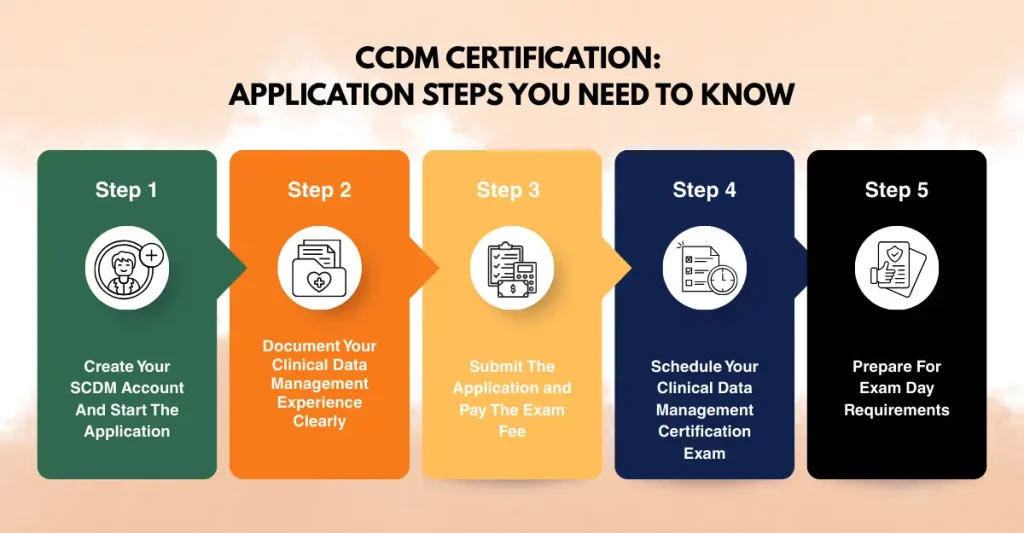
Step 1: Create Your SCDM Account And Start The Application
Begin by registering on the official SCDM certification portal. Once logged in, you will complete the CCDM application form, which asks for your educational background and professional history. Fill this out carefully. The review team evaluates what you actually did in your notes, not just your job titles.
Step 2: Document Your Clinical Data Management Experience Clearly
This is the most important part of the process. Instead of writing a generic role description, outline specific CDM tasks you performed. Mention activities such as edit check specification development, CRF design, query management, reconciliation processes, or database lock participation.
If you worked in a hybrid position, separate the CDM responsibilities from other duties. Make it easy for reviewers to match your experience against CCDM eligibility requirements.
Step 3: Submit The Application and Pay The Exam Fee
Once your documentation is complete, submit the form and pay the required exam fee. After submission, SDCM reviews your eligibility based on the criteria outlined in their handbook. You will receive an email confirming approval or requesting clarification if anything needs adjustments.
Step 4: Schedule Your Clinical Data Management Certification Exam
If approved, you will receive instructions to book your clinical data management certification exam through the official remote proctoring platform. There is a defined scheduling window, so it is wise to secure your preferred date early.
Step 5: Prepare For Exam Day Requirements
Before exam day, complete the technical system checks required for remote proctoring. Ensure you have a compliant testing environment, valid identification, and stable internet connectivity. Taking these small steps ahead of time prevents last-minute stress.
How Should You Prepare For The CCDM Exam?
Getting ready for the CCDM is about shifting your mindset from theory to practice. The exam wants to see if you can handle the daily curveballs of clinical data management. Here are five practical tips to set yourself up for success:
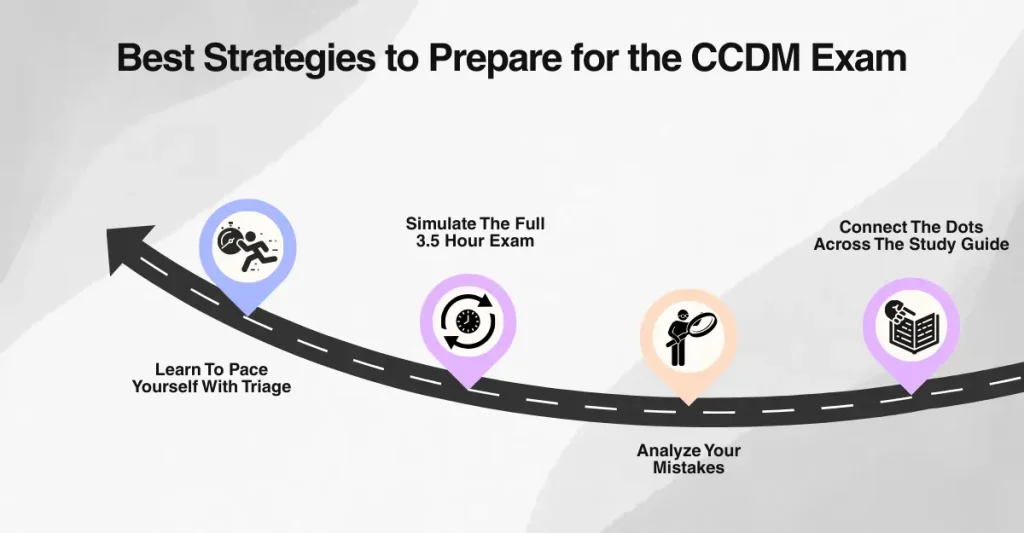
► Connect The Dots Across The Study Guide
Instead of viewing the Good Clinical Data Management Practices (GCDMP) as a list of rules, treat it like a roadmap. For every section, visualize the actual lifecycle of the data, from the moment a site enters it into the system to the final database lock. When you understand how a query in one stage affects the validation in the next, the scenario-based questions start to make a lot more sense.
► Analyze Your Mistakes
The most valuable part of any practice test isn’t the score you get but the questions you missed or had a difficult time attempting. Keep a simple log of every error you make. Write down why the correct choice was the superior option and why your initial pick fell short. This habit uncovers patterns in your logic, showing you exactly where you need to sharpen your understanding of things like reconciliation rules or data standards.
► Simulate The Full 3.5 Hour Exam
The CCDM is an endurance test as much as a knowledge check. You can’t expect your brain to stay sharp in the final hour if you only study in short bursts. Schedule at least a few full-length, timed practice runs in a quiet space. Building this screen stamina ensures that when you hit a long case study at the 3-hour mark, your focus remains sharp and you don’t make errors as a result of fatigue.
► Learn To Pace Yourself With Triage
Don’t let a single difficult question sink your score or confidence. If a scenario looks like it will take a bit too long, flag it and move on to the more straightforward items first. This builds your momentum and secures the easier points. You can then return to the complex cases with a fresh perspective and the confidence that you’ve already banked most of your score.
What Common Mistakes Can Lower Your CCDM Exam Score?
Even seasoned data managers can struggle if they walk into the exam room with the wrong mindset. Avoid these 5 common traps to keep your score in the passing zone:
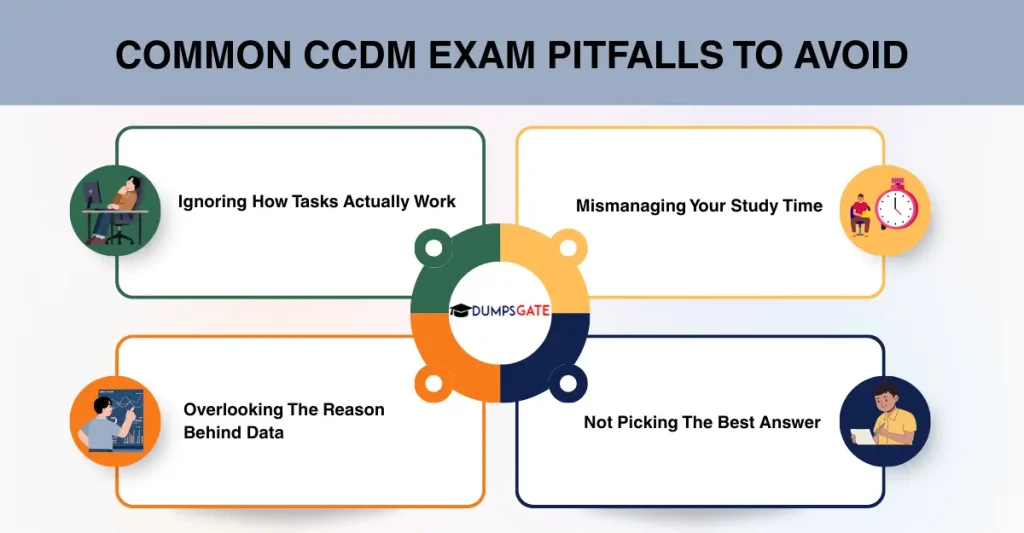
⇒ Ignoring How Tasks Actually Work
Many candidates fail because they know the why but not the how. The exam focuses on applied judgment. If you can’t link a concept to a specific study workflow, you will likely struggle when a scenario deviates from what you have already learned.
⇒ Mismanaging Your Study Time
Not every domain carries the same weight. A huge mistake is spending too much time on niche topics while skimming the high-value sections that drive the bulk of the scoring. Check the exam guide early and focus your energy where the points are.
⇒ Overlooking The Reason Behind Data
Daily experience with software tools isn’t going to be enough. The exam dives into the underlying logic of validation principles. Candidates who skip understanding the reasoning often choose answers that are technically possible but operationally weak in a clinical setting.
⇒ Not Picking The Best Answer
The CCDM often gives you multiple options that look plausible. A common pitfall is grabbing the first correct answer you see. Always ask yourself which choice provides the highest level of data integrity and subject safety for that specific context.
How Can You Renew Your CCDM Certification?
Your Certified Clinical Data Management certification is valid for a period of 3 years. In order to keep the status of your certification active once the expiry period approaches, candidates will need to renew their CCDM certification by completing a renewal form.
What If You Do Not Pass The Exam?
Not passing the exam can feel discouraging, but it is far from uncommon. Many strong professionals need a second attempt. What matters most is how you respond.
✅️ Understand The Retake Policy
The Society for Clinical Data Management outlines official retake policies on its certification page, including waiting periods and applicable fees. Always review the most current policy before reapplying so you plan accurately.
✅️ Conduct A Performance Gap Analysis
Instead of restarting from scratch, analyze your weak points. Did long scenario-based questions slow you down? Were validation principles unclear? Did time pressure affect decision-making? Identifying patterns is more productive than broad revision.
✅️ Recalibrate Your Study Strategy
Return to the CCDM study guide and map weak domains directly to the relevant Good Clinical Data Management Practices chapters. Focus on application-heavy practice rather than rereading definitions.
Simulate a full-length session to strengthen pressing. Track recurring mistakes ina short error log. Adjust your strategy, not just your content. Often, a candidate can improve significantly on a second attempt because they correct timing errors and sharpen applied reasoning. A focused recalibration can produce a much stronger outcome.
What Are The Real Benefits Of Getting The CCDM Certification?
If you already work in clinical data management, you probably know the job is detail-heavy and high-pressure. Deadlines are tight. Queries pile up. Audits happen. The CCDM certification does not magically change your role, but it does change how your expertise is perceived.
It gives structure to the experience you already have and signals that your approach aligns with recognized industry standards set by the SCDM. Here is what that actually means in practice.
➢ You Become Easier To Trust Professionally
In clinical research, trust matters. Teams need confidence that the person managing data understands validation logic, reconciliation workflows, and inspection readiness. The CCDM makes that trust easier. It shows that your knowledge has been tested against standardized practices, not just built inside one company’s processes. That can make conversations with QA teams, sponsors, or global stakeholders smoother.
➢ It Improves Your Position In Hiring And Promotion Decisions
When employers compare candidates with similar experience, formal certification often becomes the tie-breaker. It shows commitment to the discipline and willingness to meet an industry benchmark.
Internally, it can support movement into senior or lead clinical data management roles, especially where oversight and governance responsibilities increase.
➢ It Encourages Measurable Improvement At Work
Preparing for the CCDM certification pushes you to think in systems rather than tasks. That shift shows up in your performance metrics. You may notice cleaner edit check documentation, faster query resolution cycles, more predictable database locks, or fewer audit findings. Those are measurable improvements that managers recognize quickly.
➢ It Supports Long-Term Career Mobility
Because the Certified Clinical Data Management certification aligns with widely accepted CDM standards, it travels well. If you move between CROs and sponsors or step into global trials, the certification remains relevant. Over time, that portability supports career stability in a field that continues to evolve technically and operationally.
In simpler terms, CCDM helps you reinforce the quality and consistency of the work that you already do, and make that quality visible to others.
What Jobs Can You Land With The CCDM Certification?
The CCDM does not suddenly change your job title overnight. What it does is strengthen your position for roles that require structured data thinking and operational discipline. Here are some roles where the certification naturally fits:
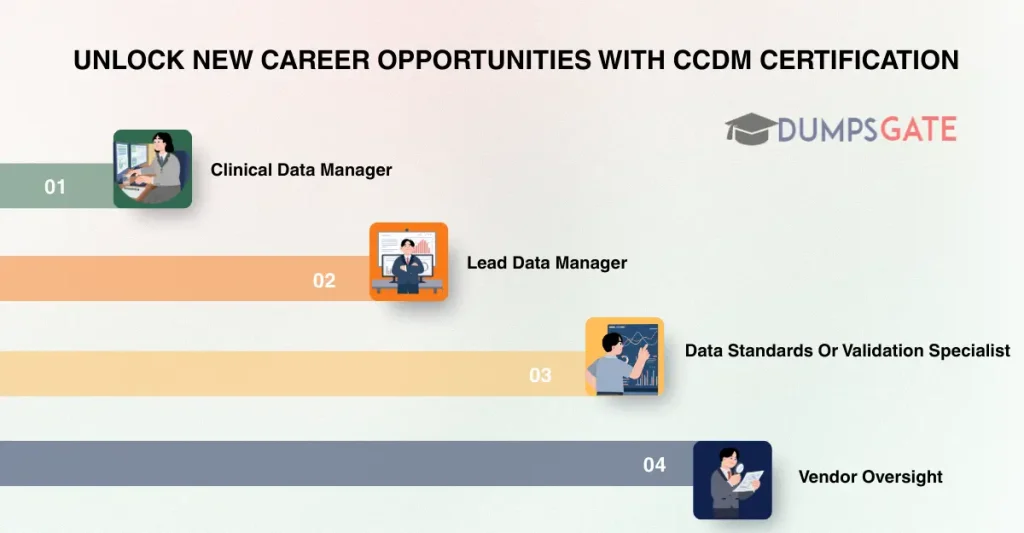
● Clinical Data Manager
This is the most direct alignment. The CCDM supports responsibilities like CRF oversight, edit check strategy, reconciliation planning, and database lock coordination. It reinforces credibility in sponsor or CRO environments where data governance matters.
● Lead Data Manager
For professionals aiming to move from execution to oversight, the certification can support that transition. Lead roles often require cross-study coordination, vendor communication, and process standardization. CCDM depicts your readiness for that broader accountability.
● Data Standards Or Validation Specialist
If your work leans toward edit check logic, data consistency rules, or validation planning, CCDM strengthens your profile. These roles value system-level understanding rather than just EDC familiarity.
● Vendor Oversight
In complex global trials, organizations look for professionals who understand how data flows across sites, systems, and partners. Certification adds reassurance when assigning complex or high-visibility studies.
Discover More: Top 25 Most In-Demand Tech Jobs: Roles, Salaries, and Certifications
How Much Can You Earn With The CCDM Certification?
In the United States, market data shows Clinical Data Managers earn roughly in the low six-figures on average, with a common salary band from about $85,000 USD to $154,000 USD roughly per year. This rounds off to an average salary of $113,000 USD per year.
How The Salary Potential Varies By Job Role
We’ve discussed the average range of CCDM earning potential. However, this may vary based on your job title. Here is a look at how salaries may vary depending on job roles:
| Job Roles | Expected Salary (USD) |
| Clinical Data Manager | $150,000 |
| Lead Data Manager | $135,000 |
| Data Standards Or Validation Specialist | $84,000 |
Learn More: Best Paying Healthcare Certifications for 2026: Boost Your Career and Income
How Does CCDM Compare To Other Clinical Research Certifications?
If you look at clinical research certifications side by side, they can seem similar on the surface. They all signal professionalism. They all sit within the same industry; however, in practice, they prepare you for very different kinds of work.
The Certified Clinical Data Management certification is specifically built around how clinical trial data is structured, validated, and controlled across the study lifecycle. That system focus is what sets it apart.
CCDM vs CCRA Certification
CCRA certification, such as those from the Association of Clinical Research Professionals (ACRP), are built around site monitoring. They focus on investigator oversight, source data verification, protocol compliance, and site performance.
An easier way to explain this would be that a CRA works at the study site level. A CCDM professional, on the other hand, works at the database level. One is more focused on ensuring sites follow the protocol correctly. The other is focused on ensuring the data flowing from those sites is structured, validated, and audit-ready. Both are critical, but the day-to-day thinking is very different.
| CCDM | CRA | |
| Key Focus | Data integrity, cleaning, and database design | Site monitoring, patient safety, protocol compliance |
| End Goal | Clean, lockable database | Trial compliance, data validation at source |
| Role Setting | Mostly remote/office-based | Heavy travel, site-focused (on-site) |
| Major Skillsets | Database systems, CDISC standards | GCP, regulatory, project management |
| Experience Requirements | Generally required before certification | Generally required before certification |
CCDM vs Regulatory Certifications
Regulatory certifications prepare professionals to manage submissions, navigate health authority requirements, and ensure compliance documentation is complete.
CCDM operates earlier in the chain. It deals with how data is captured, cleaned, reconciled, and locked before it ever becomes a part of a submission package. If regulatory certifications are about presenting the data correctly, CCDM is about making sure the data is reliable in the first place.
Specialization That Employers Notice
Some certifications create broad clinical research generalists. CCDM creates specialists in data systems and governance.
In complex global trials with thousands of data points and layered vendor structures, employers often look for professionals who understand edit check logic, reconciliation strategy, and database lifecycle control. This is where CCDM stands out.
Final Perspective: Is CCDM Certification Worth It In 2026?
In 2026. Clinical trials are more data-heavy than ever. More endpoints, more integrations, more scrutiny. In that environment, professionals who understand systems, validation logic, and database control stand out. The CCDM certification is no magic career switch. However, it is a clear signal, telling employers that your knowledge is structured, tested, and aligned with industry standards.
For professionals already working in data roles, it strengthens credibility and supports movement into senior clinical data management roles. For those aiming higher, it provides leverage in conversations about oversight and governance responsibilities.
So, is it worth it? If your career path centers on clinical data integrity and long-term growth in that space, the answer is practical rather than emotional. CCDM is a focused investment that aligns directly with where the industry continues to move.
Frequently Asked Questions
What is the CCDM Certification?
The CCDM, or Certified Clinical Data Management, certification is a professional credential that certifies applied competence in clinical data processes, edit-check strategy, and database lifecycle control. It is granted by the official governing body and maps to industry standards, making it a practical signal of readiness for regulated study work.
Who qualifies under CCDM eligibility?
Applicants qualify through degree and experience or experience only routes. Under the criteria outlined by SCDM, in order to be eligible for the CCDM, candidates must have either a bachelor’s degree and 3 years of experience or an associate degree and 3 years of experience. If the candidate has no degree, 4 years of work experience will be required. Part-time work counts when it equals full-time equivalency and must be clearly documented on the application.
How long is the Clinical Data Management certification exam?
The CCDM exam runs for 3.5 hours and contains multiple-choice items, which are designed around applied scenarios. The timed format rewards pacing and stamina, so practice under timed conditions is essential to complete all items calmly and accurately within the session.
What is the best CCDM study guide to use?
Use the official CCDM study guide as the primary roadmap because it maps exam domains directly to practical tasks. Complement it with the Good Clinical Data Management Practices reference and scenario-heavy practice banks to convert reading into applied judgment.
Is the CCDM exam difficult?
The CCDM certification exam can be a bit hard, depending on your prior experience. Apart from that, the exam primarily tests theoretical knowledge in the form of practical, scenario-based questions, which can be confusing. It mainly tests Good Clinical Data Management Practices and their application across different situations. With good preparation, the CCDM may feel a lot easier to tackle.
Is CCDM globally recognized?
Yes. The CCDM certification is recognized across sponsors, CROs, and data vendors worldwide as a standard for clinical data competence. Its alignment with industry practices makes it portable across regions and useful for professionals working on global or multi-site trials.
Article Source
- Tufts Center for the Study of Drug Development. “CSDD Impact Report, https://csdd.tufts.edu/publications/impact-reports.” Accessed March 2026.
- ZipRecruiter. “Clinical Data Manager Salary in Santa Clara, CA, https://www.ziprecruiter.com/Salaries/Clinical-Data-Manager-Salary-in-Santa-Clara,CA.” Accessed March 2026.
- Glassdoor. “Lead Data Manager Salary, https://www.glassdoor.com/Salaries/lead-data-manager-salary-SRCH_KO0,17.htm.” Accessed March 2026.